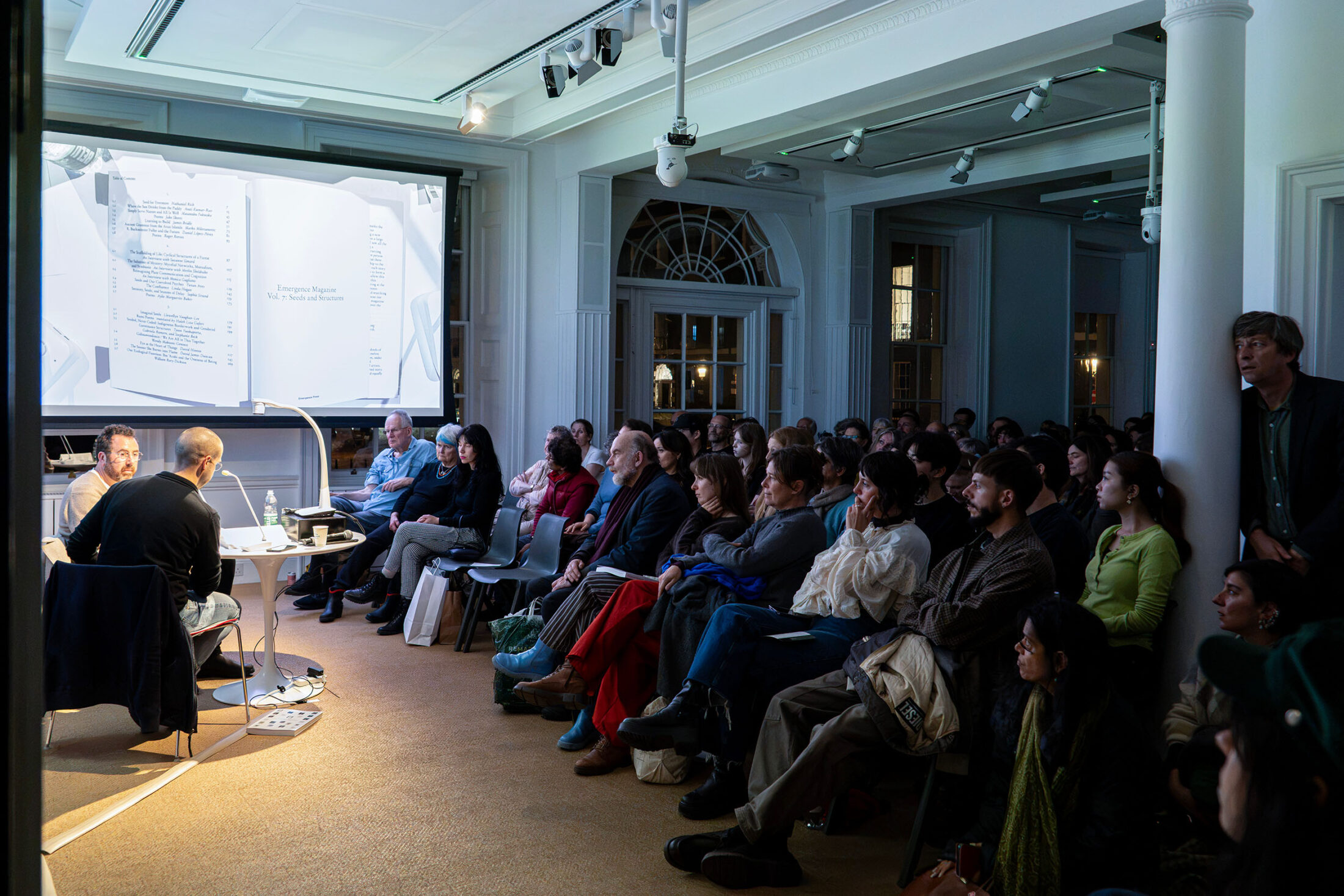
Photo by Elena-Andreea Teleaga
Seeds and Structures: A Conversation at London’s Architectural Association
Emmanuel Vaughan-Lee is an author, Emmy- and Peabody Award–nominated filmmaker, and a Sufi teacher. He has directed more than twenty documentary films, including Taste of the Land, The Last Ice Age, Aloha Āina, The Nightingale’s Song, Earthrise, Sanctuaries of Silence, and Elemental, among others. His films have been screened at New York Film Festival, Tribeca Film Festival, SXSW, and Hot Docs, exhibited at the Smithsonian Museum and London’s Barbican, and featured on PBS POV, National Geographic, The New Yorker, and The New York Times Op-Docs. His books include Requiem, Invitation and Celebration; Song of the Seasons; and Remembering Earth: A Spiritual Ecology. He is the founding editor and podcast host of Emergence Magazine.
Marko Milovanovic is an architect, writer, teacher, and founder of the production house Mylomark Design and the educational platform Free School Of, which celebrates conversation as a fundamental form of knowledge. He is the author of The Architecture of Attention and has written extensively on politics, culture, and urban regeneration for major Serbian newspapers. Marko’s projects and institutional collaborations have involved the Royal Academy of Arts, the Victoria and Albert Museum, the British School at Rome, the Holt/Smithson Foundation, the British Council, Arts Council Ireland, the Irish Film Institute, the Royal College of Art, the Architectural Association, and others. He currently teaches at the Royal College of Art and the Architectural Association, where he leads the AA Practice Platform and the Architecture Through Media Forums.
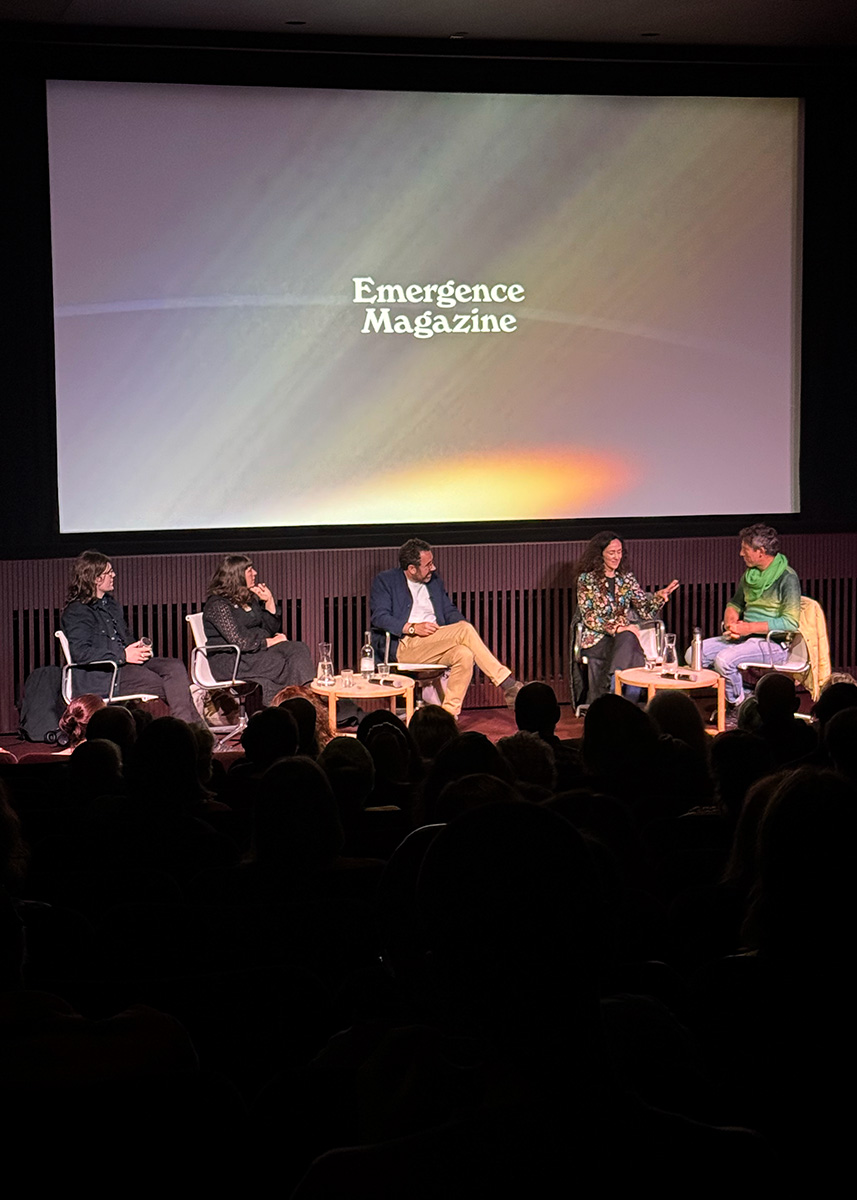
For the launch of our seventh print edition, we gathered at the Architectural Association in London in October for this dynamic conversation about the themes at the heart of Seeds and Structures. With volume in hand, Emergence founding editor Emmanuel Vaughan-Lee and Volume 7 contributor and AA lecturer Marko Milovanovic journey from the physical to the metaphysical, exploring how stories of pine cones and fire, regenerative seed-words, psyches shaped by tamarinds, and ancient spiritual systems can each help us bring into being a future rooted in spiritual ecology.
Photo by Elena-Andreea Teleaga
Transcript
Marko Milovanovic Okay, good evening everyone. Thank you very much for coming this evening. We’re here at the Architectural Association. And when I first encountered Emergence and Emmanuel, I felt very strongly that the kind of conversations and the kind of ideas that you are dealing with and you are sort of untangling are so relevant for people across artistic disciplines, including architecture. And I have, I guess, for a long time felt that within the field of architecture, we don’t really touch on many of those topics, and we are kind of intrigued by them, but we don’t really untangle them—so thank you. Welcome.
Perhaps the way we’re going to do this this evening is that we’re going to talk about the issue. We’re going to talk about what lies beneath it—what are the ambitions of it. We’re going to maybe pull a couple of threads, and then we’re going to invite everyone to talk to us, be in conversation, to pick up a copy and look at it. But Emmanuel, maybe firstly, I’d like to ask you, what do you mean by “Seeds and Structures”?
Emmanuel Vaughan-LeeIt’s nice to be here with you all. I can kind of see some people in the back. Thank you for making the effort to come out here to help us launch our seventh edition. It’s really lovely to be back here with you and to be in conversation with you, Marko, and that your voice is one of many wonderful voices in this latest edition. So, thank you for your contribution and for hosting us here this evening.
To your question, what is “Seeds and Structures,” perhaps to help answer that and maybe introduce where this issue comes from, I’ll read the “Letter from the Editor” that I wrote, to help kind of ground us in this conversation.
“The publication of this seventh edition of Emergence Magazine marks the completion of a cycle of ten years of work that began on an autumn afternoon in 2016. At that time, I had just started work developing a new feature film and was storyboarding the narrative with 3×5 cards on a large whiteboard in my office. All of a sudden, my vision blurred and I saw all the cards on the board rearrange themselves in a new order, revealing a completely different sequence than the narrative I had been constructing. My vision then sharpened, and I saw that each card was a different person, with their own voice telling a different story, and I was shown that these voices needed to come together to tell a story about our relationship to the Earth, a larger story than any one film could ever tell. It was as if each story was a thread that needed to be woven together with other threads to form a tapestry, and it was the diversity of voices and stories that would allow this tapestry to become visible. Then just as quickly as it had arrived, this moment of inspiration, or vision, disappeared, and I was back staring at the original 3×5 cards on the whiteboard. I spent the rest of the afternoon sitting with this experience, abandoning my new film concept, and searching for the right form to gather and present these voices and stories about our relationship to the living Earth. It wasn’t long before the idea of a magazine took root, along with its editorial mission, which hasn’t changed over the past decade:
“We believe it has always been a radical act to share stories during dark times. As we experience the desecration of our lands and waters, the extinguishing of species, and a loss of sacred connection to the Earth, we look to emerging stories. In them we find the timeless connections between ecology, culture, and spirituality.
“Over the last decade, we have published and presented hundreds of stories in a variety of mediums, each one an exploration of these timeless connections. From essays, poetry, interviews, and reportage, to film, audio stories, multimedia, virtual reality, and immersive installations and exhibitions. We’ve featured acclaimed and well-known writers and artists, and emerging ones, each voice contributing to a rich and multifaceted story. I am profoundly grateful for all their remarkable contributions, and equally astonished at how our magazine has grown and flourished over this past decade, for around these stories, a community has formed, gathering on this tapestry, reading and listening, sharing their own stories in response, and engaging with the ideas, values, and ways of being woven within this fabric. It feels very alive and dynamic in a way I never could have imagined it becoming at the magazine’s inception.
“This issue marks the end of a cycle of work, and is also very much tied to the beginning of a new one. The theme for this year’s edition, Seeds and Structures, draws inspiration from what we see as a next phase of our work, one that will be rooted in place, offering a space to explore a practice of embodied spiritual ecology and the values and ideas at the core of Emergence’s work. In the next few years we will be opening a small institute on Whidbey Island in the Pacific Northwest, where we will be hosting a range of programs, artist residencies, fellowships, story and innovation labs, retreats, and courses. We envision it as a space for learning, creativity, experimentation, research, all rooted in a relationship to place. As we plant seeds and build structures for this next phase of our work (quite literally, as we have begun building a regenerative, syntropic farm and cabins and spaces for gathering and teaching), we wanted to create an issue that echoes what is unfolding with the formation of our institute, and that explores many of the key ideas we envision focusing on in the years ahead.
“These ideas are rooted in an ontology of spiritual ecology, a modern term for an ancient knowing present in traditional and place-based cultures and spiritual and mystical traditions for millennia, which recognizes that everything within the living Earth—human and more-than-human—is animate, alive, and sacred. This recognition is based on an awareness of the universal spirit that is present in all things, and the bond of kinship and love we share with the living world. We all carry an ancestral memory of how to embody this awareness through conscious spiritual engagement with the Earth. It is not something we need to learn, rather it is part of our shared inheritance as human beings. Surfacing this memory and embodying this ancient connection is an essential part of preparing for a future that is hovering at the periphery, waiting to come into being.
“The stories in this volume explore the kinds of seeds and structures we will need, through physical, metaphysical, and symbolic perspectives. From existing human ways of working with seeds that embody a spiritual ecology to more-than-human structures that offer models we can emulate, and ancient spiritual and mystical systems that are increasingly relevant in seeding a new ecological consciousness. You’ll find stories on seed-saving, indigenous seeds, buildings made with seaweed, the work of visionary American architect and thinker Buckminster Fuller, and Japanese farmer and philosopher Masanobu Fukuoka and his “do-nothing” approach to agriculture. Essays about cultural memories encoded in gourds, the relationship between seeds and our psyches, imaginal seeds for the future, and the process of serotiny as a symbol for our time of eco-collapse. We speak to visionary scientists working with forests, mycelial networks, and plant communication, and towards the end of this volume we return to ancient systems and structures of knowledge, from Aboriginal governance structures and the Anishinaabe Four Orders of Creation, to thirteenth-century Sufi philosopher Ibn ‘Arabi’s ontology of the “Oneness of Being,” Daoist cosmology, and the women-led nonhierarchical Christian mystical movement of the Beguines. It is perhaps our most ambitious issue to date, overflowing with different ways of being and knowing, all in service to this great mystery that is our Home.
“I thank you for these last ten years and look forward to what emerges in the decade to come.”
MMThank you. [applause]
EVLThank you. And this community I’m speaking about is in this room. We wouldn’t be here if it wasn’t for you and the response to the work that we’ve shared. Writers like Marko, writers of some of the stories we’ll explore together, were responded to and engaged with. For me, a story that is not heard, not read, not engaged with, is a one-sided story. It’s like a one-sided love affair. A story that is heard becomes a participatory experience, becomes alive in a very different way.
And that’s part of what we’ve been exploring in this issue—that stories themselves are seeds, stories themselves are structures. It’s like whatever future we want to participate in and help co-create, stories help provide a grounding foundation, almost like a red carpet that rolls out in front of us that helps us find the way forward. And when this issue’s idea kind of came to us, as I shared in the letter, in response to actually a physical space we’re creating, planting, building, we wanted to find writers, artists, poets who were thinking about stories as seeds and stories as structures in really interesting ways—and Marko is one of those artists and thinkers and writers and teachers. And when you heard about what we were doing with this issue, you shared a film that you had been working on about seeding ideas, about how we create, you know, not just architecturally, and how that film had taken you to the Aran Islands. And you’d had a pretty powerful experience there with that landscape. So I wonder if you could talk about your story, about how it is a seed, and how it’s part of a structure and a landscape where the human and the more-than-human come together?
MMI guess something with seeds is that they grow. And when I first saw your provocation, which was to think about seeds and structures, I guess my intuition was that you’re implying that structures emerge from seeds. And they do to an extent. But I like the way in which it also separates those two: that seeds are structures, and that they’re there, they’re both here, but they’re also in the past. And that they’ve grown into the structures that we inhabit, be it institutional structures or let’s say physical structures, or maybe emotional or spiritual structures.
And so when I saw “Seeds and Structures,” I thought that structures emerged from seeds.
And I went to the Aran Islands two years ago to trace, I’d say, the origin of ideas that an Irish architect, Shane de Blacam, has worked with and sort of embedded into his architecture. He’s a very prolific Irish architect who isn’t very well known but is himself a seed, because many very well-known Irish architects that you encounter today in the world, like Shelley McNamara (let’s say, Grafton Architects), O’Donnell and Tuomey (Sheila O’Donnell), and Níall McLaughlin, who works here in London—they were all his students. So this is a person that is a seed himself. Again, not very well known, but somehow he has generated and contributed very powerfully to, I’d say, Irish architectural culture. He himself, then, is linked to a lineage of his predecessors, which include Louis Kahn in America, for whom he worked and was incredibly inspired by. And, as I met Shane, who lives in Dublin and still produces architecture, that lineage somehow became kind of extended to people like Andrea Palladio, the sixteenth-century architect from Veneto in Italy.
So very quickly— And I think we’re very drawn to origins of things. I don’t want to misquote Nietzsche, but the origin of things is something that we’re incredibly sort of captivated by, and we almost cannot imagine things without their origin. And I was drawn to kind of untangling those threads that Shane has kind of embodied. One of those threads connects Shane to Inis Meáin, which is one of the Aran Islands which I visited. And in a kind of very weird way, I discovered that my original assumption that Shane is from Inis Meáin turned out to be wrong, that he actually wasn’t from Inis Meáin. And it was his brother who, as a young man, went to Inis Meáin and met a woman there and stayed. And so my kind of preconstructed history of Shane’s story and his influence had completely sort of broken to pieces. But what I did discover on Inis Meáin was Inis Meáin.
And it is this island that was built from itself. And I met Mary Laheen. I refer to her as “Mary” in this piece. I’d never hear her last name, which was something I thought about a lot. But Mary isn’t one of these Irish architects who is very much connected to this lineage. But Mary is a Zen Buddhist practitioner who has gone to these islands, taken her students there, and learned from them. And meeting Mary— So not only did I go to Inis Meáin and not discover Shane, but I also went to Mary to talk about Shane, for whom Mary had worked as a young architect. And in meeting Mary, I kind of again rediscovered the island itself.
And Mary wrote a book about these islands, and she wrote extensively about the equitable precapitalist economic systems, which have been fittingly described as a “cultural landscape.” These are landscapes that are built from themselves. So the stones that are the building blocks of the walls are the kind of top layer of the island. There was nothing else there. And the fields that you encounter when you come to these islands are also made with human hands. So these fields are made from seaweed and sand. And potatoes were sown in these fields, which then broke up that soil and created fertile soil. So this discovery of the island that is kind of built from itself was, to me, such a powerful image of a seed and structure that are connected, that require a lot of— Again, I’m going to read another sentence that is there in front of me: “This effortless, minimalist landscape contains so much effort, so much hard work.”
So when you arrive to these islands—I don’t know how many of you have been to Aran Islands—but they appear bare and they’re vast. And you see lots of small walls and lots of small fields inside them, and that’s seemingly the only thing that’s there. And then you realize that these walls and these fields were all made with human hands. But they were made with human hands in dialogue with the landscape itself. They’re in some way a rearrangement of the landscape. So that was really this kind of strange encounter when, in both instances, I didn’t necessarily discover what I thought I was going to discover. So we’re drawn—again, as I said earlier—we are drawn to, we’re obsessed with origins of things, and I guess that’s something that drives us? But then we never quite discover those origins, but we discover something else? So anyway, that’s maybe a little bit part of the story behind this piece.
EVLIt’s a beautiful piece. It’s a powerful piece. It’s rooted in place. It applies to architecture. It applies to simple ways of being and living. It has history and culture and spirit woven into it. It’s not romantic and also really romantic at the same time, meaning it’s hard and it’s real and cold and it’s a lot of effort—it’s not romanticized, but it is romantic in that there’s a love affair between this land and the people who made a life there. There’s something you described in the piece that really struck me, which perhaps is like a broader way to think about how we cultivate relationships with landscapes, in those landscapes, and you use the term “gathering,” which is not what I would have expected in thinking about, you know, constructing structures, walls. “Gathering” in conversation with the land. Can you talk about this particular way of seeing how we create relationship?
MMWell I guess the structures that we encounter on these islands are structures that emerge from literal gathering: so gathering seaweed, gathering glacial debris, gathering sand. So I think gathering is very important, but I guess what’s probably even more important—and maybe this is a question for you as well—is whether maybe arranging is a kind of thing that makes gathering, or justifies gathering? I think just gathering, in itself—
EVLYou mean gathering with purpose?
MMYes. Yes. So I think that there has to be a purpose for gathering. But there also has to be a certain intelligence in how things that are gathered, are arranged, to then produce a relationship. I mean, it’s incredible being on these islands, because there’s so much intelligence that, over millennia, has evolved, or there is this kind of generational knowledge that is presented to us in a form of this landscape. And it’s not very clear when. I mean there are signs of sort of medieval monastic cultures, of monastic communities, that lived in these islands, but very little was found ever from those monastic cultures. So they’re also a mystery in a way, these islands. I wonder, how do you think about gathering or arranging?
EVLI think about it all the time. I think that this issue is a gathering of stories, gathered with purpose. I also think there’s a difference between gathering and cultivating, let’s say, to expand the metaphor to farming, because you’re taking the resources that are there versus cultivating it and growing it. And that’s something I think is so interesting about a story like yours, because you might say, Oh, this is a very interesting story about a place on the far side of the world. Very few people live there. It’s a rough landscape. There’s seaweed, there’s stone walls, there’s simple structures. How nice that they’ve been able to do this.
But I think the relevance of the way that resources have been gathered with intention to build structures that provide shelter, create spaces to grow food in a climate which is challenging, and people have lived there for a long time, I think there’s a lot of knowledge in that that’s really really pertinent now when we are reimagining what kind of structures we want to create, support, see for the future, that aren’t necessarily based on new technologies alone, that they return to ancient technologies. And that’s something that came up as a theme over and over again in this issue, was the ancient technologies—their relevance now. Not to take us back to the past and romanticize the past and how we used to live in harmony with nature, but rather what within these systems of knowledge is relevant to help us reorient ourselves as we think about how we want to see the future, support the creation of structures, be they physical, metaphysical, institutional, financial, what have you. And I think there’s something about this piece which, so rooted in place, also is important, because it’s not abstract.
MMYeah. I mean to maybe also make it even less abstract, or more: I do make a claim that this island is a school in many ways. Or it’s what a school could be. So I think it really made me think about me—my own institutional background, which is linked to this place [the Architectural Association]. This question of what a school is or what a school could be—it’s something that I’ve thought about a lot. And I think it was interesting in your introduction that you’re, in some way, maybe thinking about this building project on an island in the Pacific Ocean, perhaps creating a school, rethinking the school. How do you think about school as an institution? And does the way in which we can think about schools as institutions translate into how we think about a magazine, or how we think about a landscape?
EVLI think that many of the models that we have for schools really don’t make sense anymore. The direction we’re taking was informed by the process of starting a magazine, which came out of a film that I abandoned and a vision of a space to bring stories together. That informed this step we’re taking. We would never have thought about wanting to try to build an institute on an island ten years ago. But the gathering of stories and then what happened in those exchanges of voices to reveal narratives, and then the narratives that expanded to include the voices and participation of the people who were reading and listening, engaging with the stories—you [pointing to the audience]—informed how we want to think about creating space. And there is a space that a story, if it’s well told, if it’s worth its salt, creates. And then that is a space of participation. It can be a space of learning. It can be a space of creativity. It can be a space for the emergent. And when stories that hold those spaces are in relationship to each other, then those spaces expand like concentric circles. And then the whole notion of learning and what can happen in a space of participation expands.
And so for the last ten years, that’s something we’ve been participating in and observing. And I feel like one of the most interesting things about being part of Emergence this last decade is seeing the organic nature of how it unfolds. Because you put out a call for an issue based on an idea. This is Seeds and Structures: We’ll look at it through existing human structures that are aligned with these values, more-than-human structures that embody them, and then physical and metaphysical and spiritual systems that hold this, right? So you put that out as a call, and then what comes back is completely different. It’s aligned to it, but it expands that space. And that space then includes that storyteller. It includes their cultural system. It includes their place. It includes their understanding. And it becomes a much more dynamic, fluid exchange that is a dynamic place of learning and creation and participation. And what we’re trying to do with the next stage of our work is: How do we root that in place, and take these spaces and then expand those circles even further to create places of experimentation, research, participation, learning, that are the ground, I would say, for what a school should really be. And so the story can be alive, rooted in place. That’s where we’re going. But it was only informed because of the stories themselves being spaces of learning and participation that grew and interacted with each other. So it’s really dynamic.
MMI love how many times you said “space.” And I guess perhaps it’s space—that a school needs a space.
EVLYeah. And there’s something to a digital space. And we’ve been working in a digital space.
MMOr even the space of the magazine.
EVLThe space of a magazine. But, as the years go by, I’m more and more drawn to people in rooms together, or actually even more drawn to people outside of rooms together, in landscapes, sitting around a fire, walking together, engaging as human beings have always done in spaces with other people. Intimacy that you can’t have in the digital space. And so I feel like there needs to be something. Like, you can have a magazine, all these stories coming together, and it creates a space. But I feel like, how is that anchored? To me, it gets anchored when you’re in a room like this. You’re real people. You’re not like numbers on the analytics for how many people visit a magazine’s website, you know, or buy a book. It becomes alive. And so I’m really interested in the aliveness rooted in a physical experience, because then the space to me feels like, Ooh, it’s got more potential, you know? You can feel it, you can see it, you can taste it.
MMA lot of the magazine— And I think that’s partly why it was so fitting to launch it here at the AA. This is the day the magazine is launched, so I don’t know if you’ve held a copy of it before today, but there is a lot of architecture in it, actually. Can we just reflect on this first section of the magazine where, I mean, my piece is one of, I’d say, maybe four or five pieces that all in some way speak of the physical space?
EVLYeah. The first section of the magazine is very much rooted in the physical relationship with seeds and buildings, before we kind of take a leap and then go from there into the more-than-human, and from there into the metaphysical. And so we’re starting with people who think in remarkable ways and then apply that thinking into the creation of structures. So, for instance, Buckminster Fuller, who apparently used to come to the AA and meander these halls. And maybe you’re familiar with his work—geodesic domes are what is most famous. But he was thinking in a really dynamic, holistic way about structures. And he said that architects should be thinking about every aspect of society, culture, nature, not just how buildings are constructed or designed. And so we wanted to explore this relationship to the built environment through thinkers who are thinking about the built environment as something that is completely holistic. Because the whole notion of like, let’s build a building and not think about it in relationship to the surroundings—be it a landscape, people, just the elements—is part of where we’ve arrived, because we’re doing things in these spaces of isolation. And Buckminster Fuller didn’t do that. And he’s quite remarkable. This piece is not about geodesic domes, it’s about his letter to the future and his love of words—which he created a special dictionary around—words that inspired how to think differently about the future.
And the author of this piece, Daniel López-Pérez, is actually an alumni here, I found out. He just wrote to us yesterday, I’m sorry I couldn’t be here. I’m an alumni. This place was very meaningful to me. Because it allowed him to think differently. And this is a space where architecture is actually thought of in some of the ways Bucky thought through. So he’s thinking about words and their meaning and how do we create a vocabulary? How do we think about ideas differently? There’s so many ways to think about structures. So it starts with something like architecture and the built environment and then grows. And so a lot of the pieces are like that. They’re not just: Well this is how you build a sustainable house with cob. That’s beautiful, but that’s, to me— You can read about that in lots of different ways, but what about the linking of how you construct a structure with the deconstruction of a whole culture and the emergence of a new one? Thinkers like Bucky, Masanobu Fukuoka—his piece is about seeds and a remarkable way to think about what you can do with so little, that can transform anything if you really go deep into it—that’s the approach we took with the stories about structure.
So it starts with the concrete and quickly tries to go beyond it. And this is great, because what [Daniel] did is he took the map of the words that were from Bucky’s dictionary. And then there’s a layer of words that come from the stories themselves in the issue that are in line with Bucky’s thinking about what are the words that represent the way we can rethink structures. And then the writer, for kicks, thought he would ask AI: What are the words we need for the future? So we threw that in as well, which I had mixed feelings about. But, you know, that’s his perspective. So it’s like a different way of thinking about a structure, thinking about relationships, and a map and what can come from it.
And that’s what’s so interesting, because I read Daniel’s book about Bucky—beautiful book, probably have it here in the bookstore—and we reached out to him, and this is where he came back. He said, I want to take his letter on “The Future.” How is it relevant now? I want to look at these words. How can we integrate them with the words that are emerging from these stories and create a structure? To me, that was an alive example of how these stories interchange: We put a call out to an artist, they come back, then they integrate it with the way we think about words, which informed what became the narrative backbone of this issue. And throughout this issue, you have these pages which are on transparent paper that are filled with words and diagrams, and the words are all pulled from the stories themselves. So when we had completed this process of curation and commission and editing, we went through every single story and we pulled every single word for every single story that we felt pointed to the meta-level narrative we were trying to create with our initial call to the artists. And then we edited that down into a selection of words and then integrated them into the issue. Because your piece, it’s about foundations and how flow can come from foundations, they change our orientation, they lead to self-reliance. And it’s like the stories that emerge point to a new language. It’s so interesting how the stories themselves, how Bucky’s collection of 3×5 cards—to go back to 3×5 cards—then surfaced and allowed us to think of a language in a very different way.
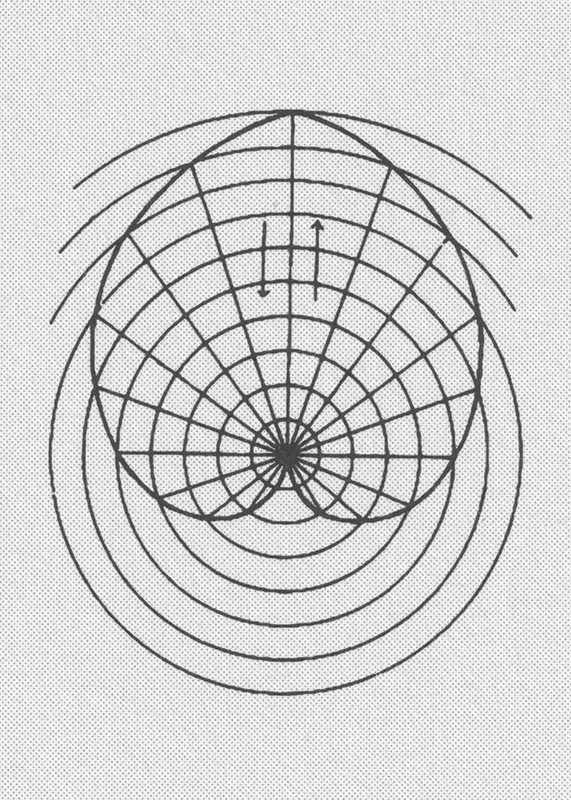
And here we have, jumping ahead, this is in relation to my conversation with Merlin Sheldrake. You guys might be familiar with him and his work with mycelial networks and fungi. And here we were talking about how his work of really studying mycelial networks and fungi, and how they work in remarkable ways, is impacting his thinking about how we can change our relationship to societal thinking. You know, when you have a hyphae that when it hits a wall doesn’t stop, but it goes both ways, to the left and right—that could be valuable thinking right now when we’re so binary-related. And here you have, from the thinking in our interview, this relationship between “cyclical,” “composition,” “mutualism,” “biological,” “intimacy,” “mycelial,” “decomposition”—these are all the kinds of key seed-words. Because that’s the thing Bucky spoke about, that those words were seeds themselves. And when they’re in relationship to a space and a story with intention, I feel like they have a different potency, like they themselves can start to work magic.
MMWe then move to, let’s say, symbolic seeds and structures. I guess from literal ones in the early section of the magazine to, I guess, more symbolic. How is that bridged? How do we understand more broadly what seeds and structures do without losing a connection to the kind of reality of—
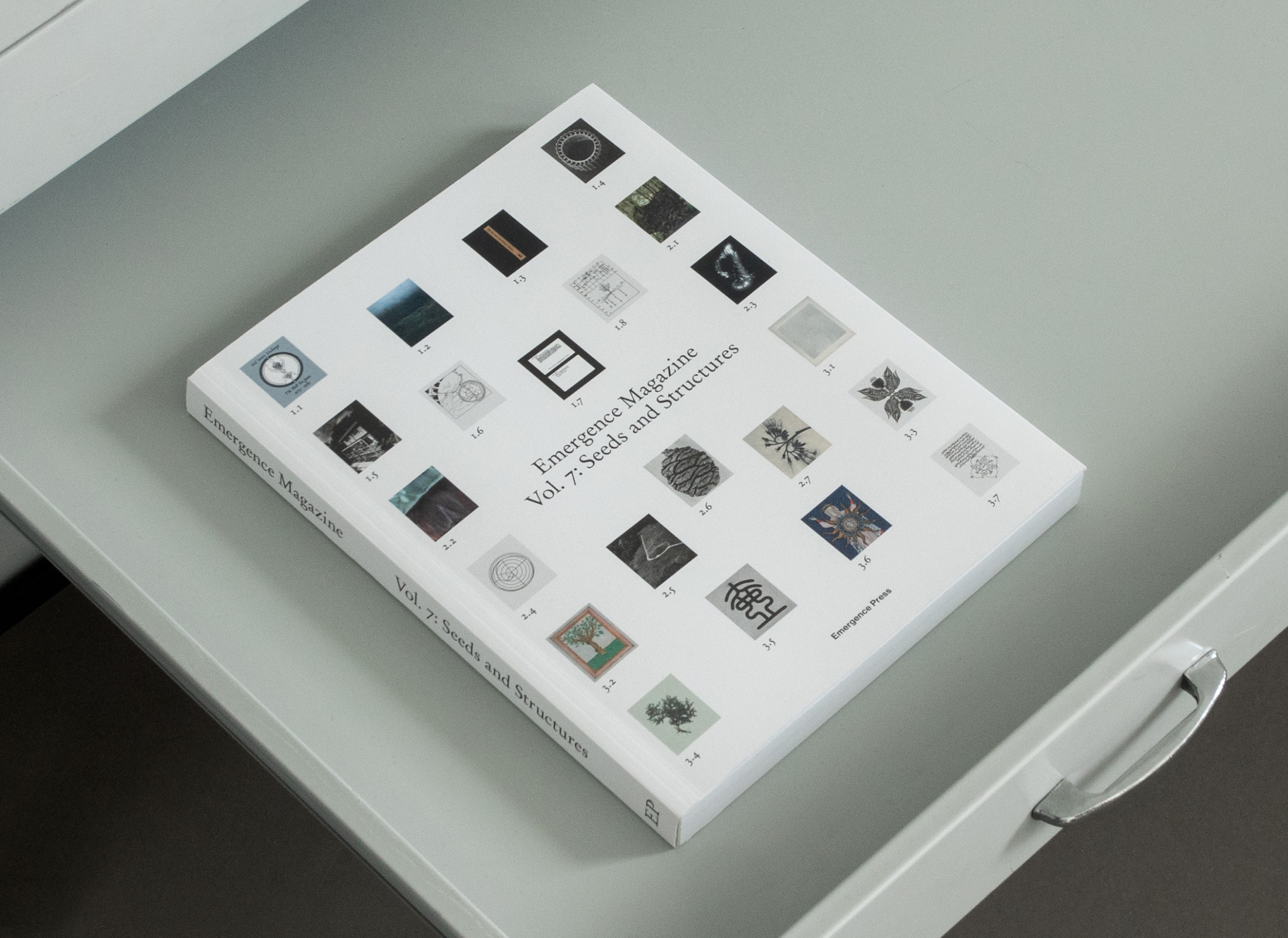
EVLWell, I mean, look at the cover. I mean, these are all images that represent the stories. Each one of those images correlates to a different story, and each one is a symbol that defines an aspect of that story. And this pine cone, it’s a physical object. Everybody here has seen a pine cone. Hopefully everybody here has held a pine cone. I don’t know how many people here know that inside pine cones are seeds that only emerge when there is fire at a certain temperature, because they are serotinous seeds. Now, that’s a very physical thing.
One of the most defining moments in my life was when my home almost burned down when I was fourteen. And afterwards I snuck past the firemen to go and see where the fire originated from. And that landscape is bishop pine trees, and they’d been controlling that landscape, not letting it burn naturally for a century. And so it had been built up and it tore through the forest, destroyed many, many homes. Ours was just at the cusp. And when it had been burned, it was littered with these incredibly beautiful orange-red seeds from the pine cone.
And one of the stories in this issue is all about how serotiny is a symbol of our time of eco-collapse. So we make the bridge between the physical and the symbolic by grounding it in a story that’s very physical: pine cones that only open and reseed themselves through a process of burning that has been denied in America and many parts of the world because of colonial practices that undermine traditional ecological knowledge. This is a story by Sophie Strand, wonderful writer, and she talks about her own relationship to landscape, her own relationship to these seeds, but she makes these larger leaps: How do we reconnect to a certain symbolic consciousness that has been often pushed to the sides? And part of what this issue is really devoted to is trying to surface those potent symbols—the symbol of a pine cone, the symbol of serotiny—and kind of take us back into that imaginal realm where there is so much potential. We limit our access to that when we deny the symbolic world and we limit our understanding of the symbolic world.
So this issue is trying to really make some leaps. From seed-saving, which is the first story, the seed-saving movement in America, and the really in-depth look at it by this wonderful writer named Nathaniel Rich, who writes for The New York Times and The New Yorker and does in-depth environmental journalism. And it’s kind of a rooted, real, on-the-ground piece of how many heirloom varieties are being saved and the impact that has in communities.
And then a few stories later, you’re leaving behind the physical and you’re moving into the symbolic, or you have a story by a wonderful young Indian writer named Yuvan Aves. Many of you may know about him quite intimately, actually, if you read Robert Macfarlane’s Is a River Alive? How many people read that book in this room? I see a lot of hands, so you know who I’m talking about. It’s the section from India, and this young activist who works to restore the waterways around Chennai—a really remarkable individual. If you haven’t read that book, just reading it for his story is worthwhile. That’s where I learned about him. I read Macfarlane’s book and I talked to him about it for a podcast, and I was really inspired by his account of this young man’s journey. And so we reached out to him and told him about the issue, and he came back with this wonderful story, which is that he had a very special relationship with the tamarind seed. That’s a seed that’s local to where he lives. And he wanted to explore the relationship between his psyche and this seed, and then broadens it to the relationship between seeds and our psyches: that we’ve had these relationships with seeds for time immemorial, and those relationships are woven into the fabric of our collective unconscious, if you will, and they’re present in our psyches. And that when we remove ourselves from relationship to seeds, because we’re no longer planting food, we no longer know where our food comes from, we no longer know what a tamarind seed looks like, even though we might be able to taste tamarind, it has an impact on our psyche. Our whole structural way of being becomes unmoored, because we are not seeded in relationship to something that is very physical. So he is doing the same thing. It’s like that seed is a physical seed, but it’s also a symbolic seed that exists in our psyche, and if it’s disconnected then we lose something of who we are from how we used to function for the majority of our existence.
And going back to what I was sharing about spiritual ecology being this return to a memory of how we used to be, a story about a tamarind seed and Yuvan’s psyche is a way to try to repair that, through a story. Because stories create a space for healing. His own story is a story of healing. He writes about it very openly. He was violently beaten as a child. And his way of healing himself was his relationship with seeds, with the aliveness of nature, with snakes, with plants, with everything that breathes and is not human. And they were symbols that are also alive, that are also healing him. And so the story is a space of healing, of his psyche actually being reconnected to something, which is deeply inspiring. It’s one of my favorite pieces in the issue, in many ways, because it’s very raw and it’s very relatable, too. Because I think everybody in this room can know we are not as connected to the seeds that nourished us as we used to be. And that’s part of this question we’re exploring: How do we reconnect with seeds, the physical but also the symbolic, to help us reorient ourselves as human beings before we begin thinking about what future we’re going to co-create? How do we become moored in something that is more foundational to help us? Otherwise, if we continue to create from a space which is disconnected from both the physical relationship with a pine cone or a tamarind seed, or the symbolic understanding of serotiny and a tamarind seed—
MMI feel this journey from, let us say, psychology to spirituality is something that also defines maybe not your personal journey, but certainly your father’s journey that then somehow also translates into a trajectory that we see in this issue. Would you agree? I mean, I almost feel—
EVLYeah. I mean, for those of you who don’t know, my father—he actually wrote a piece for this issue—is a writer. He was a Jungian and he’s a Sufi teacher, and he bridged Sufism and Jungian work in many of his early books. And so his work definitely influenced mine. Unfortunately, I grew up—those of you who have therapists as parents might be able to sympathize—overanalyzing one’s actions and especially one’s dreams at the breakfast table when you’re seven years old. [laughter] That definitely influenced my relationship between psychology and everything, you know? It was always like, well, let’s go deeper. That’s not enough. Let’s go deeper.
MMI mean, that is so interesting.
EVLFrom the periphery it’s interesting. [laughter]
MMAbsolutely, my parents weren’t. But what does spirituality do? Does it rescue you from that?
EVLSome people say that psychology can rescue you from spirituality. I think it depends. I think that you can’t separate the two. That’s what I was raised with an understanding of, that you can’t speak about one’s desire to go beyond the self and experience the Other, in whatever way the Other might be described, without also looking deep within and understanding who you are psychologically, as well as spiritually. And that in the Western culture we have a very different psyche than perhaps— I mean, not now, but let’s say, when a lot of these Eastern spiritual systems came to the West, the Western psyche was different than the Eastern sect, which is why my father’s work was really about trying to find a Western psychological model to engage with Eastern spiritual traditions.
But you can’t separate the two, and that if you want to go beyond the self, you have to actually understand who you are and look at the darkness within yourself, as well. You can’t escape. This notion of spirituality being an escape to the light above is really antithetical to the nature of real transformational work, which requires you to look within yourself and understand you on a psychological level. So to me, they never were separate.
MMBut what did it give your father? What did Eastern spirituality give your father?
EVLI can’t speak for him, but it gave him, being from England I would say, access to another experience of reality that could take him beyond the self, which is what he dedicated his life to. And what he instilled in me was that there is a space beyond the self and that space should be integrated in how we live our lives psychologically, physically. It cannot be an escape from this world. It has to be integrated into this world. So I think it gave him that, in a very simplistic, very, very simplistic answer. Which was really foundational for how I have come to think about storytelling and how I come to think about curation and space. It all has to be integrated: the human and the different aspects of the human—the emotional, the psychological, the spiritual, the physical—and the more-than-human. They all have to go together.
So, to me, when you talk about “spiritual,” let’s say, in the back of the book, we have pieces that go in depth into metaphysical spiritual systems. But when I read Bucky’s piece, I’m like, that’s a spiritual piece, because he’s thinking about things from a holistic perspective and pushing the boundaries to say, let’s engage with the mystery, let’s engage with the Other, let’s think about how we want to create outside the confines of what is familiar. And spirituality is about getting away from the familiar. But you can’t do that unless you understand yourself, so that you can bring your real self forward to go beyond the familiar, the psychological. So, to me, they all go hand in hand, and a story has to bring all of those worlds together. Even if you don’t necessarily say something spiritual, it doesn’t mean it’s not spiritual. In fact, it can undermine its spirituality by naming it.
So you’ve got a story in here by a wonderful Chickasaw poet named Linda Hogan. I know you might be familiar with her work. And this is a story about loss; about gourds that are connected to a landscape that holds the memory of genocide and murder and oppression. And in those gourds that are growing in her garden are the memories that are both ancestrally alive and also dark. Here we have on the right “bones,” “cosmological,” “ancestral.” Those are words connected to her story, because there are bones buried, connected to a cosmological system, that take her into an ancestral relationship with her own land and her people. She doesn’t use the word “spiritual.” She doesn’t use the word “spirit” in that way. She tells her relationship to her land and her people. “Last night it rained and the perfume and feel of it in the air this morning was a medicine for me, not only for me, but for all the plants growing outside.” To me, that’s spiritual. It’s an authentic relationship that includes the landscape, ancestors, the prayers woven into that land, the loss of those ancestors and the pain that goes with it. All of it, together.
MMTowards the end of the issue, as you just pointed out, certain things are named. God is named.
EVLMakes an appearance.
MM[Laughs] Exactly. Towards the end. Well, in fact, He or She or They–
EVLThey.
MMThey make an appearance very early on. They are quoted.
EVL“Keep seed alive on all of the Earth.” —God [laughter]
MMI think, the naming of Them … why? Why do we need to name Them?
EVLWhy not? I mean, one of the premises of this issue was to devote space for the metaphysical and the mystical and the mysterious. That’s present in some of those stories, but to do it more directly. And we deliberately wanted to do this from different perspectives. So we have a Sufi perspective, we have a Daoist perspective, we have a Christian perspective, we have an Anishinaabe perspective, and then a piece that brings together an Aboriginal and a Kichwan perspective—different Indigenous perspectives—that are all speaking about metaphysical systems, I would say, rather than God.
We never said we want to have God make an appearance in this issue. And that’s funny—Nathaniel is probably the most mainstream author in this issue, and we didn’t say: Please, we need to ground this piece about seed-saving in God. He just decided to put that quote in there, which is, I think, very interesting.
But we wanted to explore the metaphysical perspective. So we put the call out to these different writers. And some more deliberately. We’d worked with David Hinton before, who did a very beautiful piece, Daoist piece, about “the eye at the heart of things.” And it’s really about the Daoist relationship to the cosmos and the relationship between being and non-being in this tissue-fabric which lies at the cusp and threshold of existence that energy moves into and out of. And it’s, for those of you who understand Daoism and have read or studied it, it’s a very beautiful way of thinking about the flow of energy. In some ways, it’s like reading about quantum physics.
And it’s very ancient. Daoism is probably the most ancient non-Indigenous spiritual tradition still practiced today. And it has its roots more directly in Indigenous spiritual traditions that didn’t get disconnected. And so it’s really interesting, when you think about a metaphysical system that’s relevant now, Daoism, I think, holds a lot of very potent seeds and structures for how we need to be. And this is a piece filled with poetry, because the way that Daoism unlocks this way of being is through a collection of words—like “windowsill,” “sun,” “fly,” and “sky’s edge”—and this enigmatic way that you can go beyond the mind into this remarkable space which blends the worlds. And there is a system to it, because this was developed over thousands of years with a tremendous amount of direct experience in these realities that then was translated into text or poetry or landscape paintings that left examples of how we can learn to be with a mountain. I mean, that’s the remarkable thing about when you understand Daoism, it’s like it actually teaches you how do you sit with a mountain, how do you sit with a river, in those paintings. And we wanted to explore that. And so David is a person who writes about that and has written for us before.
We wanted to explore the Anishinaabe Four Orders of Creation, which are quite remarkable. And this is an ancient, ancient culture. And other cultures, Native American cultures, have similar ways of seeing orders of creation, understanding the relationship with life. And this author, Wendy Makoons Genuisz, describes this in the context of her relationship with her mother, who taught Indigenous cosmology, ways of being, plant medicine, herbalism. So this piece is dedicated to a practical understanding of plants and the wisdom they hold, but rooted in this notion that there are Four Orders of Creation. And the first is the sun and the moon and all the spirits which guide the world. And then the second order is the plants and the lichen and the moss and the trees—what came next after the spirits created the world. And then the third order of creation is all the animals and fish and birds and insects, which came after the plants, that help bring a different quality of life to the world. And of course, human beings are at the bottom, last in the order of creation, but they were given instructions about how to honor and hold and look after the other forms of creation. And that is what has been broken. In Indigenous culture in North America, they often speak about “the Original Instructions” that humanity was given. And it wasn’t to become top of the food pyramid; it was to actually learn how to work with the other orders of creation.
So that’s an example of a system. “God” is not used, but you could say what she’s describing is a way that the Divine, from my own Sufi perspective, reveals itself, starting with something really essential and elemental, like the sun and the moon and the spirits, that then give form to the physical world. Which is what is explored in the last piece in the issue, which is really a very complex metaphysical system rooted in the Sufi philosophy and ontology of Ibn ‘Arabi, who is this thirteenth-century mystic, poet, philosopher who was the most foundational writer, teacher, influencer in Sufism, and one could say tremendously influential in Islam. The Taj Mahal is built and designed according to his teachings. He was both vilified on one hand, because he was considered a pantheist, because he would not say that the worship of idols was not worshipping God. Because he said everything is a being revealing itself, the Divine revealing Themselves. “The self-disclosure of God” is how he describes it. And “Our Ecological Function,” which this writer, William Rory Dickson, writes about is really exploring this way that an essence reveals itself in creation, as the Divine coming into being, and our ecological function is that we can actually be in relationship to that and be respectful of that. And the ways that it comes into being. It goes into quite a lot of detail.
One thing we did in this issue that we hadn’t done before is we didn’t shy away from perhaps going more directly into a detailed exploration of some of the systems from a metaphysical perspective, or even what could be considered more academic. And I won’t say this issue is academic, but I would say that it’s more academic than what we’ve done in the past. Here God is named because that is in the context of Sufism in Islam. And so that is the reference point for understanding the mystery, the essence, the source of all things. But it’s expanding the notion of the Divine to be limitless, and saying you cannot limit the Divine. And the Divine is in everything, including everything in creation. And the Creator is not better than creation. It is an expression of creation. And, in fact, he begins this piece by grounding it in the Sufi concept of taste, dhawq, which is that you have to come to know it directly to experience it. Otherwise it remains a metaphysical system and a philosophical concept. It all means nothing unless you actually begin to taste your relationship with the Other, that you can do with every single thing in creation if you put your attention to it and get beyond a human-centric way of knowing.
And then maybe the last example is a very interesting piece that grew out of an invitation that we sent to this remarkable Indigenous Aboriginal writer and thinker named Tyson Yunkaporta. Perhaps some of you are familiar with his work. Sand Talk is a remarkable book of his. Right Story, Wrong Story. He’s one of the most powerful thinkers to come out of Australia in decades. And he did something really interesting which is, he was like, I want to do an academic paper, and I want to coauthor it with two different writers, one other Australian, another a Kichwan woman from Ecuador. And there’s two different stories that are unfolding here. One is a story of a woman. One is a story of a man. And they’re presented side by side, so here you have these two different stories—how these two stories from different parts of the world exist in relationship to each other, which is how they wanted to present it, which is also about a structure. And each story is about a different way of thinking about seeds. One is about maize and corn, and the other one is about, I think it’s the gidi-gidi bead and the relationship with this seed that is then turned into beads, and how in both of these cultures, the way that these seeds are gathered, the way that these seeds are worked with in a very practical way and the ceremonies and songs and ways of being that surround the way that you work with the seeds informs the basis for a governance structure that is actually put in place in these places, and has functioned in Australia for tens and tens of thousands of years.
And it’s a remarkable piece. It’s quite radical, actually, in this very subtle way, in that you can’t separate the physical—going back to your question about the physical and symbolic and metaphysical—you can’t separate the physical experience of actually when you plant corn, you harvest corn, you gather to cook the corn, with what the teaching of how those interactions can inform how a governance structure that could be the backbone for an entire culture to function. You can’t separate the two. And they’re doing these parallel stories. This is ancient, ancient knowledge that’s a metaphysical, spiritual, physical, symbolic system that has relevance now when we look around at government structures, which are essentially uninitiated men running rampant, to put in the context of Aboriginal culture.
We’ve turned to systems, ancient systems, and looked at those systems, and we’re not saying we want to go back in time, but what is the relevance of those systems as we want to reimagine the future and participate in co-creating it? And we can’t ignore these incredible Daoist, Sufi, Anishinaabe, Aboriginal, Kichwan systems, just in the same way we can’t discard Buckminster Fuller and the work that he did.
There’s these remarkable people who were storytellers—they’re all storytellers—whose work exists to help us at this time. And then there’s the storytellers that are coming into being, whose work is needed at this time to help us reimagine the future. Because this issue, and maybe Emergence writ large, is really about that: these threads woven together—ecology, culture, spirituality—they can’t be separated. And we have to weave them back together and return to these remarkable ways of being to help inform us as we want to move forward. It can’t just be about sustainability or environmental progress or social equity. It’s all those things, yes. But it has to be about something more foundational, like what are the ways of being that need to be seeded again, which this issue is getting at the heart of and trying to do it more directly. Which is why we feel comfortable maybe being more directly spiritual than some of the issues in the past, or to use the word “God” at the beginning and at the end.
MMThank you for creating this space.