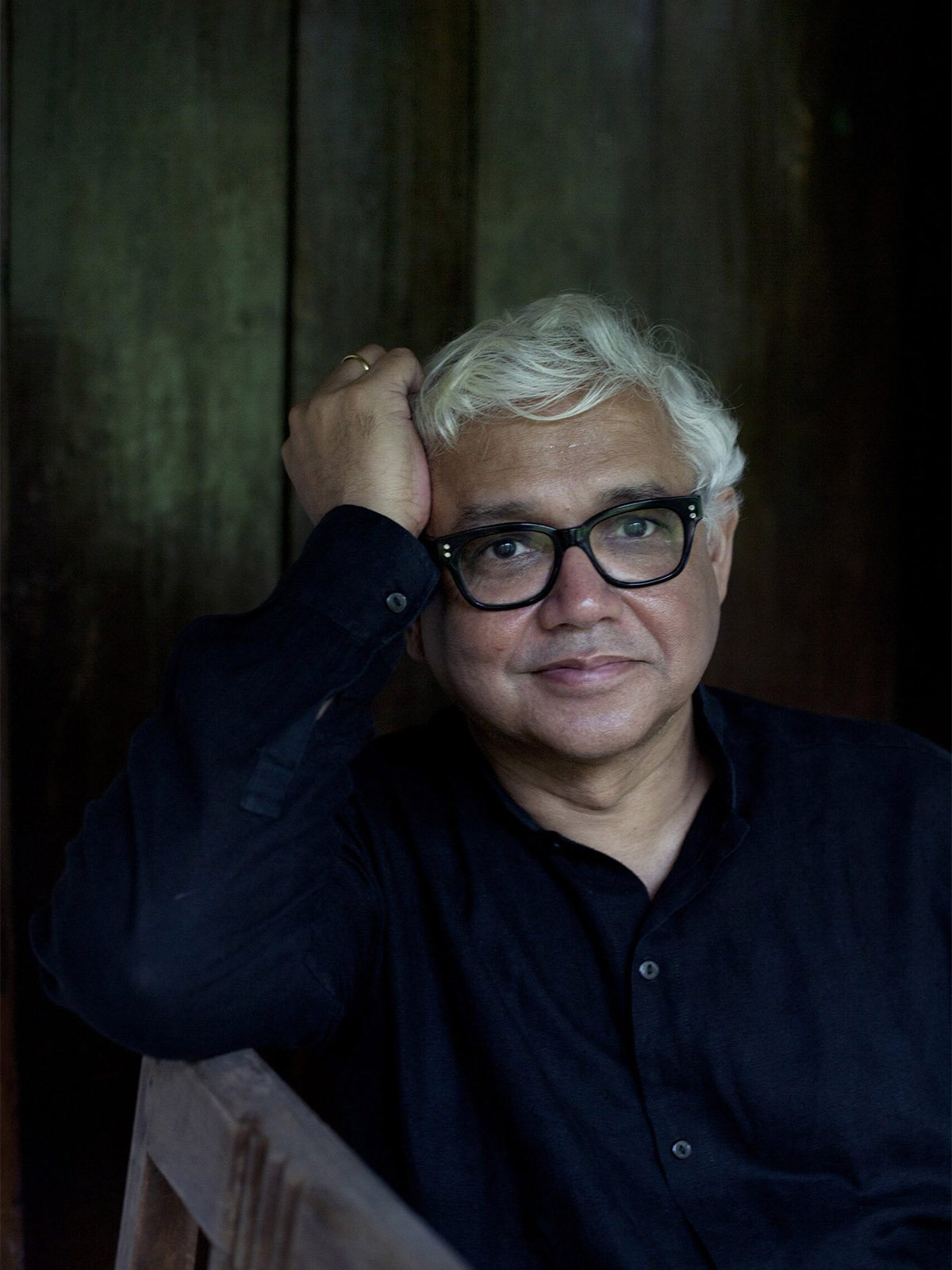
Yuvan Aves is a writer, naturalist, and environmental defender based in Chennai, India. He is an active part of resistance and community movements against ecocide and industrial violence and the founder-managing trustee of Palluyir Trust for Nature Education and Research. His books include A Naturalist’s Journal, Seashells, and Intertidal, which is the first South Asian work to be shortlisted for the Wainwright Prize. He is the recipient of the Sanctuary Asia Green Teacher Award and the M. Krishnan Memorial Nature Writing Award, among other accolades. His latest book (forthcoming) is Inscendence: A Journey with Insects.
Naturalist and educator Yuvan Aves explores how intimate encounters with the living world become woven into our psyche, opening pathways of relation that may otherwise remain inaccessible.
It’s impossible to know, now, who I’d be, had I never met a seed.
When I was four years old, seeds were a staple in my education. My school—called just The School—was at the time a forest campus in Besant Gardens, Chennai, part of the Krishnamurti Foundation of India, founded by the philosopher J. Krishnamurti. I would often go off foraging for seeds across the campus to use for counting, adding, subtracting, making number kits; for imaginary currency, make-believe food, playing pallanguzhi (a traditional South Indian game); and for the subtle thrills of finding newer and newer forms.
Between the rainbow-colored jungle gym and the tile-roofed junior-quadrangle stood a large tamarind tree (Tamarindus indica) five hugs thick. The air would smell rancid post-summer from hundreds of fallen tamarinds pestled into the sand by the feet of older boys and girls playing “running and catching.” The tamarind’s craggy trunk was a “waitese”—the spot a runner could touch to get respite from a catcher. I would search near the walls to find untrampled tamarinds, crack their long brown shells, and eat their sour pulp, sometimes so much pulp that my tongue dried up and tasted of blood. I’d spit the seeds out into my palm, each a slightly different shape, a slightly different face, then roll them on my T-shirt to dry off the saliva. The tamarind seeds were strong as stone and impervious to my new molars. They lingered forever in pencil pouches, school bags, pant-pockets. All the tamarind seeds in the wooden boxes in class had been inside at least one mouth.
My kindergarten teacher, Kamala Anilkumar, once wrote an essay on how playing pallanguzhi, usually with tamarind seeds, helped children learn about sharing and fair play, given the game’s unique redistributive rules. But tamarind seeds were involved in less noble pursuits too: I once perplexed my teachers by collecting pouches full of tamarind seeds and hurling them as artillery towards the balconies of a nearby apartment building, then hiding when the tenants appeared and yelled. I’d convinced a few gullible friends to join me too. All of us sat together on the cold, red floor of the staff room later that day when the teachers spoke to our parents. I was unfortunately introduced to computer games—Mortal Kombat, Tekken, Prince of Persia—too young.
Then there were gulmohar seeds. On the long tree-sheltered walk from car park to classroom, gulmohar pods (Delonix regia) as long as arms, fell split-open like birds mid-flap amidst the scatter of red petals and crow droppings. When a pod was torn open, twenty or thirty hard, long seeds spilled out in a rush and tinkled on tarmac. Palm squirrels often gnawed at the unripe green pods hanging on the tree and ate the seeds, leaving behind windowed train-carriages. The pods oozed sap and resin, inviting bright-green flower chafer beetles, foil-blue bottle flies, hairy flesh flies, and black rajah butterflies, which flew between branches in hops and skips. I’d pocket the seeds I could find and hold each dry, half pod case like a sword and feel warrior-like.
Far beyond the gulmohar trees the school road forked into three mud paths. Here were crowds of dehiscent wild almond pods (Sterculia foetida). Their huge frog mouths gaped open, lined with black oval teeth. Each pod would have scores of Indian red bugs (Probergrothius sanguinolens) joined back-to-back in their ritual of post-copulatory mate protection, wherein the smaller male superglues itself to the bigger female after mating and is dragged along wherever she goes, till she’s ready to lay eggs. Senior students named them bum-chums, lovebugs, horny bugs, husband-and-wife insects. They were my first sight of sex, as I’m sure they were for lots of other children in Chennai. The red bugs love nothing more than wild almond seeds. During the months when these pods don’t fall, the bugs almost vanish. The few that remain live off trampled snails.
Post-winter, through February and March, was wild almond season and bugs red-carpeted the roads. They pierced into, sucked, and hollowed out their seeds in homicidal mobs, not always discerning between a pod and a trampled body of a clan member. The tarmac was printed here and there with insect pairs who had been stepped on, their hemolymph supplementing the seed diet of their kin. When I’d pass them again on my return home in the afternoons, the bugs would be resting up on the wild almond tree’s cratered trunk, seemingly asleep, having nightmares of shoes and tires, I’d think.
The School was rooted in the philosophy of J. Krishnamurti, whose teachings on self-directed learning—“Truth is a pathless land,” and “Be a light unto oneself”—were sowed in me very early. These ideas perennated for years, and then in my adolescence germinated abruptly into the courage that allowed me to run away from an abusive home. My family was deeply religious and superstitious, and often used their dogmas to justify their physical and psychological violence against me throughout my youth. Krishnamurti says: “When one loses the deep intimate relationship with nature, then temples, mosques, and churches become important.” Having found safety among the seeds, insects, trees, birds, and open horizons of this wild campus, I intuitively felt this to be true.
Over the past fifteen years working as a naturalist, educator, and ecological activist, I’ve observed thousands of students and recognized what I now call the “coevolved psyche.” The human psyche is enmeshed in the whole Earth. To deepen our relations with the more-than-human living world is to deepen our connection with our own psyche too, because there are paths into our psyche which only other beings can open for us. In their absence, access to certain places in our inner realms is cut off. If that being goes extinct within our attention or on the Earth, a bit of our psyche becomes buried forever, begging expression. In lieu of such connections, we flounder for wholeness, reaching for artificial sources of meaning. Nothing quite works, because like our bodies and brains, our psyches coevolved with the rest of life on Earth. Without this recognition, we wander incomplete. Frances Weller, in his book In the Absence of the Ordinary, said it this way: “The grief and sense of loss, that we often attribute to a failure in our personality, is actually a feeling of emptiness where a beautiful and strange otherness should have been encountered.”
Recently, at Manotsava 2025, the National Mental Health Festival in India, I took about 150 neuroscientists, counselors, psychotherapists, and many interested members of the public on a walk exploring this idea of the “coevolved psyche.” Using a series of perceptual practices with the surrounding trees, sky, seeds, birds, and soil, we observed our “coevolved psyches” together. Through a guided tree meditation that I read to them, participants reminisced and shared about trees and places in their past that they’d experienced as caregivers. In an activity called “Near and far,” we observed changes felt in our body’s valence while looking at a wall, then looking out far into the sky or a canopy. Towards the end we played a game called “living metaphors” with a collection of wild objects I’d brought—seeds, snakeskin, shells, fossils, flowers. People found new language to describe their minds with the help of these more-than-human objects that would have been otherwise difficult to imagine. When holding a pine cone, people would say, “My mind is a pine cone, it is full of ideas, but only a few will actually grow to trees”; or “My mind is a pine cone, it can extend simultaneously in many directions”; or “My mind is a pine cone, it waits patiently under the surface for the right conditions to grow.”
I imagine my four-year-old self, whose days were steeped in the search for seeds on a campus with a radical philosophy, and remember the emotional encounters with these many-colored embryonic shapes which nourished my psyche.
Near the school lawn, bright-red, hard, idli-shaped seeds would appear. They looked like they were always embarrassed and smiling. In my childhood, kids could employ red seeds for settling a fight or forging a friendship. Good things happened when red seeds lived in your pockets.
With these seeds, I learned the names of numbers one through ten, and then later learned to group ten red seeds in ten red clusters on the soil to make something called a “hundred.” I liked the magical tens of red seeds more than the stolid tens of tamarind seeds or the crumbly tens of neem seeds. Numbers began for me with red seeds. Learning to count was learning to map, in my young mind, the sites of seed fall and the landmarks near them. Numbers began with giving place-values to my curiosity. Only many years later would I learn to recognize the red seeds’ tree (Adenanthera pavonina).
A tree is too large to notice when one is three feet tall. The world is by and large underfoot. At this age the neck is not too keen to keep tilting upward. Seeds then become autonomous entities, each with their own form and face, not falling down from above but appearing at their own will in the locations they like. At times I perceived the campus as an archipelago of seed scatter.
During some special assemblies the entire student body would gather at an amphitheater called the “open circle” at the far end of campus. We would walk in a single file across the school grounds and settle amidst a grove of old tamarind trees whose canopies wrapped around like a cave. After the singing or dancing or speaking was over, I would seek Pillaiyar kannu or kundrimani, little lidless eyeballs that only appeared in this one place on the entire campus. I never saw the rosary pea creeper (Abrus precatorius), curled around branch, bush, and fence, from whom those eerie seeds fell. Rather, numerous unknown animals were dropping their eyes into the open circle: red orbs with a dot of black. The ancient Tamil poet-activist Thiruvallaur used this seed’s size and color to metaphorize and warn against the fragility of human reputation—
Kundrin anaiyaarum kundruvar kundruva Kundri anaiya seyin
(A mountain of greatness can be brought down by a disreputable act the size of a Kundrimani, even if it’s just a dot.)
In 2024 I visited my school’s old campus after a long absence. The School had moved to a different part of the city many years earlier, having lost their rights over the wooded land. That forest campus has since been acquired by the Indian tech billionaire Shiv Nadar for a school named after him. I visited the places where old trees and patches of forest had raised me, but found much of it had been cut down, replaced by iron construction rods and cement pillars. The large pond, barricaded by centuries-old rain trees, where I spent countless hours sitting watching birds, dragonflies, flapshell turtles, mongooses, and golden jackals, was being covered up. The new owners had invited me to run a nature education training program for their teachers. After seeing the carnage over the land, I refused.
Aching for the forest of my childhood, I found myself recognizing how places sow themselves into our psyche. Like the seeds of dream vines (Entada rheedei) or sea beans (Canavalia rosea), with their hard coats and large cotyledons which can survive for years till the conditions for germination appear, the imprints of places live in us for a very long time. Places can be our primary caregivers, providing a care no human can. A care which holds itself open, does not engulf, and is a stable witness to us. This can feel like unconditional love. At least, this is how it was for me. Even when places are decimated, a chronic source of grief in our times, it is possible for them to resurrect themselves in different forms through the psyches they’ve merged into. Places have both physical forms and the forms through which they live in people’s minds. The psychoanalyst Heinz Kohut called this “transmuting internalization,” where an abiding relationship with a “self-object” (a thing, a person, a place) gradually integrates into one’s psychic structure, providing nurturance from within even when it ceases to be in the outer world. Ecosophist David Abram described such an internalization as “each ecology has its own psyche,” and “people bind their imaginations to the psyche of the place by letting the land dream its tales through them.” All my adult life has germinated around ecological work, and I can see how in complex ways my life is a radicle and plumule of the late forest I grew in. Its presence in me also allows me to practice traversing and observing myself in ways only it can.
Foraging seeds in early childhood opened specific paths into my being that most children growing in cities do not experience. This is difficult to extricate and explain, but I think it had to do with the direct experience of something manifesting itself in endless forms—that one seed could be numerous things and live many lives together. Seeds professed their own philosophy of finding, giving, playing, imagining, and waiting. Here were subconscious political lessons as they taught a specifically groundward curiosity and practice of attention.
Inner and outer attention are coextensive. Hence we can find a symmetry between the attention we practice in our environments and the attention we practice within ourselves. An attention honed to be sensitive to small entities, their forms, seasons, and slow lives, I observed, also flowed into one’s inner landscape. Seeds disperse and find places to grow alone, autonomously, following some existential yearning. They show land to be a mosaic of small sovereignties. Such experiences during childhood and adolescence immerse us in certain practices of attention at a time when our psyches are said to be the most formative, shaping the directions a life germinates towards.
To deepen our relations with the more-than-human living world is to deepen our connection with our own psyche too, because there are paths into our psyche which only other beings can open for us.
Who would I be if I’d never met a seed? What happens when a child never hears birdsong or observes a butterfly? What happens if a human being never held earthworms or walked amidst wildflowers?
Having worked with children and young adults, I can say that something deep within ourselves becomes disoriented and impoverished when such deprivations happen. These wounded minds turn rapacious in their search for wholeness. The last few centuries of ecological deracination seem to parallel our disconnect from and repression of our subconscious minds, which Carl Jung writes is the central “spiritual problem of modern man.”
The physical human body, like any living body, is coevolved matter. Our fingerprints are thought to have evolved with fruit textures. The epidermal ridges we see on our palms are theorized to have developed as a way to test the ripeness and identity of the fruits we eat. Our thumbs and shoulders are shaped by tree branches, structured to grip, hold, hang, and climb long lengths of wood. Placentas are thought to have first formed after our mammalian ancestors were infected with ancient viruses, from whom we borrowed genes that let us fuse tissue between mother and developing child. Flowers shaped our vision. Soil shaped feet. Wind and rain shaped our skin. Mosquitoes helped concoct our collective blood. Meditate on any feature of the human body; we will discover it to be a unique convergence of life.
Our brain is also coevolved matter. A tiny brain part called the suprachiasmatic nucleus is reserved for watching sunrises and sunsets and, sensitive to the contrast of blue and red in a twilight sky, sets the body’s internal clock. The human olfactory bulb, a direct extension of our brain located behind our noses, is most sensitive to soil microbe smells: geosmin, methylisoborneol, thiols. It can sense these at a few parts per trillion. The parahippocampal place area in the brains of primates, highly sensitive to changes in scene and setting, might have evolved from our distant ancestors’ history of seasonal dwelling, foraging, and migrating. Birdsong sanded our auditory cortices; sound ecologists have found that human hearing is most sensitive at the peak frequencies of birdcalls, perhaps from navigating our lives in response to their alarms and affirmations.
If it’s true for body and brain, why not consider that the psyche, too, might be intricately coevolved? Carl Jung defines “psyche” as “the totality of all psychic processes, conscious as well as subconscious.” One of the shortcomings of conventional psychology is that it sees our psyche in isolation and in shallow time. Seen in deep time, new theories of mind emerge. Various philosophers have hinted at the psyche’s inextricability from nature and have given it different names. Jung called it the “bush soul.” Arne Næss called it “the ecological self.” Félix Guattari called it “mental ecology.” Thich Nhat Hanh simply said that we “inter-are.” Ecopsychology as a separate field was founded by Theodore Roszak, though the subject is still nascent in the modern world.
I’ve been thinking about this in seed-speech. As an Elaeocarpus nut’s hard wrinkled coat, unscarified by a hornbill’s gut, is unlikely to germinate in a rainforest; as a hog plum withers, in the shade of its parent tree, when its fruit is not dispersed by a barking deer—our psyche too, which continually germinated in such diversity of life, will have aspects of it unfulfilled and left in the dark when separated from its “extended family.” The pain and dysfunctionalities arising from this separation might be difficult to see for some of us, given that this withering happens deep beneath the surface. As endosperm is to seed, the living world is to psyche. And our endosperms are shrinking. Perhaps this is what Krishnamurti meant.
On November 8th, 2022, I was on the beach of Odaikuppam, a fishing hamlet. I was cheering for two children who were having a race. A strong, fickle northeasterly wind was blowing. The boys held spiky spinifex (Spinifex littoreus) grass seeds, which look like large sea urchins growing on the backshore. With their backs to the breeze, at the count of three, they let go of them together. The seeds sprang out of their palms and rolled rapidly on their long brown spines across curls of sand. After a few moments, the two boys ran behind them—a double race—kicking the spinifex ahead if they got lodged in the sand, till the seeds got ragged and ripped and could roll no more. The boys collapsed breathless on the sand. Spinifex is locally called “Ravana meesai,” or Ravana’s moustache, after the mythical Tamil king with ten heads. Walking among spinifex, whose edges have sharp phytoliths, can scathe one’s shins. This littoral grass parents the beach, birthing it by binding and sheltering sand and nursing it back to shape after storms. Its seeds mature during the November-December monsoon, when the winds are strongest, and sprint south, settling only when all its legs wear off. “Neenga oru round vaanga Anna?” (You come for a round?) the boys ask me. I tell them there’s a protest I must attend, and they could join too.
The promenade on this beach is known for protests. From “Save Sparrows” to “Stop Adani” to “Let Chennai Breathe,” it dresses itself in demonstrations and bellows with slogans several times a year.
I joined about five hundred people wearing bright-yellow paper bandanas that said, “No GM Mustard.” Children from nearby fishing hamlets and those from Montessori schools across the city had gathered too, holding placards they’d made. Their headbands were soggy with sweat. Students held charts saying, “We have our traditional seeds, ban GM seeds”; “We are not lab rats”; “NaMo, ban GMO”; and “Dear CM and PM, ban GM.” Teachers in Chennai were increasingly finding protest sites to be rich learning spaces. The convener of the protest that day, Ananthasayanan, or Ananthoo as he is fondly called, stood tall over the crowd with a long, white beard and khadi clothes. He is one of India’s leading voices in the safe food movement.
“That genetically modified mustard will help India is an utter lie,” he said with a chopping hand to the crowd. “The DMH-11 seed is modified such that it is resistant only to a herbicide called glufosinate produced by Bayer…. Glufosinate is highly neurotoxic…. But who is Bayer you ask? They are one of the most notorious pesticide companies in the world. Usually we say that Monsanto is the worst agrochemical company of all, but Bayer bought Monsanto over, so imagine who they are.”
For the next two hours, flanked by police and watched by hundreds of people from their balconies, the crowd marched up and down the road screaming slogans:
“Vendam vendam, marabanu mattram vendam.”
(No need, no need, no need for gene modification.)
“Podhum podhum parambariya vidhaigal podhum.”
(Enough, enough, traditional seeds are enough.)
“Kadugukulla vishama, corporate kaiyila panama.”
(Poison inside mustard, cash in the corporate’s hand.)
“Kaapom kaapom, vidhai urimaigal kaapom.”
(We will protect, we will protect, we will protect seed rights.)
My vocal chords were burnt down by the end. I felt abducted by the utter power of the mustard seed, which was simultaneously mobilizing millions of people across the country. A seed so small that, in Tamil, the word “kadugalavu” (mustard-sized) is a common metaphor for tiny.
A few weeks later I was in Assam, a land abounding in yellow seas of mustard fields. There I witnessed another massive rally, along the entire length of the road, demanding the Indian government ban GM Mustard. The rally was organized by members of a resistance movement called Sarson Satyagraha, which was painted yellow on a large white cloth banner. “Sarson” is Hindi for mustard; “satyagraha,” a term coined during the Indian freedom struggle, means rule by truthfulness. Mustard may sit silently, and in small quantities, on Indian kitchen shelves; it may seem inert when looked at in shallow time. But in deep time, it has a chronic and chthonic power over, and reach within, the human psyche.
For those who live with the land, traditional seeds don’t just enable sovereignty, they embody it. And land expresses and defends itself, in good part, through the metaphors and symbols it sows in people.
Metaphors are a fundamental human need, because meaning in life is a relational quality. Metaphors are not just a poetic device. Those that are prevalent or repeated become subconscious symbols we employ; together, as Jung showed, they make up our psychic lives. Psychic energy takes the form of symbols, showing hidden realities within and outside us that cannot be easily articulated. One could say landscape speaks to, speaks through, mindscape, symbolically, metaphorically.
“Trees let us understand our minds,” said the great nature writer Robert Macfarlane: dendron, dendrite, arbor vitae, arborization—concepts for brain parts grew on trees. Words like “ramify” and “radical” are from trees too, and “truth” derives from a Proto-Indo-European root which refers to the sturdiness of tree trunks. We can imagine the evolution of life only through forks of trunks and branches. A Tamil word for forest is “kaanagam,” which literally means “to look within.”
Seeds, too, have been germinating specific imaginaries in human beings simultaneously across cultures. To social movements, seeds symbolize “genesis,” helping envision change in a place barren of the justice it seeks. The legendary ecological farmer Fukuoka wrote, “Look at this grain. I believe a revolution can start from this one strand of straw.” The convenor of the Beej Bachao Andolan (the “Save the Seeds” movement), the great seed defender Vandana Shiva, wrote that the seed has become “the site and symbol of freedom” and that the seed is asserting its rights through this movement. The great Tamil organic farmer Nammazhvar said, “seeds are our greatest weapon” against the corporatization of food. While these visionaries have been fighting for seed sovereignty, the seed itself shapes their vision of sovereignty. It guides them, speaks through them. The seed becomes an ultimate embodiment of hope because it shows that it’s always something tiny that grows into something world-shaping.
This is recurrent in myth too. The renowned Indian mythologist Devdutt Pattanaik tells an indigenous story from Laos wherein the rice goddess is enslaved by a king. A hermit finds her and cuts her up into countless pieces, which turns her into endless varieties of indigenous rice. The tyrant king can no longer control her or her people. In spirit, this story reverberates with the popular phrase, “They thought they could bury us; they didn’t know we were seeds,” and with the movement against genetically modified mustard.
In Staying with the Trouble, Donna Haraway wrote, “It matters what matters we use to think other matters with.” A large body of cognitive theory shows the shortcomings of our postindustrial practice of using mechanical metaphors to describe our minds. Terms like wired, stressed, strained, tension, burned out, pressure, circuitry, regulate, depressed, liken us to metals, engines, and electrical components. These metaphors betray and misrepresent our coevolved psyches. These symbols introject states into our minds that do not inherently change, grow, seek connection, care, resist, grieve, or rejoice. They trap us in deep dissonance as they get internalized by our subconscious, becoming the primary symbols of our inner realms and making us feel fragmented, not inherently whole. There is a disease of imagination, yet to be recognized, which comes from detachment from the living world—the birds, trees, butterflies, seeds, snakes—and a mind permeated with dead and dysfunctional symbolisms. Would we recognize that pathology if we saw it? What might that disease’s manifestation look like?
Not too different I think from the collective psyche of a multinational like Bayer, which sees the world and sees the seed through mechanized symbols. More dangerously, this is possibly how they see themselves. The psychoanalyst Melanie Klein described how when a fragmented psyche perceives itself as a collection of unconnected objects, this renders the individual or group dangerous to themselves and to those around them. I feel this is at the core of capitalist projects, whether that be genetically modifying seeds or mining a billion-year-old mountain range or building a mega-dam on a river. Such projects seem to emerge from fragmented minds cut off from the vast places within the coevolved psyche, perhaps forcefully separated from a nurturing relationship with the living world in their formative years.
Early in the summer of 2025, my friends Elizabeth and Sudha, who teach primary children at Abacus Montessori School, observed that some of the four-year-olds were keen on collecting seeds around the school campus. They asked me to teach a session on the subject. In preparation, I roamed around the city on a foraging tour, collecting helicopter seeds from the gyrocarpus trees at St. Thomas Mount, screw nuts and soap nuts from Pachamalai hill, silk cotton pods and mahogany pods from the Theosophical Society’s forest, gulmohar pods and tamarind and red seeds from the Kotturpuram Urban forest, spinifex seeds from Odaikuppam beach.
The following week, I went into class with a jute bag, rattling from within.
“I have a bag full of seeds from all across the city. Who wants to see?”
“I!!! ME!!!” twelve voices squealed.
I took out a helicopter seed first and dropped an achene from as high as I could, three times. Each time it spun faster than it fell, hypnotically, ending in a gentle touch to the ground.
“AHHHHH!” some kids chanted in excitement at the seed’s fanning fall, which it does to protect its embryo from damage. I passed a few around and the kids jumped as high as they could, each throwing the winged seeds up in the air then latching their gaze on it.
Then we went out into the school grounds where I passed around a few silk cotton pods and let the children blow them around. The fibers got stuck in hair, fabric, and window grills.
One boy called the gulmohar pod a “katana.” Another brought me a long stick-like pod from beneath the golden showers tree (Cassia fistula).
“Do you know which tree this is from?” I made the mistake of asking him. A tree is too large to notice when one is three feet tall. The world is by and large underfoot. He showed me instead how he could make buttons on his shirt with the seeds inside the pod. Insisting that I break the pod open, he took out the spongy locules one by one and popped the hard bronze seeds out of them. Then placing the spongy seed casings under his sleeve, he pressed the hard seed through his cloth, making the seed stick there. “You’ll start a new fashion trend,” I told him.
Another child brought me a handful of copperpods (Peltophorum pterocarpum) from under the copperpod trees at the parents’ waiting area. I crouched to his height and showed him that the pod had an inside. I peeled its tough fiber and showed the soft, flat tawny seeds within, which are cold to touch and fun to collect. Some children seemed shaken with wonder at this interiority of a seed they see in plenty every day. They rushed away to find more and opened the pods on their own, discovering with thrill what was within them again and again.
Through physical, metaphysical, and symbolic perspectives, our new print volume seeks the kinds of seeds and structures we will need to embody a new ecological consciousness. Exploring spiritual ecology as an emerging ontology, it reimagines our most fundamental bodies of knowledge, investigates more-than-human structures we can emulate, and looks to ancient spiritual systems that recognize the Earth as animate and alive.
Sign up to receive our biweekly newsletter, arriving every other Sunday morning. We are an ad and subscription-free magazine committed to sharing stories crafted with care. Join us as we explore the threads connecting ecology, culture, and spirituality.