Writer
Manchán Magan was an Irish author, broadcaster, documentary maker, and passionate advocate of the Irish language. He made dozens of documentaries on world cultures, and hosted several programs about Ireland, including No Béarla, a documentary series about traveling around Ireland speaking only Irish; Crainn na hÉireann, a ten-part series on the trees of Ireland; the podcast The Almanac of Ireland; and Manchán’s A-Z of Ireland, a five-episode road trip unearthing Ireland’s natural heritage. His books include Thirty-Two Words for Field: Lost Words of the Irish; Ninety-Nine Words for Rain (and One for Sun); Tree Dogs, Banshee Fingers and Other Irish Words for Nature; Listen to the land Speak; three books in Irish; three travel books; and two novels.
Weaving together folklore, proverb, and cultural memory, Manchán Magan traces the ecological intimacy encoded in the Irish language.
Kaleidoscope
It was my grandmother, Sighle Humphreys, who taught me Irish and when I asked her one day what the word for a hole was, she replied, ‘Do you mean one dug into the ground by an animal? That’s an uachas. Or one made by fish in a sandy riverbed for spawning? That’s a saothar. Or if it’s been hollowed out by the hoofs of beasts and then filled with rain it’s a plobán. Or if a lobster is hiding in one it’s a fach. Or if it’s been created as a hideaway by a wild beast it’s a puathais.’
Perhaps it was then that I first noticed that the two languages I spoke, Irish and English, required not just different forms of grammar and syntax but different ways of interpreting reality. It wasn’t just that the sun rose in five distinct stages in Irish, but that if I needed to give directions to someone I had to orientate myself in relation to the sun quite specifically. I couldn’t just say I was heading ‘up the road’ or ‘back to someone’s house’ or ‘into town’. Instead I would first situate myself in relation to the planet. I would be heading siar ó dheas (‘south-west’) along the road or aduaidh (‘to the north’) or soir abhaile (‘eastwards home’). Even when someone or something was just a little way off, such as a cow in the next field, I would say, Tá an bhó thoir sa pháirc (‘The cow is in the field to the east’).
Later on I learnt that there were many other words for holes, such as one dug into a bog, a criathar, and one made by an auger, a tarathar, and a cup-like hole in a rock, a ballán. Log is a water-filled hole in the landscape, cró a hole in the eye of a needle and spail a hole at the stern of a boat. Each can be translated into the English word ‘hole’, and perhaps it’s efficient to do so, but I have always wondered what subtlety and nuance is lost and whether the richness of the reality the Irish words describe would wane.
Our landscape now looks like an increasingly anonymous expanse of indistinguishable fields, yet seen through the Irish language each field has its own word, depending on its characteristics and function.
There are well over thirty-two different words for field in Irish. To a city-dweller these patches of land may all look the same, and in English each would probably be just referred to as a field, yet to someone whose ancestors have been cultivating the ground, growing grain and tending cattle for over four thousand years, and who has built up the soil over centuries by hauling seaweed from the shore and burning limestone to add alkalinity, they look very different.
Geamhar is a field of corn grass, biorrach is a marshy field, buaile is a field for keeping cattle before milking.1 There is a word for a tilled field worked in partnership with a neighbour, a fallow field, a night field for cattle, a meadow field between two woods, an arable field in an arid area, a field for games or dancing, a level field for spreading flax or hay, a sheltered field in which a mare would foal, an upland field, a low-lying open field, an enclosed field, a level field, a neat, well-arranged field, a smooth finefield and an unenclosed field in the middle of a créig (a stonier area of limestone). A field with a fairy-dwelling in it is known as a cathairín.
Each of these words summons particular swathes of our landscape and the activities that happen on them. Some words even refer to fields in which something occasionally happened but no longer does, such as bánóg, a patch of ground levelled out by years of dancing, among other things, or buadán, a hillside that once had gorse growing on it but has since been cut with a scythe or hook, leaving only stumps. A hillside on which the gorse has been removed not by cutting but by burning has a different word.
Having lived on the island for so long, we have perhaps inevitably become rooted quite deeply in it, becoming entangled in its complex network of clay, sand, stone, weeds, worms, mycobacteria, flora, pollinators and mycelium. But I hadn’t realised how far back this connection stretched until my grandmother taught me a seanfhocal (a proverb, literally ‘old word’) that shook my sense of time and space so much that I am contending with it to this day.
Saol trí mhíol mhór saol iomaire amháin, saol
trí iomaire saol an domhain.
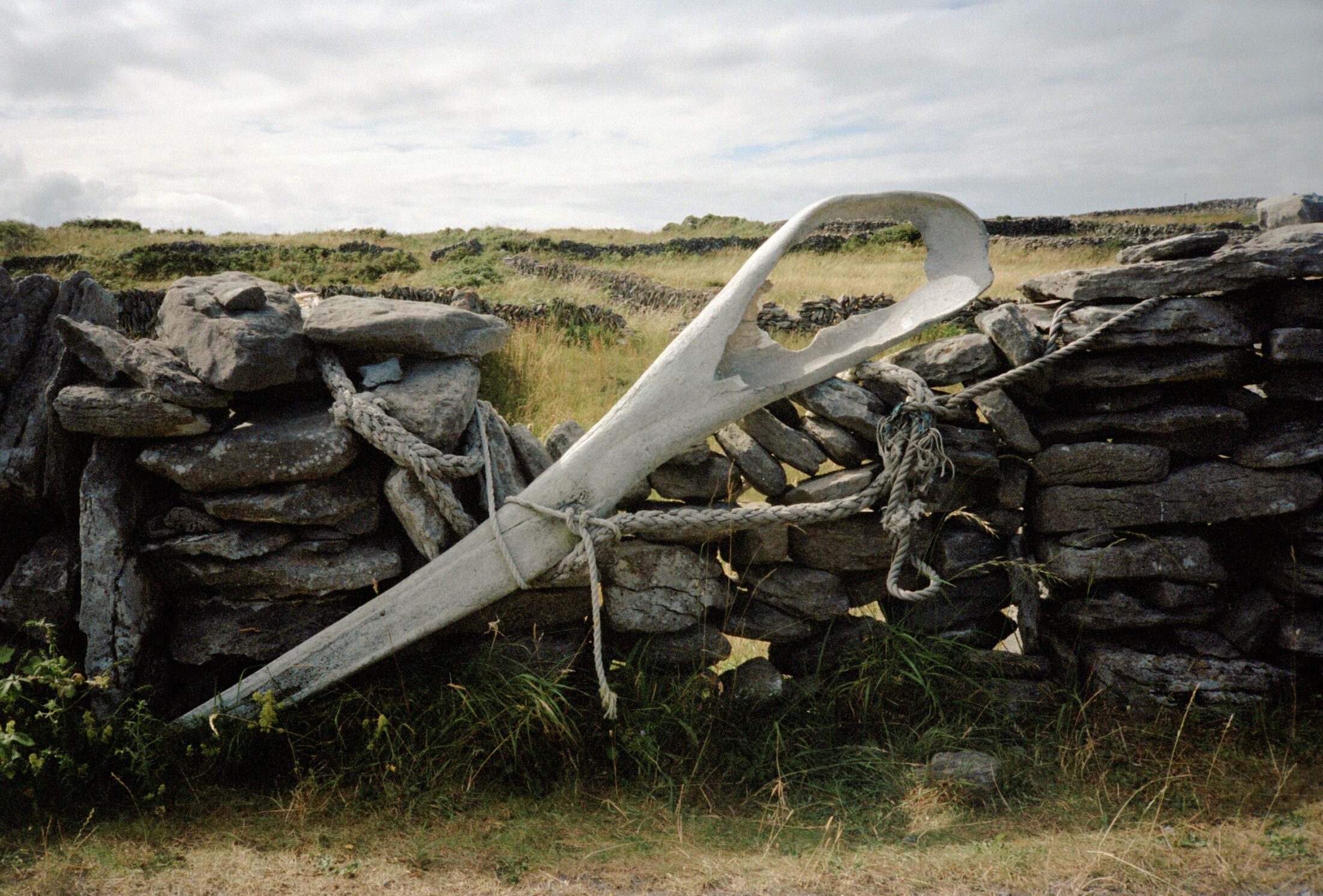
It translates as ‘Three times the life of a whale is the lifespan of a ridge, and three times the life of a ridge is the lifespan of the world’. For me, it encapsulates just how far back the knowledge contained within the language stretches on this island. A whale was thought to live for one thousand years (although they live for about a century), so it was believed that some of the cultivation ridges that we see in the fields around us could be up to three thousand years old. Archaeologists agree that there are indeed ridges of that age still visible in such places as the Céide Fields in Co. Mayo and Slievemore on Achill Island.
The span of three cultivation ridges would amount to nine thousand years, which takes us back to the time when archaeologists believe significant numbers of humans first settled here—the beginning of our world. That our ancestors appear to have kept a count of how long we have been here—and that they encoded it in our language—is precious.
My grandmother often pointed out the still-visible cultivation ridges left by her grandparents’ generation during the famine known as the Great Hunger of the 1840s. Some were more visible than others, as they had been left undug; our forebears either were too weak to dig them or, having noticed the blight-rotted potato stems, had realised that there would be nothing but a slimy mush beneath the soil. I had been struck by the longevity of such memories, but it wasn’t until I heard the proverb that I realised quite how far back these folk memories can stretch.
It appears, at least, as though we managed to keep some wispy thread of memory intact from our Neolithic forebears, who planted, weeded and harvested along such ridges thousands of years ago. The knowledge is contained within the land, and over the years I’ve realised that an easy way to access it is through the language.
First Utterance
Aduantas is that feeling one gets in unfamiliar places—a light fear with a tinge of sadness. It captures well the sense of, say, starting out on a book on something as potent and amorphous as the Irish language. This feeling is mixed with a sense of sclimpíní, which conveys the effect of lights dancing before one’s eyes—either real light or supernatural light, those glimpses one gets through the veil of what lies beyond.
When the forebears of those Neolithic farmers first arrived on this island ten thousand years ago, they didn’t yet speak Irish, but that doesn’t mean we don’t know what was first said. The unfathomable channelling known as the oral tradition has left us a record, passed down through the generations in the minds of druids and poets until the arrival of that poisoned chalice—writing—in the fifth century with St Patrick and fellow missionaries, who used it as a spell to entrance us and as a tool to control us.
It was they who helped jot down and then transcribe our first memories, insights and acts that had been encoded into the old mythology and poetry that was passed from mouth to mouth across thousands of years. They recorded them all onto parchment, and from there these have made their way to us in the form of tales and songs and poems, as well as a shabby set of ancient memos, known as annals and chronicles, that list the history of our people from the time of Noah’s flood to our arrival on this green island and right up to the 17th century.
The annals were like newspaper headlines, noting the most significant events, such as that ‘a huge dragon was seen, with great thunder after it, at the end of autumn’ in AD 736 and that ‘ships with their crews were seen in the air above Cluain Moccu Nóis’ in AD 749. We also know that in AD 1116 there was a ‘great famine in the spring, so that a man would sell his son and his daughter for food and men would even eat one another, and dogs.’
It is these written records that claim that we first set foot here on April 1 in 700 BC, having sailed up from Spain. Many archaeologists agree with this account, but suggest the date is closer to 8000 BC … Both versions may be right in different ways.
The old lore also preserves the first words spoken here. They were an invocation by our chief poet and druid, Amergin, who, it is said, managed to reach the coast of Co. Kerry because of a magical wave that plucked him from the Atlantic Ocean and dropped him on the shore during a tempest. His wife and his siblings were all drowned in this storm that was created by a supernatural tribe of earth-bound gods, Tuatha Dé Danann, who were living here before us. They had made a promise that if we managed to reach Ireland from a distance of nine waves from the shore they would gladly surrender. When Amergin did make it to dry land in spite of the storm they had sent, they fulfilled their promise and slunk away under the surface of the earth into the Otherworld, where they continued to live.
Amergin became leader of the island and his first act was to begin uttering an incantation, summoning up the world that we intended to create here and clarifying the interrelation between it and all other planes of existence, physical and spiritual.
This could be seen as a rather obtuse thing to do, but the Irish people always had a flair for the dramatic. Proclamations, blessings and invocations are second nature to us; often, we favour them over actions. And yet Amergin’s words were somewhat different; they were our declaration of the unity of all things, and our lives have been based on it ever since.
Am gaeth i m-muir I am wind on sea
Am tond trethan I am ocean wave
Am fuaim mara I am roar of sea
Am dam secht ndirend I am stag of seven tines
Am séig i n-aill I am hawk on cliff
Am dér gréne I am shining tear of sun
Am cain lubai … I am gentle herbs …
His incantation continues for many lines, laying out who we are in this world and beyond, making it clear that we are all things, united as one entity beyond the veil of duality.
When I was young I recited these words, hoping to get to grips with them. The Irish in them is very old and has an incantatory quality, as if the sounds were designed as much to summon the object into this realm as to describe it.
In a way, everything that I want to say in this book is contained within those lines. They reveal a language that not only describes things but also summons them into being, a language that communicates not only to others but to the psyche and the subconscious, a language that is deeply rooted in the environment and can connect us to our surroundings in remarkable ways.
Amergin’s words, just like the Irish language itself, are our gift to ourselves from the ancient past, grounding us to this particular emerald patch while also hinting that we are connected to everywhere else, reminding us that we are united and connected to all things—waves, fields, hawks.
Excerpts from Thirty-Two Words for Field, by Manchán Magan (Chelsea Green Publishing, Feb. 2026), printed with permission from the publisher.
- Cuibhreann is a tilled field worked in partnership with a neighbour, tuar a night field for cattle. Cluain is a meadow field between two woods, tamhnach an arable field in an arid area. Réidhleán is a field for games or dancing, plás a level field for spreading flax or hay, plásóg a sheltered field in which a mare would foal, raon an upland field, machaire a low-lying open field. Mainnear is an enclosed field, réidh a level field, mín a smooth fine field and réalóg an unenclosed patch of good land in the middle of a créig. Losaid, a neat, well-arranged field, is similar to cúilín, which is also neat but smaller.
read more