Marie Mutsuki Mockett is the author of two works of nonfiction and two novels. Her book American Harvest: God, Country, and Farming in the Heartland won the 2021 Northern California Book Award for General Nonfiction and the Nebraska Book Award for Nonfiction. Her memoir, Where the Dead Pause and the Japanese Say Goodbye, was a New York Times Editors’ Choice, a finalist for the 2016 Pen Open Book Award, and a finalist for the Indies Choice Best Book for Adult Nonfiction for 2016. Other works include the novel Picking Bones from Ash and the widely anthologized essay “Letter from a Japanese Crematorium,” featured in Best Creative Nonfiction, Vol. 3. Her essays and reporting have appeared in Orion, The New York Times, Salon, National Geographic, Glamour, and elsewhere, and she has been a guest on NPR’s The World, Talk of the Nation, and All Things Considered. She currently teaches writing at Bennington College in Vermont.
Marie Mutsuki Mockett asks what it means to inherit the timeless tradition of haiku when it is tied to an ecological reality that no longer exists.
THE ONLY STORY I have about my Japanese great-grandmother comes from my American father. It was 1968 and my Japanese grandmother had been reluctant to introduce her son-in-law to extended family, since it was my father’s country that had decimated the family home in Nagasaki. But at my mother’s urging, the three of them trekked out to the tiny apartment where my great-grandmother lived alone—and their meeting was an instant success. They smiled at each other as they sat on the tatami floor, and despite the language barrier, instantly felt each other’s warmth, kindness, and desire for acceptance.
And then, said my father, my great-grandmother turned and tossed out the beginning lines of a poem. My mother was supposed to be able to finish the poem to participate in an advanced game of exquisite corpse, but she couldn’t think of what to say. My grandmother, still remembering her aristocratic upbringing on the island of Kyushu, chimed in, and then she and her mother went back and forth until the whole poem was complete, at which point the two women laughed, and then my great-grandmother gently scolded her daughter for not having taught my mother the art of Japanese poetry.
I know now that they were most likely engaging in haikai, which developed out of renga; the latter is a seven-hundred-year-old art which literally means “linked poetry,” and the stanzas are very generally comprised of alternating lines of five or seven syllables. A descendant of this poetic form, haiku is today popular throughout the world.
The three women in my family who came before me were all artists. I am a writer too, but so much has changed between their time and mine that when I imagine being in the small apartment listening to them compose that poem, I see myself merely grasping at the edges of their conversation; even if I could be there, time, war, and my upbringing in America would render me a ghost of a figure. And yet, this story always fills me with longing to be able to join them, to mend the broken bridge of time.
ONE OF MANY THINGS these forms of Japanese poetry—renga, haikai, and haiku—have in common is that they must make mention of the season. Chances are my great-grandmother, grandmother, and even my mother studied something called a saijiki, a kind of encyclopedia which charts the words that are associated with each of the four seasons: spring, summer, fall, and autumn. Each seasonal word, a kigo, allows the poet to express a human feeling, conveyed via the natural world. A subset of five hundred of these kigo has been listed by the scholar and haiku practitioner Kenkichi Yamamoto as essential, with subcategories for animals, plants, and other established topics.
When I look at this list, I recognize almost all of the words and can attach a memory to many of them: like the time my mother told me to look out the window at fields of rice pulsating with emerald light (summer); or the time we traveled to the ancient capital Nara in February, saw the sasanquas blooming in the cold (winter), and ate Japanese sweets shaped to look like those very blossoms. You may well be aware of some if not all of these words too.
Even though the most famous of the haiku poets, Basho, lived nearly four hundred years ago, his work in translation has arguably done more than anything else to influence a global understanding of what Japanese poetry can be. Here, for example, is one of his most famous poems, as translated by Donald Keene:
古池や
蛙飛び込む
水の音
furu ike ya
kawazu tobikomu
mizu no oto
The ancient pond
A frog leaps in
The sound of the water.
If, as I wrote, all haiku (and renga and haikai) utilize the seasons as a starting point to express an emotion, in what season would you place this poem? The frog, as a symbol of spring, is the giveaway, and a great deal of ink has been spilt over the deeper meanings contained in these three lines. For example, when we think of frogs making a sound, we usually conjure their springtime courtship calls, but Basho overturned this expectation, making the frog responsible for giving water a voice.
In addition to a seasonal word, haiku also include a “cutting term,” which gives a poem breath—a kind of negative space in the middle of all the phonemes. In the case of this haiku, Basho has included the particle “ya,” which functions as a beat so the reader will pause before continuing on. Knowing this, Alan Watts retranslated the poem like so:
The old pond,
A frog jumps in:
Plop!
Last spring, my friend Matthew and I took a quick trip to Jūniko Lakes in Akita Prefecture, home of one of the world’s largest remaining primeval beech forests; we were on the hunt for the rare Okinawa ruddy kingfisher. While I missed the kingfisher, I did come upon dozens of green frogs mating and reproducing in the branches of the thick trees above the blue waters. They hung onto foamy, oozing egg-filled balls of white goo, and every now and then a frog, presumably done with mating, would fall down into the water. Plop. The world felt sticky, and fecund. It is possible I would have noticed the frogs even without knowing the Basho poem, yet because of his haiku I found this compressed observation of nature in action riveting, my mind linking it to many other readers and writers of poetry across time, back to Basho.
IF SPRING SIGNALS birth and sex, autumn, with its fading light and drying grasses, often conveys longing. Here is another of Basho’s famous haiku:
夏草や
兵どもが
夢の跡
Natsukusa ya
Tsuwamonodomo ga
Yume no ato
summer grass—
all that remains
of warriors’ dreams
The ancient aristocrats, who helped to first codify the seasonal words, were writing about the natural world around them not so much to preserve nature, according to Columbia University professor Haruo Shirane in his book Japan and the Culture of the Four Seasons, but to advocate for imperial legitimacy. Their view of nature, which was greatly influenced by China, was of endlessly and predictably cycling seasons; nature, like imperial rule, was stable. The poetics of nature evolved, crossing the centuries in Japan, eventually codified into the saijiki. Such an attunement to seasonality is also expressed in Japan’s social and material culture in what Haruo calls “secondary nature”—the tea ceremony, flower arranging, and poetry writing—and even today in the seasonal offerings of Starbucks, which in Tokyo includes a cherry blossom cake in the spring. As a young adult, I loved coming to Japan and seeing that cake everywhere starting in March. Never mind the Easter rabbit and Easter eggs! The Japanese love flowers! But I have had to face squarely that these aesthetics have not prevented the large-scale destruction of much of Japan’s natural beauty. The aforementioned Jūniko Lakes or the Shiretoko Peninsula, two places where remaining native forests preserve wild bird and mammal habitats, are proportionally quite small to the rest of Japan’s forests. I sometimes fret that the new practice of “secondary nature”—art installations like Team Lab Borderless which feature projected flowers and schools of fish into large rooms—gives viewers the sensation of being in harmony with a natural world that in reality is under continuous destruction.
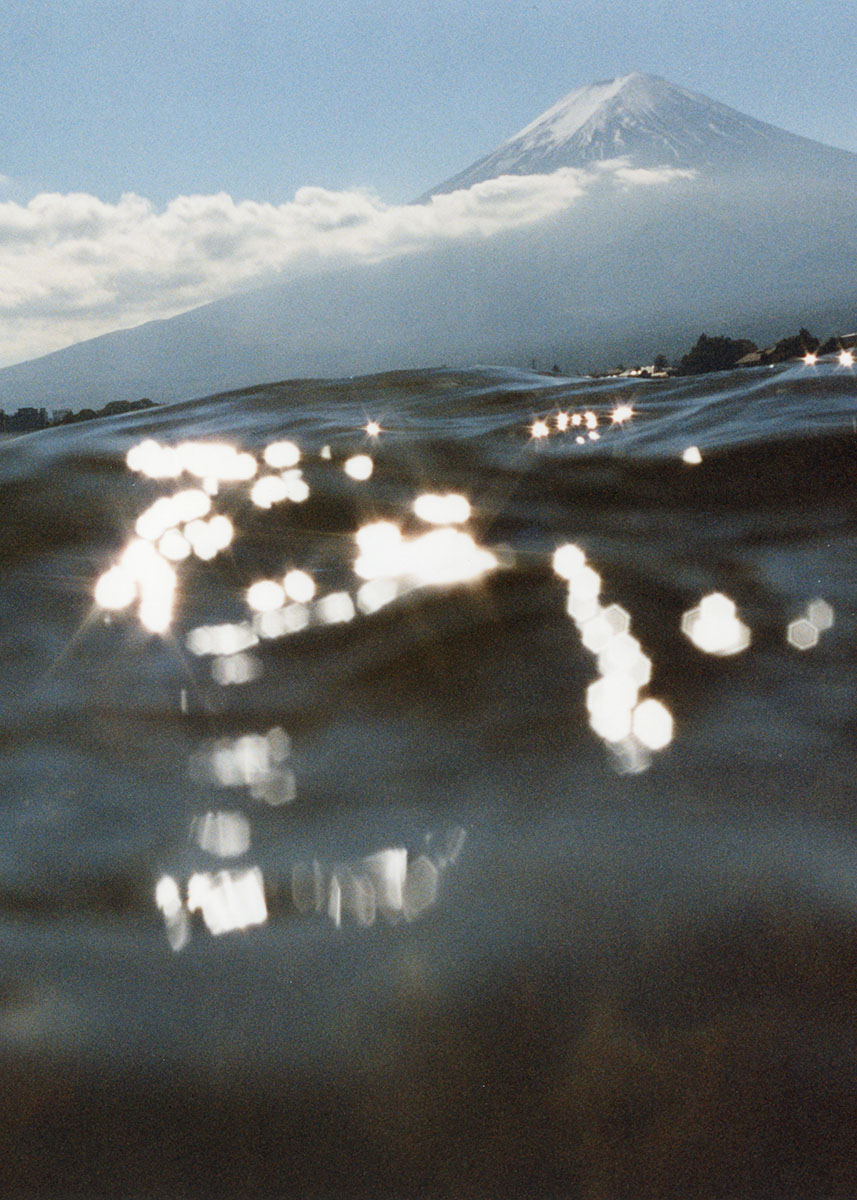
Today, the distinctions between the four seasons in Japan are collapsing, so it is becoming increasingly difficult to align not only the anticipated festivals and décor to the seasons, but the lists in the saijiki with external reality. As I write this, in November 2024, Mt. Fuji remains snowless for the first time in over 130 years. The Soma Nomaoi horse festival, historically held in July in the Tohoku town of Minami-Soma and which I attended as a child, is now scheduled for May because the horses and the humans cannot cope with the dangerously high temperatures of summer.
Every time I hear about something traditional being lost or changing in Japan, I feel at least a twinge of sadness. I’m relieved the horse festival will be preserved, because its existence was greatly threatened by the 2011 earthquake and tsunami, but the change in date has upended expectations around seasonal preparation. So many precious cultural traditions feel endangered in Japan, and not just because of climate change. Many Japanese houses with traditional tatami mats now sit empty as young people understandably prefer more modern structures. My feelings toward my own mortality are of course bound up with the weightiness of such losses, but I suppose I feel an additional vulnerability where Japan is concerned. If only I could just have had enough time in “real” Japan, then perhaps I could have completed a chain from myself to my mother and back through time to my ancestors.
It’s worth noting that a modern seasonal almanac, the Nihon Dai Saijiki (Great Japanese Seasonal Almanac) (1983), includes the new words “short-sleeve shirts,” “baseball night game,” and “sunglasses” for summer. It seems inevitable that the saijiki, and its seasonal words, will only continue to change. The poet Natsui Itsuki anticipates this and has even written a book titled Zetsumetsu sunzen kigo jiten (The Dictionary of Endangered Seasonal Words) and in an interview gave a free verse–worthy answer when asked to predict how change will finally happen:
Do you know a shell called “Akoya pearl oyster”? It is a shell that produces pearls, but if a foreign substance such as a stone gets inside this shell, it will be wrapped in multiple layers so as not to damage it. As a result, pearls are slowly made. The maturation of seasonal words is similar. It takes a long time to make one season word, and I think that period [of time] is what we call culture.
But she rejects the idea that old words need to be jettisoned. “There is no accreditation body [to determine which words are excluded]. It is not something that some kind of association recognizes, but something that naturally takes root in a long history.”
I have said that I wished I could imbibe culture to complete myself. But Itsuki’s point that culture is not about a set of rules one can memorize and master challenges this viewpoint. What matters, she says, is responding to living culture and thus making culture.
IN A BRILLIANT, intellectually challenging essay titled “Haiku, Time, Ecology”—too profound to completely unpack here—Hisao Suzuki, the poet and editor of the poetry magazine Coal Sack, reframes the question about seasonal words entirely. Traditional haiku has assumed a kind of timelessness in the world; climate change along with nuclear proliferation give the lie to such perfect circles. We do not, in fact, know that the spring grasses will always come and grow over the soldier’s remains and, worse, we may be the architects of their demise. What is an artist to do? Suzuki foresees three options:
1. Remain true to the “fiction” of the seasonal calendar and pursue classical beauty.
2. Take “reality” and denounce the post–climate change world with realism.
3. Reimagine and reconstruct a new relationship between “fiction” and “reality.”
I think sometimes that it is the child part of myself who doesn’t want to let go of seasonal words as they have always been, and who wants to think of culture as something fixed to which I can always return. If the seasons stay the same, then I can always return to the memories of my mother, for example, eating the sasanqua sweets as a fixed point in time. I feel that Suzuki is speaking directly to all artists when he basically says it is not the saijiki we should be worried about, but rather whether or not we have fully realized the potential of our poetry. “Haiku is ecological literature. It teaches us how to live in surrender to the relationships and natural processes of nature.” One of the reasons Basho remains such a great haiku poet is because his work does engage with ecology, even though he likely couldn’t imagine what impact we would be having on the Earth hundreds of years later. Taken one way, Basho’s haiku about autumn grasses and dead warriors can be read as a simple observation of the follies of man. But it could also be taken as a deeper philosophical observation about interdependence and the living relationships of all things—and the grave threat man’s ability to wage war imposes on the world.
In her classic, visionary work Tree Spirits Grass Spirits, the bold, feminist writer Hiromi Ito meditates on the tensions between indigeneity and naturalization of both people and plants. She walks the wilderness around Mt. Aso on the island of Kyushu, noting the appearance and disappearance of both native and invasive plants, when she comes across a classic patch of Japanese flowers:
I recalled the memories of my ancestors, for whom this profusion signaled the arrival of autumn. The ancient days of the poetry collection Man’yōshu and The Tale of Genji, and even further back. They must have been alive at that time, my ancestors’ ancestors’ ancestors, and their ancestors as well. While life loomed over them, while they lived and died, they saw them: these flowers of autumn.
This is not haiku, but in sensibility feels in communication with Basho, speaking to a deep longing for connection and the brief joy we feel at union across species, and across time. I think this is part of what Ito means when she states in an interview: “I have studied plants, I have seen that they have a system for living and dying that is not like the system of living and dying for humans. Plants can show us how to think in new ways when we are thinking about death.”
Reflecting on the saijiki has made me think more deeply about the nature of culture, and what we expect from it. In childhood, Japan was my alternate reality, not in the video game sense, but a place powerfully different from and more real than the world of surfing, golfing, and shopping malls of my childhood home in California. Japan was a solid place with rules I needed to learn, so my body and then my heart would bend into my own personal expression of being Japanese. But culture is a living thing, and it is somewhat childish to expect it to be infallible, always there to nurture and to care for us. As Itsuki, Suzuki, and others have suggested, the real question isn’t whether the essential words for nature will remain, but what we might do with them, for culture is always ours to create. Might we learn to think and write and feel from the point of view of plants? Such a blurring of boundaries actually has a cultural precedent in Japan. The introduction of Buddhism to Japan included the idea that all plants and animals could attain enlightenment. By the fifteenth century, the occasional plant as character appeared in plays to remind audiences that all are capable of salvation. These playwrights doubtless were aware of the seasonal terms in Japan but expanded their work to address issues of justice and immortality. The real work of making Itsuki’s “pearl” relies not on following and mastering rules, but on human compassion, daring, and imagination.
I think about my great-grandmother finishing her life in a small apartment in Nagoya, her home long ago destroyed in the war, and how she kept on making poems with her daughter. I wonder if these poems were a private way of keeping her home with her. When my grandmother died over a decade ago in April, my grandfather read a poem he had composed at the memorial service. I remember it had the line: hira hara hanabira. “Hira hara” was a play on my grandmother’s maiden name, Hara, and on her married name, Hirabayashi. Taken together, the two words are an onomatopoeia for something falling or drifting; the third word, hanabira, means “cherry petal.” He was trying to convey to us the sadness and the beauty of my grandmother softly fading away. He was saying that she is now in the petals of the cherry tree. He was writing a poem for her, or perhaps completed the poem she had started. I ask myself: How will I—how will we—respond?
Reflecting a world where snow no longer arrives, annual migrations fall out of time, yet first blossoms still burst, Seasons, our sixth print edition, moves through three themes: requiem, invitation, and celebration—each a contemplation on the paradoxical ways the seasons now beckon us into intimate relationship.
Sign up to receive our biweekly newsletter, arriving every other Sunday morning. We are an ad and subscription-free magazine committed to sharing stories crafted with care. Join us as we explore the threads connecting ecology, culture, and spirituality.