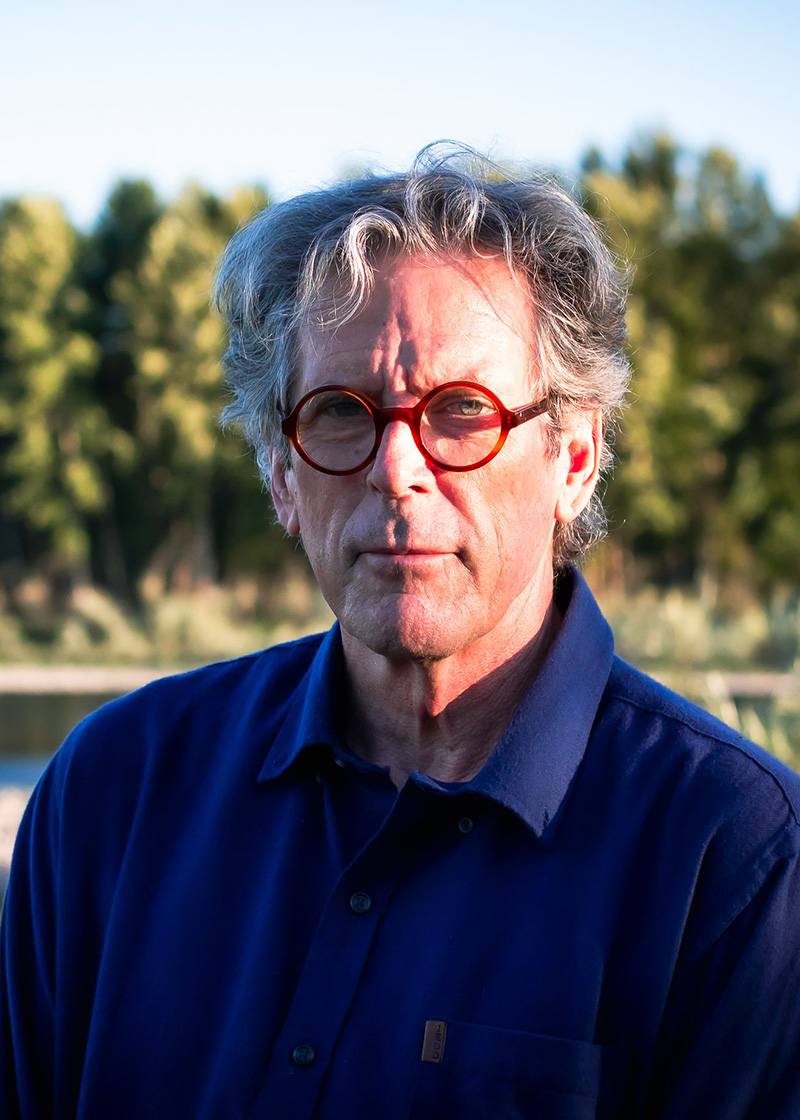
David James Duncan is author of the award-winning novels The River Why and The Brothers K, and most recently, Sun House; the nonfiction collection My Story as Told by Water, which was a finalist for the National Book Award; the best-selling collection of “churchless sermons” God Laughs and Plays; and the story collection River Teeth. His recognitions include three Pacific Northwest Booksellers Awards, two Pushcart Prizes, a Lannan Fellowship, and the American Library Association’s 2004 Award for the Preservation of Intellectual Freedom (with co-author Wendell Berry). David lives on a charming little trout stream in Missoula, Montana, in accord with his late friend Jim Harrison’s advice to finish his life disguised as a creek.
Photographer
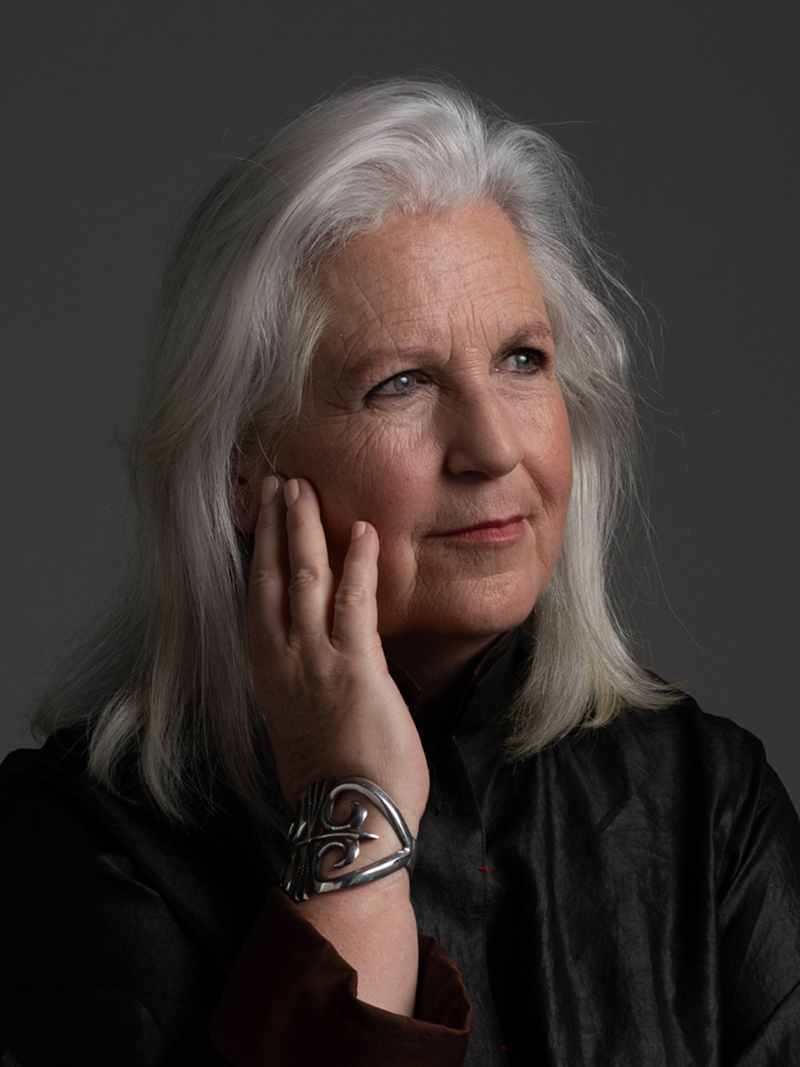
Ron Jude is an American photographer whose work explores memory, identity, and place. His photographs have been widely exhibited internationally and are held in the permanent collections of the George Eastman House; the J. Paul Getty Museum; the Museum of Fine Arts, Houston; and the San Francisco Museum of Modern Art, among others. Jude is the author of twelve books, including Emmett; Lick Creek Line; Lago; Nausea; and 12Hz. He is a professor of art at the University of Oregon.
Drawing upon a lifelong intimacy with the rivers of the Pacific Northwest, David James Duncan improvises a cosmology that ties the universe to deep experiences of place.
I. “The Environment” Is Not the Guardian Holiness
Emergence has invited me to explore, in their words, “spiritual traditions tied to the seasons that have been broken and must be remade.” I chose the above title because I’ve spent seven decades immersed in the ways the Pacific Ocean makes love to the Rocky Mountains, and my title is not a fanciful poetic flourish. Based on my lifelong immersion I’m here to tell you that most of this lovemaking is a literal, mutual, two-way giving and receiving involving thousands of interwoven species of flora and fauna, but the spiritual traditions tied to that interweaving have been very broken by the “free market” delusion that Earth is an infinite “resource” to be exploited for financial gain regardless of the cost to life. My lifelong familiars, the states of Oregon, Washington, Idaho, and Montana, are a tapestry of extremely varied and vulnerable landscapes, weathery forces, living beings, and wild intricacy to which people from all over the world flock like grateful birds simply to see Earth being Earth; see wildness intact; see the beautiful creations of the Divine Female properly known as Sophia—not Rome’s masculinized “Holy Ghost”—dreamt up before our eyes.
We call these landscapes ours, but the Pacific Northwest and Northern Rockies are a web of life-forms and mysteries we did not create, and cannot regenerate once the wild’s ability to sustain life has been savaged. What we currently call “North America” is pre-American and will be post-American, and it is not even vaguely described by the pitiful term “the environment.” If the Bible began with the words “In the beginning God created the environment,” it would be out of print. The lovemaking between the Pacific and the Rockies is a guardian holiness that enables biodiversity to diversify, natural selection to naturally select, and generation after generation of kids to muck around in river shallows playing with frogs, fingerlings, and caddis fly casings, and it is governed not by such creatures as “governors,” but by elemental and celestial harmonies as powerful as Earth’s spinning, yet as delicate as an orb weaver’s dew-bedecked web. These places, forces, and spiritual mysteries, to put it the ancient way, are our Mother; the living terrain her body; the flora her clothes; the lakes, rivers, rills her blood and arteries; the seasons and weathers her moods; the birds, fish, fauna, humans all, equally, her offspring. And every man, woman, and child striving to defend the life and lives she supports—even in poverty and political impotence; even against monstrous power and seemingly hopeless odds—is not only a hero but an integral part of her, hence every bit as holy as she whom they seek to defend.
II. Ceaseless Flow
The Native salmon tribes of the 258,000-square-mile Columbia River Basin did not measure the passing of time with calendars that divide the flow of seasons into linear months, weeks, days, digital minutes, seconds, and nanoseconds. Judging by the tribes’ twelve-thousand-year-old artifacts, surviving languages, and remnant myths and legends, they experienced the flow of seasons by tracking the copious number of fish species that came charging up the rivers of the Basin, affording the tribes and hundreds of other species unsurpassed protein and Omega-3 fatty acids as the vast forests of the same region throve on marine nitrogen distributed over thousands of riparian miles by the salmon-eaters’ scat.
Is it possible for those of us measuring our lives with computer digits and procuring our food at chain supermarkets to track the eternal Now by turning our attention to migratory species arriving by rivers and skies many fossil-fuel-sucking miles from our urban and suburban homes? The answer “Not likely” probably goes without saying. So what can we do to deepen connection to a cosmology based on literal and spiritual life-forms?
In Thoughts in Solitude the great Trappist contemplative, Thomas Merton, put it like this:
Our destiny is to live out what we think, because unless we live what we know, we do not even know it. It is only by making our knowledge part of ourselves, through action, that we enter into the reality that is signified by our concepts…. Living is the constant adjustment of thought to life and life to thought in such a way that we are always growing, always experiencing new things in the old and old things in the new. Thus life is always new.
This is a way of understanding time’s flow that I can get behind. My main method of experiencing new things in the old and old things in the new has been intimately entwined, lifelong, with what began as fishing to catch fish, but long since evolved into friendships with rivers and streams, where the main attraction is intimacy with the hosts of birds, fish, aquatic insects, and riparian flora and fauna that thrive thanks to rivers and creeks. Catching fish has become secondary.
In the last stanza of “Cabin Poem,” my esteemed friend, the poet Jim Harrison, said he yearned to finish his life “disguised as a creek, / an eddy, joining at night the full, / sweet flow, to absorb the sky, / to swallow the heat and cold, the moon / and the stars, to swallow myself / in ceaseless flow.”1 Like Jim, I’ve had hundreds of strange and wonderful encounters with the denizens of creeks, rivers, and riparians over the thousands of days I’ve spent on, and literally in, flowing waters. An uncanny example of “strange and wonderful”: Listening to one of Emmanuel Vaughan-Lee’s talks on Emergence last year, he asked his listeners, referring to the Earth, “How would you walk across a lover’s back?” His question set off wild resonations in me when it summoned from memory how, in my late twenties, to reach my favorite high desert Oregon river from Portland I had to get up in pitch darkness and drive so far that, after just half a day spent fly fishing in desert heat, I’d nap to be rested for when the trout would rise to evening caddis hatches.
After one such nap I woke in the shade of the towering canyon walls and noticed my back felt oddly cool. Sitting up, I removed my shirt—and burst out laughing. Field mice had tiptoed onto my back and eaten a 12-by-18-inch hole in the flannel! What a reply, nearly fifty years later, to Emmanuel’s uncanny question! I’d given the mice the shirt off my back, passing a gift on to their offspring in the selfless way Earth, day and night, gifts us all.
As said, the Native tribes who inhabited this region celebrated the flow of seasons by preparing for precisely which anadromous fishes would next arrive in their customary fishing places. There were a plethora of species and subspecies in the historic Columbia Basin’s dam-free rivers, about which we know almost nothing today. My river-brother, the writer and sage Barry Lopez, tapped into a version of this preparedness during the fifty years he spent observing spawning Chinook salmon on Oregon’s McKenzie River. “The world of variables salmon are alert to, to which they respond, is astonishingly complex,” Barry wrote. “The closer we look the more we see the individual animal is a reflection of the organization of the energy around it. To try to understand the animal apart from its background—except as an imaginative exercise—is to risk the collapse of both.”
To closely witness the Chinooks’ epic migration, redd-building, and total self-sacrifice to create tiny silver offspring is to experience salvific wisdom alive and well in running water; it’s the Pacific making love to mountains before our eyes. Barry felt this so strongly he couldn’t sleep during the McKenzie’s modest fall salmon run if he didn’t first check on the adult Chinook that reproduced in the side channel closest to his home.
Because I’ve known my favorite eight or ten rivers so intimately, I too know what has gone missing from them. Essential Indigenous food traditions have been devastated globally in a multi-century disaster larger than any mind can track. This might be the place to admit that educating one’s wild heart teaches, in the words of William of Saint-Thierry, that “Amor ipse intellectus est, love in itself is already the beginning of knowledge.” But it’s also the place to admit that love for Chinook salmon and orcas in the Columbia River’s compassion-stripped corridor teaches, as the American poet laureate Stanley Kunitz wrote, that in a murderous time / the heart breaks and breaks / and lives by breaking.
III. Streams Cascading Empty Toward Human Realms
So many beautiful things happen in even the smaller streams blessed with runs of salmon and steelhead. In the November creek I lived on near the Oregon coast I have sat, buddha-style, in neoprene waders, watching two otters not twenty feet away share an adult coho’s entire body, discussing its complex flavors in urbane otter chitter. I once fished the headwaters of a coastal salmon and steelhead stream so fog-bound and so seldom visited by humans that a blacktail doe stepped out of the gray a few feet from me, stepped even closer to sniff the tip of my fly rod as if to ascertain whether I was real, strolled fifty feet upstream, gave the same sniff to my fishing partner’s rod, then melted back into the gray. I’ve watched water ouzels stroll the massive, rotting backs of still-living still-spawning Chinooks, singing blithely as they danced upon the salmons’ very death. I’ve watched scores of coho salmon arrive in my home river, spawn for long, exhausting days, then weaken, drift downstream, and die; watched their carcasses hang from branches or flutter from the torn metal of drowned cars; watched them lie inert in the quietest water, turning black for days, white for a few more, before sending out pale clouds of a ghostly green growth that let me see decomposition as a kind of blossoming. I’ve watched swarms of the ghost cohos’ two-inch offspring nibble those blossoms the way the faithful nibble the body of Christ. Like all who worship on salmon rivers, I’ve witnessed in water the death, the resurrection, and the life.
When I moved to Montana in 1993, I became intimate with the longest wild salmon migration route on Earth, and caught and released Idaho salmon and steelhead that had come six hundred miles inland and six thousand feet above the Pacific, climbing the most powerful river of its size in North America with no help from legs or feet.
A dozen years into that fishing I began losing sleep over the spring and summer Chinook that should have been coming home to their high-elevation birth houses on the Montana border, but whose young were being slaughtered annually by a migratory passage chopped into 450 miles of overheated desert reservoirs by eight gigantic dams. For millennia Idaho’s Chinook salmon, born in Columbia and Snake River headwaters, all turned north at the mouth of the Columbia, becoming the main food source of the Puget Sound orcas living fifteen hundred or more miles away. Those orcas still teach their young an ancient word for this largest of salmon species. Orcas literally leap for what a child would call joy as the Interior West’s last few Chinook reach the Sound. But a feeble remnant of formerly abundant salmon is not enough. Extinction now speeds toward the Sound’s dwindling orca pods. If you have not made a study of the grief-shattered orca mother, Tahlequah, who with the help of her pod carried her dead and disintegrating calf a thousand miles through the Salish Sea for seventeen days as millions of people, globally, tracked her sorrow, you have missed a tragedy more poignant than any by the ancient Greeks or Shakespeare.
How to bear the emptiness of the Interior West’s headwaters as they flow all those miles to the starving orcas of Puget Sound? Cormac McCarthy’s novel The Road ends with a staggeringly beautiful description of wild brook trout in a post-apocalypse world that could no longer sustain trout. If Cormac had lived in wild Idaho, his famed final paragraph may have read more like this:
Once wild salmon defined these mountains. You could see them holding in the strong, clear currents, the edges of their fins trembling in the flow. They were wounded silver, massive, muscular, torsional, their ancestral wildness blessing every high-elevation stream. They smelled of ocean in our hands. On their sides gleamed maps of the Pacific in its becoming. On their backs, mazes of the ways by which they’d come. Maps and mazes of things that could not be put back. Not be made right again. In the birth houses where, for eons, they had sacrificed their lives that their kind might live, all things hummed of mysteries older than man.
How to part with creatures so perfectly self-giving? What to pray for as I wander tributaries stripped of their keystone species in just two purblind human generations?
I pray thanks to salmon and steelhead for the treasure it’s been to know their impossible strength via a rod that carried me across the species barrier as I played them. I pray thanks to have held, loved, and released each one. I pray thanks that their lovemaking has for millennia wed mountains to ocean as no other creature’s has, or can, or shall. I pray that, like the speaker of the Gospel words “It is finished,” crucified salmon will one day rise from the dead. I pray their spirits, lifted by tree roots from the riparians, migrate up the trees’ torsos to keep company with owls in the canopies, and with higher mysteries in the canopy of stars. I pray their beauty and self-sacrifice remain so alive in my heart and hands that, even now, spirit salmon will guide me on the shores of what remains:
Streams cascading, empty, toward human realms.2
IV. Other Worlds in This One
Before I submit to the mournfulness of what I’ve written, I confess I feel far less devastated by the havoc being wreaked upon this world when I bear in mind that the world I seem to see daily may not be the only world. I have many times experienced glimpses of what some Tibetan Buddhists call “the view.” In Ani Tenzin Palmo’s Reflections on a Mountain Lake, a wisdom book I’ve carried into the Rockies to add Tibetan resonances to my mountains, she writes,
[W]e are so fixated on things being solid…. But even physics tells us that matter consists mostly of space. The actual solidity here is minute, and maybe that isn’t really solid, either. But we think that the way we perceive things is the way they really are.
There are many layers of perception. Each one of us believes that our way of perceiving is the only way. But that’s not so…. Dilgo Khyentse Rinpoche said that he first started [meditating] when he was eight years old. He saw the walls and all the furniture begin to quiver and become transparent…. [And] the fact is that that kind of perception, seeing things as if they were made of wisdom light, is actually more akin to reality than our normal ways of seeing things as solid…. [W]e have the impure perception which says, “Things are like this, and they couldn’t be like anything else”…. That’s our ignorant mind. Vajrayana [meditation] is trying to align us with the way things really are…. [to get us] closer to the inherent nature of things than our usual perceptions, which is why it can affect us very deeply…. [A]t a very profound level, we recognize it. We know that it is true.
I’ve had many glimpses and dreams of deeper realities and have kept an ongoing spiritual journal about them for decades. In 2008 for example, in the last hour before dawn, I had an enlightenment dream that, when I woke from it, left me feeling that I’d fallen out of my real existence. My waking life now felt like an unenlightened dream from which I try daily to wake, grateful for glimpses of deeper realities that pierce days of “unenlightenment.”
The original dream unfolded like this:
A woman standing at the front of a small classroom has an intelligent and pretty face, a white blouse, dark skirt, dark hair, and I’m concentrating on her so hard that I don’t know whether there are even other students in the room.
Suddenly she says, “Consider this equation.”
Extending her right arm and hand, she points at the air in front of her, and the word “Atom” appears in blue letters, hovering before her as a holograph. In one continuous sentence, which I’ll break into paragraphs to convey what I felt as she spoke, she continues,
“The word ‘Atom’ means ‘I am’...” And I feel a shockwave of bliss.

“And the words ‘I am’ mean ‘The King.’” Another bliss-wave.

“Be that!” she concludes. “Only that!” And the bliss, truth, and simplicity of her equation seizes me so completely that the quotation marks should be removed from the pronoun “I.” I sit in the classroom as The King Himself now, and it seems impossible that I could fall out of this eternal state back into ordinary “I”ness.

But alas, within seconds the classroom, teacher, equation, and King begin atomizing into a mist till I’m lying in a night-blackened bed by a creek in Montana beyond reach of the bliss, truth, and simplicity that just subsumed me.

“Even so,” the now-imperceptible King somehow assures me, “if, come dawn, you remember the world inside your world in which you have been Me, I, the King Himself, will remain closer to you than your inmost thoughts and breath.

“I am the Inmost,” He whispers as He retreats into the eternal world inside my mortal realm, leaving “me” to marvel, which all these years later I continue to do:

“I” am Perfection’s illusory son.

The King in me is the reality.

Every atom means I am.

An equation in the air of a dream classroom once proved it.

Everything in my undreamt Montana world except “Be that!” is illusion, and every day and night is Perfection disguised as a chaos of confusions waiting to stop waiting, and be as Perfect as the days, nights, and atoms truly are.
V. Water Meets Soul
Turning back to how the Pacific makes love to the Rockies, but bearing in mind that I had dreamed something, as Tenzin Palmo contends, much closer to the inherent nature of things than my workaday perceptions, I can’t shake the feeling that, at a profound level, I know this dream to be true.
A related set of intuitions I’ve had in connection with my love for mountains and rivers: Certain mythic things in our world strike me as being so close to omnipotent that I feel they deploy us to achieve their ends, not the other way around. Even the names of these things strike me as so mountainous they generate weather systems, sending forth thunderhead-energies that blast my attempted definitions to pieces.
Soul is such a name. Water is another. And to complicate matters, these two names strike me as profoundly interrelated. Water and soul both link the natural to the supernatural. By “supernatural” I don’t mean the weird, the occult, the unnatural. I mean the inexpressibly natural, which in my fiction I have sometimes called “the extra extra-natural.”
Water links us to the extra-natural because it’s crucial to the creation and continuation of all earthly life, and communes with us through life-forms in an infinite number of ways. Water covers four-fifths of our planet, it pervades all flora and fauna, humans included, and its pervasiveness is reflected in world wisdom traditions and scriptures. As a river worshipper I relish the fact that the word theology occurs nowhere in the concordance of my King James Bible, whereas the words fish and rivers occur 180 times, and the varied forms water can take occur close to a thousand times. I also love it that the primary realm of the gods in Northwest tribal, pre-Christian European, and many other aboriginal mythologies is not celestial: It is submarine. Pre-industrial Finnish, Celtic, Haida, Druidic, and neo-Druidic lovers of wild water didn’t yearn for a “heaven above”: They worshipped a fathomless Ocean hidden inside the oceans of Earth—and within us, if we consider Rumi’s lines, “When the Ocean comes to you as a lover, / Marry her at once for God’s sake!”
Every drop of rain and fresh melted snow shares this oceanic yearning and acts upon it in obedience to the form of love we call gravity, setting out at once in search of ever-greater bodies of water. This is why the spirituality of the Watershed-Aware is so much more holistic, alive, and literally baptized than the spirituality of such people as Baptists. Water, as Henry David Thoreau put it, is “the Earth’s eye; looking into which the beholder measures the depths of his own nature,” and in these depths I sense something so extra-natural about this wondrous liquid, and my essential self, that water strikes me as not just resembling the indweller we call “soul,” but as being powerfully linked to it.
Perhaps my favorite definition of soul is Lord Krishna’s in the Bhagavad Gita. Krishna tells Arjuna: The soul is not born, it does not die. Having been, it will never not be. Unborn, enduring, constant, primordial, it is not killed when the body is killed…. Weapons do not cut it, fire does not burn it, waters do not wet it, wind does not wither it…. Fools pass blindly by it, and of its majesty know nothing. It is nearer than knowing.
Substitute “water” for “soul” and much of Krishna’s definition holds. Water is not killed when the body is killed; it evaporates as a body desiccates, but evaporation isn’t death.
Can fire burn water? Let’s be scientific about this. Extreme heat changes water from liquid to steam that returns to the atmosphere, but changing form is not the same as burning up. Burning is an exothermic, self-propagating oxidation reaction that usually gives off flames. Extreme heat causes water to decompose by reducing its hydrogen atoms to H2, but decomposition is not the same as burning. Is water then “deathless,” like the soul? A tricky question. If our sun eventually becomes a nova, Earth’s waters will become a fleeting cloud of H2 and O and disappear, but disappearance may not be dying.
I’ve seen five streams and rivers firsthand that were pronounced dead, but then sprang back to life once the industrial madness of humans stopped “killing” them. Just this year, in October 2024, Chinook salmon returned to Northern California’s Klamath River less than one month after four dams were removed. In June of 1999 a trout and salmon stream in Bellingham, Washington, Whatcom Creek, was assaulted by 330,000 gallons of gasoline spilled from a broken pipeline. The gas was then accidentally ignited by two boys playing with a bottle rocket, causing an extended explosion that killed the two boys and a young fly-fisher farther downstream, burning the creek deep into its stone substrata, killing every fish, insect, and riparian creature in a single terrible day. Just four years later I waded that same creek, found a plethora of healthy nymphs in its waters, and learned from biologists and friends working on restoration that nearly every life-form the stream formerly supported had already returned.
So could water, like the soul, be unborn and incapable of dying? To possess this eternal attribute water would have to precede creation. Impossible as this sounds, some of our most respected wisdom traditions suggest that water was indeed here before any other describable beings or stories began.
“In the beginning,” say the ancient rishis of India in the Brihadaranyaka Upanishad, “there was nothing here at all…. Death alone covered this completely, for what is nothingness but Death? Then Death thought: ‘Let me equip myself with a body’ (Sanskrit: atma). So Death undertook a liturgical recitation (Sanskrit: arc), and as Death was reciting, water (Sanskrit: ka) suddenly sprang from it. Amazed, Death thought: Recitation caused water to spring from me!” This is what gave the name to and discloses the true nature of recitation (arc-ka). “Recitation is running water.” And we’re back to the wonder-inducing fact that “running water” is hidden in the bodies, breath, words, imagining brains, and beating hearts of every user of human languages. I adore the depth of mystery here. In this ancient account of life’s beginnings, water springs from Nothing before the first body, or anything else, even exists. In this sense it is indeed “unborn.”
And the book of Genesis reinforces this contention. As Genesis has it, “In the beginning, God created the heaven and the earth. And the earth was without form, and void; and darkness was upon the face of the deep. And the Spirit of God moved upon the face of the waters. And God said, ‘Let there be light’: and there was light.”
If we carefully consider this familiar text, it’s not familiar at all: It’s mind-bending! Before the first instant in Time or point in Space from whence the Creator began to fashion our world by letting there be light, Genesis is saying water was already here, already deep, already had a face, and it feels safe to say this face was wet. Is the Bible then declaring that water is the one element the Creator did notcreate, implying that water is as old as, or even coequal to, the Creator herself, latent in the “dark energy” physicists say was here before the universe burst into existence? In water’s solid forms, no two snowflakes or ice crystals are alike. Does this mean water is infinitely creative due to its extra-natural nature? Being unborn, deathless, and primordial, might water be the pellucid “paint” the Unseen Painter uses to place life on the canvas of our entire universe?
Though I can’t answer such questions, I can’t help but marvel at them. My lifelong love of flowing water links me in the most natural way I’ve found to the marvelous, the mysterious, the extra extra-natural, and the Genesis and Upanishad authors and I are far from alone in having noticed this.
“Wisdom begins in wonder,” says Socrates.
“From wonder into wonder, existence opens,” adds Lao Tzu.
To bring all this home to the true nature of a “you” or “me,” when water is so mysterious, essential, and possibly deathless, comprising 60 to 70 percent of our bodies and 75 percent of a brain, continuously flowing between what science calls “different compartments and cell types during physiological and pathophysiological processes,” how scientific is it to define this process as pathophysiological—which means abnormal—when a wondrous extra-natural watershed is flowing through our bodies and brains at all times?
For all I know (and don’t laugh: the watershed in my head is being serious!), it could be the soul’s own autobiography that makes me feel I was once an iota of a life-form floating on the face of dark and silent deeps, when a Voice arose, saying, “Let there be a firmament in the midst of the waters, and let it divide the waters from the waters,” and my iota-self watched the waters swell, roil, and divide till a firmament of heaven burst into being. For all I know, I could be the Alpha and the Omega wading through a literary fly-fisher’s life due to a hilariously low self-esteem problem! For all I know I could be the Almighty Herself, stuck in the throes of a “Hi! My name is David” dream that will one day burst like a bubble in a Bitterroot River foam line, leaving the Creator of the Universe standing, radiant, in Burst-Bubble-David’s place.
VI. Three Improvisations on Seasons and Time
The countless things that fit inside our minds and imaginations do so because they are abstract. Abstraction, in this sense, is highly useful, making memories and knowledge portable, art, science, and stories possible, and music, images, and experiences had by one person able to move through time and space into many persons.
The danger of abstraction is that the matter and life-forms that sustain us are not abstract. Our actions unleash forces latent in abstract concepts into the realm of matter and living forms. If insufficiently faithful to life, abstract concepts can then cause harm. This is why we need cosmologies. Cosmology is creation and abstraction engaged in imaginative negotiation; it is mind, matter, and spirit at play.
When the cosmos speaks to us, it does not use words. We are all involved, daily, in translating creation’s nonverbal messages into abstract thought and language. To live in harmony with other life-forms our translations must be accurate. If, for instance, we flout the cosmologists known as meteorologists and wear shorts and a tank top at ten below, we suffer hypothermia; if we defy the cosmologists known as soil scientists and irrigate with alkaline water, our gardens wither; if we flout the cosmologists who study pollutants and power our cities with coal-fired electricity, we fill the air, clouds, rain, soil, rivers, and foods with mercury, and thousands unnecessarily suffer and die.
Moses was a living man, not an archaic list of dos and don’ts. His cosmology was an ongoing series of creative responses to ever-changing circumstances. But for all his wisdom, Moses had a famously short fuse. When I picture him learning that human industry is spewing so much heat into the atmosphere that we’re destroying both the polar caps and the life-sustaining ocean gyres that give us viable seasons, setting off planet-heating chain reactions that could make Earth uninhabitable to every life-form Moses pronounced “very good” in Genesis, it’s hard to imagine he wouldn’t storm into corporate boardrooms, turn his staff into a wizard’s wand, turn fossil fuel spreadsheets into clouds of locusts, and issue a fresh list of thou-shalt-nots that would leave coal plants, Tar Sands, and runaway internal combustion to be dealt with as the abominations they’ve become.
Informed in part by scripture and tradition, a cosmology is a living relationship between humans and the universe that envelops us, inhaling what’s fresh, exhaling what’s obsolete, cross-pollinating, reasoning, intuiting, imagining, and responding as needed. The best cosmological speculation is therefore more like an improvised Indian raga or American jazz tune than a classical recital. A jazz pianist or sitar player can, on any given occasion, pull trained instincts from their fingers, pull structures from their imagination, and interact with their keys or fretboard to perform extempore music utterly unique to time and place. Shouldn’t the possessor of a viable cosmology be able to do the same?
I live in the extreme upper Columbia River drainage in the Bitterroot Mountains’ rain shadow on a cottonwood- and willow-lined creek between six-thousand-foot pine-covered, fire-vulnerable ridges. We call the current year 2025 and the current season “spring.” Can I extemporaneously pull trained instincts from my fingers and structures from my experience and imagination to produce a series of cosmological improvisations in response to this time and place?
Assignment to self: Find out. Sit down, place fingers on keys, and see if you can improvise three cosmological riffs based on what is materially and spiritually perceptible; what is moving through time and space with me; what I see, hear, touch, smell, dream, and intuit to be true in this ever-changing Season and Time…
Improv I: The Season of Two Seasons
It is March in Montana and the door between winter and spring is swinging violently open and closed. For days a sometimes-gentle, sometimes-brutal southwesterly wind has been breaking over the Bitterroot Range, bringing walls of cloud so towering and dark they look world-ending. But no sooner does each dark wall dump its wintry load than the seasonal door swings back open to spring, an impossibly blue sky breaks out, the snow swiftly melts, birds burst into arias, summer feels just round the corner; and then—tied to the balm like an anti-proverbial March lion to its lamb—the next cloud-wall arrives, briefly hurtling us back an entire season.
Studying this weather after dropping my daughters off at school, I return home, go to my desk to capture what I’ve been seeing, but instead see that after a long winter of writing my study looks as if the schizoid weather has been blasting through indoors.
Grabbing a vacuum and cleaning products, I set out to restore order, but an hour into this work I start to recycle two old magazines (a Time, a National Geographic), open the Time to save a nice grouse feather bookmark, and the page the feather marked stops me in my tracks:
It’s a Hubble Space Telescope photo of clouds in the Orion Nebula, 1,500 light-years away—that’s 10,000,000,000,000,000 miles from Montana and me—and these clouds are made not of ice crystals like the clouds outside, but of superheated hydrogen that lights them up from within. In color they range from orange to gold to rosewood brown, pierced here and there by tiny flares of bright pink. In form they’re flagrantly phallic, reminding me of stalagmites, velvet moose antlers, coral formations, and, begging your pardon, one of the exceedingly odd parts of Everyman. In size, however, the Orion clouds annihilate all earthly analogy: They are six trillion miles long.
There are projections coming off them. Shaped like animal ears, bean sprouts, the antennae of slugs (some artfully tipped by the pink flares), the protuberances are minuscule compared to the masses out of which they grow. Yet even the smallest protrusions, the Hubble astronomers tell us, are as wide as our entire solar system, and even the smallest contain something astounding: stars.
Those piercingly pink flares? Fetal stars, every one of them, caught by the Hubble in the very act of being born. What’s more, the astronomers say, our sun, solar system, Earth, its waters, life-forms, and selves are all the offspring of pink flares such as these and their clouds.
In other words, the Sun, Earth, and us humans are siblings, for we’re all the progeny of these stupendous clouds. Here at my Montana window I’m seated on the lap of an Ancient Sister, enjoying the light of an Ancient Brother, looking as if in a family album at a photo of our Heavenly Father/Mothers, experiencing waves of feeling so paradoxical they make me dizzy. I’m so tiny and short-lived compared to my parent-clouds! Yet I share a progenitive shape with them, I have conceived offspring as have they, and my offspring shine like stars to me.
Improv II: True Wilderness
Recalling why I saved the dusty National Geographic as well, I open it—and am again struck dumb by a Hubble Space photo even grander than the one of the Orion Nebula. To capture this image the Hubble was aimed, the astronomers explain, at one of the darkest parts of space, focused on an interstellar region “the size of a grain of sand held at arm’s length,” and 276 exposures were taken over ten days “to gather as much distant light as possible.” The result is a photograph not of layers of stars, but layers of literally thousands of galaxies in this single image, stretching “as far as the Hubble’s eye can see.”
Feeling my mind bend severely, I circle slowly back through what I’m seeing. Here is a mere speck of our universe, a sand-sized grain of it, yet when a 276-exposure jury turns in its verdict, this grain is seen to contain a vast field of jeweled galaxies glittering in blankness and blackness. The physical gaze of this photo has penetrated so deep it tells a story too vast for thought or word, yet here it sits on a page, speaking a beyond-language of spheres, swirls, colors, light. Even the tiniest points in this image, astronomers say, are not stars but entire galaxies. The light from some, traveling at 186,000 miles per second, takes eleven billion years to reach Earth.
This is what I call a Roadless Area! This is true Wilderness. But how to even partially describe its relationship to Time and Seasons? The number of stars, star-birthing nebula-clouds, solar systems, planets, moons, mineral-forms, life-forms, dead-forms implied by this photo stop my mind and leave me hearing music. If we could look back toward ourselves from some bright point here pictured, our entire Milky Way would be a single shining dot, our sun a nothingness lost in the deeps of that dot, and our Earth and selves a dream within those depths.
Another fact that stuns and consoles me is the realization that Earth is at one not with industrial humanity, but with this photo’s multi-galaxied swirl. Lacking some unthinkable sci-fi miracle such as “warp speed” that would let us travel millions of times faster than light, not a molecule of this vastness will ever be disturbed, colonized, debated, exploited, degraded, or even touched by our too-often insanely manipulative species. Human-caused havoc has knocked our planet terribly out of balance, creating extinctions that throw the evolution of life-forms eons backward in time, but the birthing of stars, cooling of stars into planets, and evolution of planetary life-forms are so inexorable they’ve recovered tremendous biodiversity after all five of the great extinctions we know of. Earth will swirl on. It’s only a self-obsessed species known as “terrestrial humanity” that may not. The wilderness in this photograph contains us the way a shoreless ocean contains a drop. Even at our worst, we’re a negligible jot of darkness in a boundlessness filled with symmetries, mysteries, colors, creations, and heavenly lights.
Improv III: Assailed
On a five-foot shelf within reach of my desk I keep thirty or so books I love so much that their imaginative flights and insights now bleed into my own. Turning from the Hubble photo to this shelf, my eyes alight on Annie Dillard’s For the Time Being as I try to remember words spoken by Annie’s hero, the French paleontologist, priest, and mystic Pierre Teilhard de Chardin, words that once left me hearing the same inward music that spring snow clouds and Hubble images are playing now. I page through Annie’s masterpiece till Teilhard’s words and the inward music mesh:
By means of all created things, without exception, the divine assails us, penetrates us, and molds us. We imagined it as distant and inaccessible, whereas in fact we live steeped in its burning layers.
My God! I whisper as the words somehow reverse the Hubble image, throwing the swirl of galaxies into my interior. I’m covered instantly with goosebumps. It seems an unneeded act of cosmic exhibitionism when, out the window, sunlight bursts forth, finches, crossbills, grosbeaks, and siskins burst into song, and the swirling snowflakes turn blindingly bright.
Turning from snow to the galaxies to embryonic pink stars to a desk photo of my daughters, I am assailed. In the photo my youngest oh so carefully holds a single petal of a living sunflower between her thumb and index finger. The same flower’s blind eye followed the sun across the sky every day last summer, in autumn bowed low, and in winter fed its great eye to the siskins, juncos, and chickadees who repaid the gift by planting black bits of the eye in the snow-softened soil. Tiny green sprouts now unfurl all over the yard. While our sun is burning four million tons of itself per second to enliven this world of bird-sustaining sunflowers and snow, countless agèd suns are exploding like spent blossoms, scattering fragments throughout their solar systems, falling into orbits, becoming planets, as future suns gestate in fiery phallic clouds.
This sunlit snow is a falling Milky Way. The cells of my body are another. We are born of, fed, and assailed by a sacrificial burning. We live steeped in its layers. My daughters’ brown eyes burn so serenely in the photo—yet they burn. The music of Teilhard’s words rises. Tears rise. I turn from stars to sunlight to sunflowers to snow to my children’s faces. I feel us steeping in the sacrificial layers. How gorgeously the Pacific makes love to the Rockies!
I start plundering my journals for quotes to enhance the explosion of feelings assailing me:
Albert Einstein: In the new physics, there is no place for both field and matter, because field is the only reality.
Jalal al-Din Rumi: Out beyond ideas of right-doing and wrong-doing there is a field. I’ll meet you there.
Willigis Jager: There aren’t two kinds of laws: matter and mind. Rather, there is a single continuous law for both matter and mind. Matter is the domain of space in which the field is extremely dense.
Pierre Teilhard de Chardin: Concretely speaking, there is no matter and spirit. There exists only matter that is becoming spirit.
Frederick Sommer: Spirit is the behavior of matter. Perception does not take spiritedness into a state of affairs that does not already have it.
Stephen Hawking: What is it that breathes fire into the equations and makes a universe for them to describe?
St. John of the Cross: The fire! The fire inside!
Julian of Norwich: We shall be tempested, we shall be travailed, we shall be dis-eased, we shall pass through death, but we shall not be overcome, and all manner of wounded and vanished things shall be well.
Thich Nhat Hanh: Tomorrow, I will continue to be. But you will have to be very attentive to see me. I will be a flower, or a leaf. I will be in these forms and I will say hello to you. If you are attentive enough, you will recognize me, and you may greet me. I will be very happy.
Think about it, you who fear the swift passing of seasons out of yearning for an immortal life: the simplest way to begin living forever is to remember you already have!
Reflecting a world where snow no longer arrives, annual migrations fall out of time, yet first blossoms still burst, Seasons, our sixth print edition, moves through three themes: requiem, invitation, and celebration—each a contemplation on the paradoxical ways the seasons now beckon us into intimate relationship.
Sign up to receive our biweekly newsletter, arriving every other Sunday morning. We are an ad and subscription-free magazine committed to sharing stories crafted with care. Join us as we explore the threads connecting ecology, culture, and spirituality.