DURING THEIR LONG WALKS the females are dots on the map, slowly moving across a landscape of dry washes and desert vegetation. In my downtime I like to roll into the tech tent and park beside a watcher.
He might say, “Hey, you want to look in on Adah? Or how about Esther? Esther’s booking it. Esther’s on fire today.”
He’ll click on a dot and a scene will pop up.
The chips on their shells have microcameras programmed for a sequence of angles: close, medium, wide. We tend to see only bunchgrass or a bare stretch of dirt in a close angle, where a medium angle may show us a rusted-out stock tank or the concrete bank of a canal. Once, in a wide angle, we saw three condors feeding on a goat carcass. Watchers gathered around and sent the footage off to Condor Station.
Sometimes we see a dot that remains in place and an unchanging view of a brittlebush waving in the breeze, with its yellow flowers on their delicate but wiry stems. Or a stationary view of the gray skeleton of a fallen cholla, recognizable by its lacework of oblong holes.
This means the old one has died, and after an interval her dot will turn black and fade away.
In former times the female old ones didn’t walk far—mostly it was the males who went to them. These days their walks can last for weeks. A female can walk for so long on her short, stocky legs that she perishes in the pursuit of love.
Scientists don’t call it love when it pertains to other animals: they say mating or breeding, reproduction or propagation. They’re afraid of imputing human emotions to other organisms. So in our funding requests and progress reports we use their words.
But here at the base we use our own. We see emotion as an animal attribute of which we, also animals, partake.
Even if their encounter is only brief, the old ones still wish for love.
Some of us follow the females, though not every female can be followed. Knowing they will starve if the journey stretches on too long, or their bodies will dry out and wither beneath their shells, some of us shadow them and recapture them before they can die. These followers call in a transport when their female becomes too weak and bring her back to the pens and burrows, here at the base, where she can lie low and gather strength.
To fatten them up for brumation we give them the fruits of prickly pear cactus, whose fuchsia flesh covers their brown faces in a bright stain. These fruits, the tunas, are their favorite food. We cook or pickle the pads for ourselves and save the raw tunas for them.
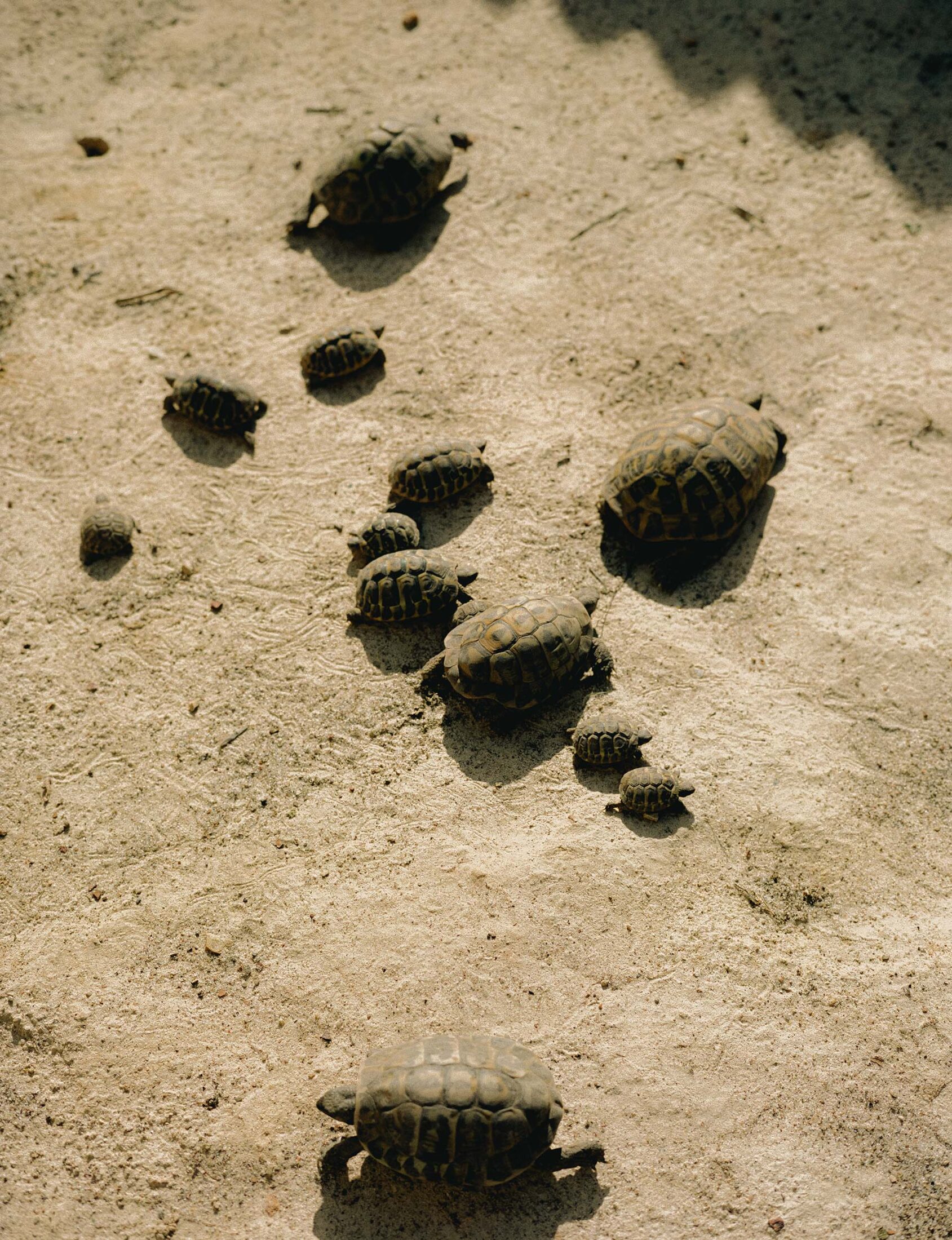
The old ones don’t have chromosomes for sex—their sex is determined by temperature, and the eggs only hatch as males when the soil’s not too hot. But the soil is always too hot, nowadays, so all the wild-born are females. The spread between genders is four degrees Fahrenheit, roughly: above 90.5, it’s all females; between 87 and 90.5, a mix; and below 87, all males.
In former times it was against the law to bring about their union in captivity. It was also illegal to release the captives later, due to the risk of spreading disease. But we have no choice—we have to try. We ask the females to mate with the very few males, respected elders, who live in our enclosures. On the joyous occasion of a successful union we incubate the resulting clutch in our machines. Where the temperature is kept beneath 87.
Sadly such a union is extremely rare. The old ones seldom decide to mate in the spaces we offer them. They cling to the habits they remember, the lifeways they knew in their ancient home.
We keep the male elders, and care for them, in the hopes that one will be introduced to a female who will inspire him. The truth is that none of our male elders has mated in years. The youngest viable clutch hatched over a decade ago: four males, chipped and released at the correct moment, of whom one contracted an undetermined illness and another met with misadventure. In the form of a feral dog.
The dog who ate him was a labradoodle. So here at the base labradoodle has become our expression for dark doings and mayhem.
“Well, that’s a labradoodle,” someone will say, shaking their head at bad news.
Two of those males survive, green dots on the tracking map. Genetically unrelated females are regularly taken to their territories for sorties, and some matings have occurred, but so far no viable eggs have been produced.
Others among us are devoted to the prickly pears, working to keep them alive so that old ones on sorties can forage naturally. In former times four species of this Opuntia cactus were abundant in the wild, growing from the Chihuahuan and Sonoran to the Mojave with their clumps of oval paddles reaching for the sky.
Now, on sprawling farms from Mexico to Africa, they’re raised as a human crop, adapted as they are to dryness and heat.
But in the desert, invasive cactus moths have descended to devour the prickly pears. They lay their eggs inside and the larvae destroy the whole plant. The moths first arrived on the continent far to the east, in what was then south Florida—a wonderland of cypress swamps and Spanish moss, mangroves and rivers of grass, and at the bottom tip a thin string of coral islands. Those were the days of the bonneted bats and salt marsh voles, Everglade snail kites and smalltooth sawfishes and numerous butterflies. Before all of it was covered by the sea.
They were the last days of the Florida panthers, too, whose endling died not from the rising ocean but a car.
From there the moths migrated west.
Some of us who aren’t followers are finders instead. Mothmen, they’re also called, though there are women among them. Moth traps appear as yellow dots on our maps, and when the moths begin to fill the traps mothmen are dispatched from base or redirected from another site. They go to the trap location and scour the cacti and remove all the moths and egg sticks they see, tossing them into crushers by the tens of thousands to halt their advance.
I know a finder who tried to eat the moths, believing it was a sin to let them go to waste. But they’re not pleasant in the mouth, with their feathery, dusty bodies, and he quickly developed a strong gag reflex.
The followers are solitary folk. Some walk with a partner, if they’re committed, but more choose a solo following. When a female sets out on her first mating sortie, usually at the age of about fifteen—either a captive, a found wild female, or one of the semi-wilds we discovered at birth and chipped—a follower will top off his or her pack and set out after her, armed with a wristband and a lightweight tablet for redundancy in case of a mishap or equipment failure. Both the devices show the red dot on the map and the camera view.
Most followers visit their females daily as the journey progresses, catching up with them to ensure they’re all right or to investigate a scene the camera is relaying. This may be an accidental meetup with a person, such as a solar farmer patrolling his panel fields or a wind rancher tending to turbines. More frequently it’ll be a coyote or fox or ravens. Ravens, in recent years, have begun to hunt together more regularly than in former times. They’re highly intelligent and know the strength of numbers. This new group-hunting tactic enables them to attack even mature old ones with hardened shells, where before they only preyed on tender juveniles.
The followers call a raven flock an unkindness. “She met up with an unkindness,” one will text back to us at base. “No harm was done. I dispersed them.”
We have a directive never to hurt the other natives, but we can interrupt their predation.
If a female goes too near a road and appears to be on a course to intersect, a follower has to step in. This is risky because if he can’t deter her by blocking, and has to pick her up, she may startle and release nearly all of her water. When that happens the follower has to bring her back to base. Near the beginning of her sortie she may be able to rehydrate and go out again, but near the end of the season she will have to wait.
The followers hate roads.
Mothmen travel in packs, and while the followers stay silent, the finder bands are noisy. They play music in their encampments and sing ballads about lonesome cowboys, engage in contests of strength and wrestling. Theirs is a warlike attitude—they consider themselves soldiers, mobilized in defense of the unmoving. They yell out strings of curses as they work, each trying to outdo the others in filthiness, and between sites march along to army cadences.
We see the videos they post of the moth purges or marches overlaid with the soundtrack of their chanting. They say that in the army the chicken’s mighty fine, one jumped off of the table and started marking time! Up in the morning, out of bed. Do some stretches, hit the head!
Or they’ll call out a foolish one they make up themselves, on the fly: Another day another purge! Man oh man we feel the urge! We fight we fight the cactus blight! A plant can’t walk so we talk and rock!
Without these rituals—they do not say but the rest of us know—their job would be too depressing. For even the moths would prefer to live.
I’m a feeder, myself—I can’t travel overland in my chair. It has rugged tires and my arms are muscular, but followers and finders have to navigate mountain passes, scree-covered slopes, and the loose sand of washes. And even if I didn’t use a chair, I wouldn’t be drawn to a hiking regimen. I enjoy the hominess of the base, its orange lights at nighttime, the comfort of shade and cool water to drink and the gravity showers. I rely on the steady rhythm of arrivals and departures and calm twilights over the familiar ridgeline. I know all the followers, even the newest ones on staff, and all the mothmen and their bands, their slogans and tattoos.
Sometimes the finder groups will shift, after a dispute or breakup, and one of them will confide in me. The warlike energy brings drama to the bands.
I have duties other than feeding the old ones, such as laundry and keeping track of food shipments and various other logistics, but feeding is why I’m here.
If a female old one finds a wild mate, her follower is celebrated on their return. Festivities are held. It may take weeks for a clutch to be laid, or no clutch may be laid at all, but after the union the follower either chips the wild male or, if his home territory is deemed high-risk, brings him back. At first, after the trauma of transport and newly captive, the wild males don’t want to mate again. Male old ones are more frightened by relocation than females. Over time one may master his fear, but if he doesn’t he’s chipped and re-released. For that he needs to be taken back to his territory, and this second transport may traumatize him further.
It astonishes me how swiftly the old ones’ pheromones seem to have adapted and grown more powerful. In former times they didn’t range more than a mile or two from their birthplace. Nonmigratory, they were classed. And females didn’t do the seeking.
Now almost every female is willing to travel. For dozens of miles in a season.
Last week a momentous event took place: a female named Bethel found a sequestered male in private captivity. He was living as the pet of an elderly woman, in a pen outside her rural trailer.
There was a fence between Bethel and the captive male, however, so her follower, Tomás, knocked on the trailer door.
The woman opened it holding a rifle.
Tomás stepped back with his arms raised and carefully described the situation.
“Huh,” she said. “Well, I’m gonna need to get paid. If Sheldon’s being used for stud.”
“I am empowered to offer you significant compensation,” said Tomás, reciting from his memorized script.
Inwardly he was sickened, as much by the crass word stud as by the demand for money. But he sat down with the woman on her front stoop—she did not invite him in—and showed her the map of hundreds of red dots, along with the six green ones that currently exist. He explained how painstakingly Bethel had traveled all those miles and appealed to the woman’s sympathies, making his pitch for the monitoring of the male and the schedule for health checks and visitation.
To which she finally agreed.
Our protocols allow for involuntary seizure but the better alternative, by far, is to leave a rogue male in his preexisting habitat, avoiding the trauma of relocation and setting him up for return visits from multiple females.
Of course the old one is not the rogue: rather the rogue is his captor, keeping him separate from all others of his species and thus unable to help prolong their existence.
A previously sequestered male, if he can be chipped and kept safe, is a precious treasure.
That night Tomás bivouacked in the woman’s yard while the old ones mated inside the enclosure.
But when the transport arrived in the morning to take him and Bethel back to base, the woman announced she wanted to revise the deal they’d settled on. Toward greater profitability for her.
“How about this,” suggested Tomás. “A specialist will be in touch. To handle further negotiations. Heck, this contract stuff is way above my pay grade. You know—I’m just a lay biologist. A herpetologist. Herp guys, they call us. Or herp gals.”
“Fine,” said the woman. “But you better make it soon. I have a contact in Texas who’d love to buy Sheldon. She has some rare snakes, too. And she’s willing to pay top dollar.”
“I see,” said Tomás. “Well, it does sound like you need a specialist.”
He did not mention that the specialists, like the elderly woman, carry firearms. Though they rarely use them.
Still, she wouldn’t enjoy her meeting with the specialist. Even I don’t enjoy meeting with specialists. And I’m not harboring a sequestered male.
The specialists are given deference but avoided, socially. They move through base camp leaving a wake—followers, finders, and feeders fade into the background as they pass. They specialize in compliance, not disappearing life forms, and are in high demand. So they never stay put for more than a night or two. They’ll get called away by a forest manager or a tribal river guardian. Or frequently they respond to calls from Condor Station, when a deer hunter is caught using illegal lead bullets. They travel to Wolf Station in New Mexico, Jaguarundi Station down in Hermosillo, Pronghorn Station or the large Multispecies Station outside San Diego that used to be a zoo.
Or Colorado River Toad Station, which has to contend with the licker market. Users of bufotoxin are known as “lickers” even though they don’t lick toads directly—this can cause cardiac arrest. Rather they milk them for their poison and dry it out to be smoked. Lickers claim that the toads are sacred to them but refuse to accept synthetic substitutes. In their ceremonies, they say, they experience a sublime euphoria. They behold God and come away with calmer hearts.
Meanwhile the toads’ population dwindles.
When Tomás and Bethel reached us, and he told us all the story in his celebration speech, no specialist was present, so one was alerted by text—we have to book specialists hastily when we need one. The potential buyer in Texas was a dubious claim, but empty threat or not, “Texas” isn’t a word we like to hear. Texas is a synonym for death: once an animal goes to Texas, that animal does not return.
Texas is not a party to the Agreement.
It was as the celebration was starting to wind down, and the sky was turning a deep indigo, that the caravan arrived.
We hadn’t been given any heads-up. The station chief, who was sitting at my and Tomás’s table under the big tent taking sips from his festive glass of wine, got a voice call—from gate security, as it turned out.
He stood up, seeming flustered, and gestured impatiently for someone to turn off the music. Then he removed his hat.
The station chief isn’t in the habit of removing his hat. His head is bald and pink and his wife, who lives with him in the management cabin, doesn’t like him to expose it to the sun—after years of constant rebukes he’s decided it’s easier to keep the hat on all the time, more or less. Even when there’s no sun around.
We all call him the Egg. It’s a term of endearment and he considers it a compliment: eggs are our Holy Grail.
Over the door of the cabin he shares with his wife hangs a sign we made. “The Nest.”
“Announcement!” he said. “An important visitor is arriving, I’m told. A dignitary. In from the capital.”
“The capital of what?” asked Ron. He’s a finder and had been dancing in a freewheeling, spinning style when the music stopped. Now he stood in the middle of the floor holding a beer bottle. He wore only a pair of baggy shorts, bearing a Hawaiian print, and flip-flops. Ron takes any opportunity to remove his shirt. He’s proud of his torso ink, a jungle-like mass of colorful extinct plants. In Memoriam, proclaims his chest in a flowery script.
“The whole shebang,” said the Egg.
He was distracted, craning his neck to see past Ron to the distant front gate. Where a line of headlights had become visible, wending its way toward us in the gloaming.
“What kind of shebang?” asked Ron. “There’s a shit-ton of shebangs.”
“You better put your shirt back on,” said the Egg. “That kind of shebang. Anyone else around half-naked? If so, get fully dressed ASAP. For the love of Pete!”
Ron flip-flopped over to his table, put down his beer, and grudgingly lifted his T-shirt off the back of his chair.
By then the line of cars was parking, one beside the other, in a neat row along the leading edge of the parking zone. The Egg came around his table and walked in their direction, weaving along the paths between the cabins and enclosures and bathroom outbuildings with the rest of us behind him.
We don’t get a lot of dignitaries here.
I took up the rear: my arms were sore from folding. It had been a laundry day. So all I could see, at first, were the legs and lower backs in front of me.
I heard a low murmur of surprise as—I assumed—the dignitary exited a vehicle.
“No way!” exclaimed a follower beside me.
“Who is it?” I hissed.
“No fucking way,” muttered Ron on my other side.
That was irritating.
He was still bare-chested, with his T-shirt slung over his shoulder. His mouth hung slightly open.
People were talking up at the front of the crowd and maybe shaking hands. I heard someone laugh politely. Near me whispers rustled.
I grabbed his arm.
“Ron. Tell me who it is,” I insisted.
“It’s the chief.”
“I meant, who’s the dignitary?”
“The chief! The big chief. The chief of the whole Service.”
“Director Douglass?”
She’d never made an appearance at our station. And the last time she’d showed up at the Multispecies it had been for a grief ceremony after an endling frog died.
My first feeling was fear. It made my stomach lurch. Maybe we were losing some of our funding. Or the water allocation had been cut.
“Looks older than I thought she would,” mused Ron.
“Put your shirt on. Seriously. Before she sees you.”
“Fine,” he grumbled, and pulled it over his head. “Oh, hey. She’s got her kid with her. The one with the syndrome! That synesthesia thing. She’s introducing him to the Egg.”
“He’s her only kid. So you don’t have to say ‘the one with the syndrome.’”
“Whatever.”
“Good people!” came the Egg’s voice from up front. “As you can see, we have Director Douglass with us tonight. A great and unexpected honor. Let’s give her a warm welcome. Mourning Dove Douglass, ladies and gentlemen.”
Clapping.
“Thank you,” said the director. “Thank you very much. It’s an honor for me, too. This is my son, Bright Holding. He goes by Hold.”
“Hi everyone,” came a child’s voice. “Can I see an old one now?”
“We’re headed for Delta Station,” said the director. “To meet with the Cocopah riverkeepers. It’s been a long trip. But Hold is fond of the old ones. And he’s only ever seen them in videos. I said, Why don’t we make a quick stop? So it’s just a personal visit. Say anything you like—I won’t be using my scribe.”
“Well, we better get to it, then,” said the Egg. “You never know who’ll be outside a burrow at this hour.”
“Cre-pus-cu-lar,” piped up the child’s thin voice.
His voice was drowned out as the group started moving. I had an advantage, though—the back of the crowd had turned into the front. I spotted Bethel in the G enclosure, as a motion-sensitive light snapped on, and rolled up to the low wall.
In the center of the enclosure she was wolfing down tunas.
Behind me people cleared a path, and then Hold and the director were beside me, along with the Egg. And Tomás.
“This is Bethel,” I told the boy. He was smiling. “Tomás brought her back to base today. We’re very excited about her. Because she may lay eggs.”
“Eggs!” said the director. “How wonderful. Then we’ll have new old ones, Hold. Baby old ones that are boys.”
“What it’s all about,” nodded the Egg.
“Her shell is so dusty,” said Hold. “And she’s so brown.”
“She’s really brown,” I agreed. “I sometimes think the old ones are the brown of rocks and mesquite bark and desert willows. Like they all came out the same brown because they’ve lived together for so long. So it’s the brown of time.”
“The brown of time,” repeated Hold.
“Sorry. That doesn’t make much sense,” I amended.
“Yeah it does,” said Hold. He was still smiling. “Totally! There’s the brown of time and the green of time. Those are the colors of time.”
“What about blue?” asked the director, with a tender pat to his shoulder. “Like the ocean? Or the Earth from outer space?”
He shook his head. “Blue’s an excellent color. But not the color of time.”
The director winked at me.
“I’d let you touch her shell,” Tomás said to Hold, “but when people touch her, it can be upsetting. And she was just relocated. So she’s been touched a lot today. Already the maximum.”
“She’s already been touched the maximum,” echoed Hold.
“But you can touch another old one, maybe.”
“It’s OK,” said Hold. “I don’t need to touch. I can hear the shape.”
The syndrome, mouthed the director behind him.
“See?” said the boy. “Look!”
Suddenly he dropped to the ground and bent himself into a hump beside my right wheel. I had a close-up view, and it was strange: I wouldn’t have thought he could do it. Or that anyone could. I can’t say what the contortion was, exactly—how he shaped his body in such a precise mimicry.
But damned if he didn’t capture the essence of an old one. For a fleeting second.
Then he was up again, sand and pebbles on the knees of his pants.
He didn’t bother to brush them off.
“I tell you what,” said the director to the Egg. “Why don’t you give me the tour. And Hold can stay here for a bit.”
“Happy to.”
She moved past her son, who was leaning against the low wall gazing at Bethel, and looked me in the eyes.
“Would you mind watching him? Say, half an hour?”
“Not at all.”
I gave her my name and my job title, and we shook.
“OK,” she said. “You’re in good hands, Hold.”
Then she and the Egg and Tomás moved off, drawing the crowd after them.
Hold and I stayed quiet for a while. He was patient, watching the old one—a patient, smiling boy.
Bethel had a fuchsia beak. And neck and front feet.
“She’s a messy eater,” I said.
“I’m a messy eater.”
“As soon as she stops eating,” I said, “try talking to her and see what happens.”
The old ones have excellent hearing. We don’t play loud music, even when we dance at celebrations, so as not to disturb them. This is one reason the finders get rowdy out on their moth runs.
I told him about the prickly pears and the finders and moths. And at last Bethel seemed satisfied. She ignored the last tunas in her pile and began to move sluggishly toward her burrow.
“Wait! Don’t go in yet, Bethel,” said Hold. “Stay out till I have to go back in the car. Pretty please.”
She paused and turned herself in our direction.
“Whoa!” said Hold. “Magic! It’s like she understood me!”
“They respond to the sound of voices,” I said. “They’re curious. Just keep talking. It doesn’t matter what you say.”
“Old ones don’t stay with their eggs,” he said as she neared us.
“No,” I agreed. “But here at the base, that comes in handy. We can go in and collect the eggs and put them in an incubator and she won’t mind at all. She may even lay another clutch.”
“They work so hard to lay them and then they just go away,” said Hold. “Anything could happen. They leave it up to the world.”
Bethel had made it to the bottom of the low wall. She stood up on her back feet, scrabbling her front ones against the wall and reaching her head up toward us, and Hold bent over and stared at her face.
“In former days,” I said, “they could trust the world. They lost plenty of eggs to skunks and snakes and birds, but enough survived. Because here they are.”
“They could trust the world for a long time,” said Hold.
“Their ancestors came here from Asia over thirty million years ago. And these particular animals, some paleoecologists say, may have existed for five million years. There might have been some tunas around then for them to eat. Prickly pears go back five million years too.”
“That’s long.”
“Well, the oldest Gopherus agassizii fossils we’ve found are from the Pleistocene. But that’s still a hundred and fifty thousand years.”
“Now they can’t trust the world anymore. So they have to trust us,” said Hold.
“I guess they do.”
“You can trust us,” he told Bethel, and turned to me. “She can trust us, right?”
“We do our best.”
“Is it enough?”
“Ah. Only time will tell.”
“Brown and green will tell.”
“There you go.”
After Bethel ambled into her burrow, we had a few minutes left and I didn’t think we should try moving to another enclosure. The director might not be able to find us right away. She might get nervous.
“Tell me this. How come green’s a color of time but blue isn’t?”
“It’s hard to explain.”
“I bet.”
“It’s like, brown smells old and green smells new, but they’re both time.”
“So what does blue smell like?”
“I love blue. Blue smells sweet. But not like time. Just life. Or wait. More like possibility. Wherever there’s blue, there’s possibility.”
“Is it tough, sometimes? To be smelling colors? And hearing shapes? When most people don’t?”
“It’s just how it’s always been. Only explaining it is hard.”
“Sorry I asked. People must ask a lot.”
“It’s OK. I mean, you being in your chair—if someone else isn’t in a chair they can’t feel how it is. No matter what you say. Right?”
“That’s true.”
“The words mean different things. At least, the words for senses. The sense verbs, my mom says. And if words mean different things to other people, they don’t get it when you say them.”
“But isn’t it frustrating?”
He shrugged. “Only if you worry too much. You have to let it go.”
“I guess I do that too. With being in the chair.”
“Or with the old ones. We can’t be them. We can try to imagine. But we can never know. But it’s OK. Because their world is still there. Outside and inside ours. It’s a secret kingdom.”
The director came striding back along the path, the Egg’s wife by her side and two bodyguards in uniforms with guns and tasers in their belt holsters.
The Egg’s wife held out a packet of cookies.
“For the road,” she said to Hold. “I baked them myself. Chocolate chip.”
“Excuse me. I’ll take those,” said one of the bodyguards, and intercepted the packet.
“Just a standard precaution,” said the director apologetically.
“Oh,” said the Egg’s wife. “Of course.”
They said their goodbyes and headed off toward the parking zone.
Hold turned and waved at me as they went, still smiling.
“Goodness,” said the Egg’s wife when they were out of earshot. She shook her head. “They have to screen cookies?”
“She does get threats,” I said. Recalling the media reports.
“I suppose.”
“And … was it just a personal visit?” I asked. “Or was there bad news? I heard there could be water cuts in the offing.”
“No bad news,” she said. “But get this. I heard, from a friend at Ocelot, that she brings the child with her as a litmus test.”
“A litmus test?”
“If he likes the personnel, she’s reassured. If he’s on the fence, she finds a pretext, sticks around, and observes. And at that point, major staff reshuffles can come down.”
“Oh!”
“So congratulations are in order. You must have done all right.”
After the caravan had turned into taillights and been swallowed by the night, I stopped at an outbuilding to wash my face and brush my teeth. Back in my tent, on my cot, I took off my work smock and pulled on my nightgown. I smoothed an analgesic gel onto my aching arms and lay down on my back, gazing up into the dark.
Black, I wondered. How does black smell?
It smelled of my pillowcase, right then—the artificial lavender of our bulk detergent. It smelled like the aloe gel on my arms, the lotion on my face, and the minty residue of toothpaste in my mouth.
All smells are the smell of time, I thought, drifting off to sleep. Time flowing past me. Or me flowing through time.
And now is the time of waiting. We wait to see whether a clutch is laid. And if it is, wait again. To see whether the eggs are viable.
Wait, also, to hear whether the specialist is able to persuade the elderly woman to keep her old one where he is, healthy, stable of mood, secure in his routine, and available to females. Rather than ordering in a care team and commandeering both the pen and the property.
Or—if the woman tries to resist with force—falling back on the last resort of direct seizure, which would make our hearts sink. Since it would, almost surely, result in another relocated male too traumatized for love.
We watch and feed and follow. Meanwhile a new influx of moths has begun and mothmen are once again dispersing across the land. Yelling out their cadences as they march past derelict gas stations and mining shacks and through the ghost forests of Joshua trees.