Sandor Ellix Katz is a fermentation revivalist and self-taught experimentalist who lives in rural Tennessee. He is the author of several books, including Fermentation as Metaphor; Wild Fermentation; and The Art of Fermentation, which won the James Beard Award and was recognized by The New York Times as one of “The 25 Most Influential Cookbooks from the Last 100 Years.” His latest book is Fermentation: A Natural History. He and his work have appeared on NPR’s Fresh Air with Terry Gross, The New Yorker, The New York Times, The Guardian, PBS, The Washington Post, and The Financial Times. Sandor was awarded the Craig Claiborne Lifetime Achievement Award from the Southern Foodways Alliance. He teaches workshops globally helping people reclaim the tradition of fermentation.
Sharing recipes and a passion for the pickled, Sandor Ellix Katz revives practices of fermentation into a living seasonal tradition we can easily participate in.
I GREW UP EATING SAUERKRAUT on street vendor hotdogs and loved it as a salty, sour, juicy condiment. Little did I know how important sauerkraut was as a survival food, enabling people in temperate climates with long winters to survive by providing them with a stable and reliable source of vitamin C. Yet I vaguely understood that sauerkraut had something to do with preserving cabbage and found a recipe in the cookbook ubiquitous in twentieth-century American kitchens: The Joy of Cooking. I couldn’t quite believe how straightforward the process was: Shred cabbage; lightly salt and gently massage the cabbage until it gets juicy; add seasonings if desired; then stuff the juicy salted cabbage into a crock or jars until it is submerged under its own juices; and wait while bacteria on the cabbage ferment carbohydrates into acids, which preserve it and protect it from pathogens.
Once I made that first batch of sauerkraut, I started experimenting and learned that I could ferment almost any firm vegetable or combination of firm vegetables in the same way; I could do it with less salt or more; I could shred finely, chop coarsely, or even leave vegetables whole; and I could season the vegetables any way I like. Since that first batch more than thirty years ago, I’ve had kraut going continuously and eaten it with almost every meal (even breakfast).
Wherever you live, and wherever your ancestors came from, fermentation is part of your cultural legacy; it’s as integral to how people everywhere use food as cooking and drying. Yet most of us have become removed from the cycles of growing foods and fearful of traditional processes such as fermentation that transform them. Do not let the “war on bacteria” scare you into believing that fermentation requires microscopes, laboratories, and specialized knowledge! Disparate fermentation processes were developed hundreds and thousands of years ago, with tools much more limited than those found in any contemporary kitchen. Consider this an invitation to celebrate the seasons by developing an annual fermentation practice in your kitchen.
WHERE I LIVE IN TENNESSEE, early spring brings tender young asparagus shoots and luscious juicy strawberries; in high summer you’ll find tomatoes and okra; and in autumn, hearty root vegetables. Though our globalized economy has promised transcendence from the limitations of geography and season—for instance, tomatoes available on demand, all year round—it cannot alter the inherent specificity of food production: what grows where, and when. Fermentation has been used for ages as a strategy for preserving seasonal abundance, catching foods at their ripest and most flavorful, so they can be enjoyed throughout the year.
Wine, for example, is fermented from fresh, ripe grapes and is generally made near where the grapes are grown. There is great variability from place to place, and season to season, in terms of soil, topography, and climate, which affects the growth and specific qualities of the grapes, as well as the microorganisms and conditions of fermentation. After the fermentation, wine can be aged and stored for long periods, but it is not something that can be made at any time. The same can be said for cider fermented from pressed apples, or any fruit-based alcohol. (In contrast, beer and other alcohol based upon grains—which are dry at harvest and can be stored for many months—can be fermented later, as needed.)
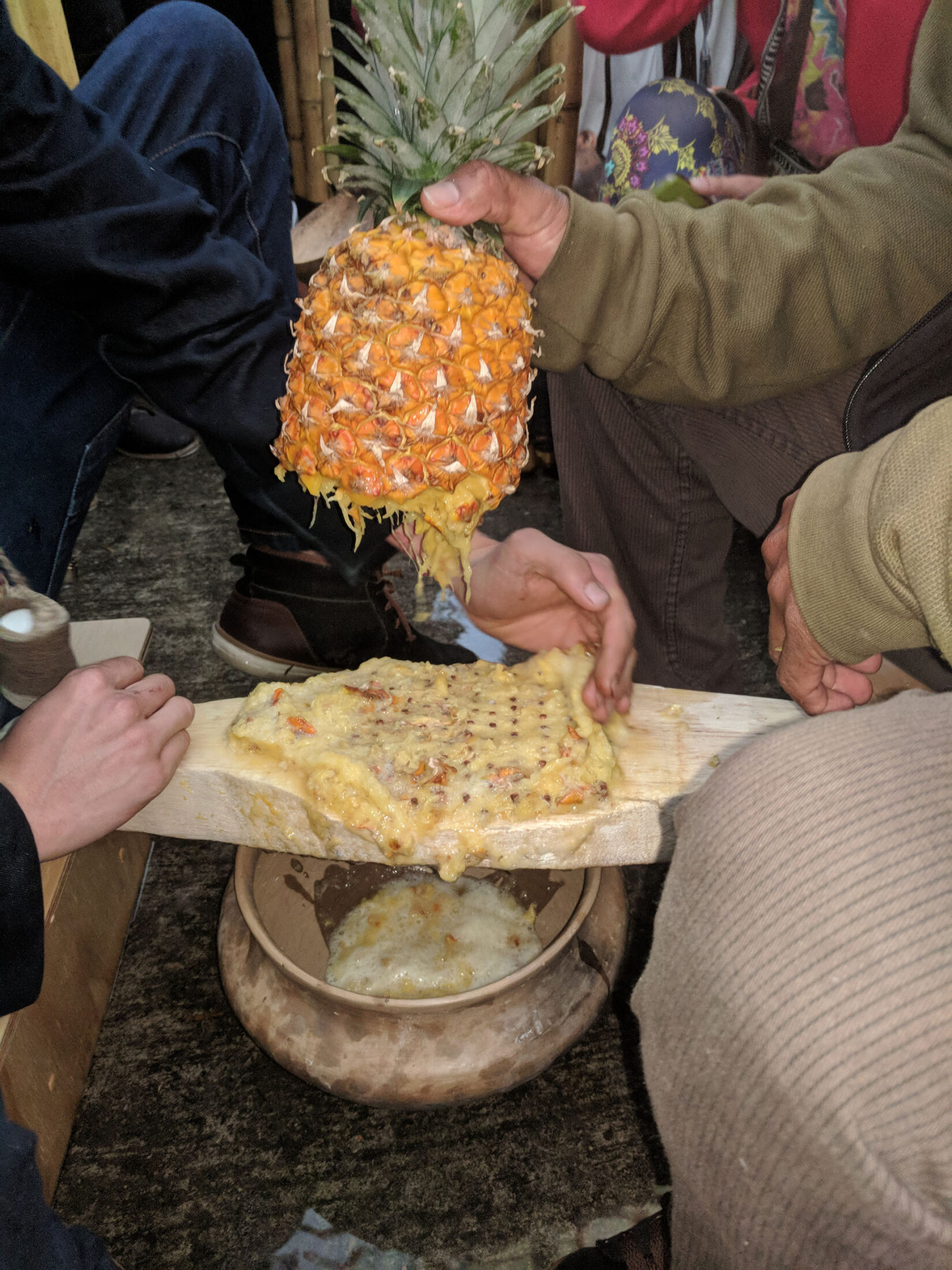
Many ferments are little known beyond the places where they are made. In Colombia, I tried a fizzy, delicious lightly fermented pineapple beverage called guarapo de piña, made by a man named Pacho, who belongs to an Indigenous Amazon group called the Matapi. He demonstrated how he makes the guarapo, and it is deceptively simple. Pacho grates ripe pineapples (skin and all), and lets the mash spontaneously ferment, meaning it ferments without added starters or intervention, driven by yeasts and bacteria indigenous to the pineapple itself. The fermentation requires just a day or two in the tropical heat, then Pacho strains the liquid and serves it. Guarapo de piña requires an abundance of pineapples, and it is made only where they grow and in the season when they are most abundant. Interestingly, in the Matapi culture guarapo de piña plays an important role in an annual ceremony marking the passage of the seasons and celebrating reciprocity with other life-forms. For days, participants dance and sing, foregoing all food and beverage except for guarapo de piña. As my Colombian host Esteban Yepes Montoya explained it to me, this brings them into a trance state, in which they “surrender to the here and now of the season” and “bow to the sacred essence of the pineapple.”
Another approach I’ve encountered for fermenting pineapples is perhaps more suitable for those of us living far from where pineapples grow: Mexican tepache, made from the skins and cores, the parts typically discarded when you eat a pineapple. Tepache exemplifies the potential to apply fermentation as a strategy to reduce and make use of food waste. Flavor, sugar, and acidity in the pineapple flesh that is inevitably cut away with the skin are infused into a sugar-water solution, as microbes in the skin begin to ferment it. Tepache is pretty straightforward to make and takes just a few days, so try it the next time you eat a pineapple!
Photo by Sandor Katz
TEPACHE
Tepache is a wonderful, effervescent, lightly fermented pineapple beverage popular in Mexico. It is made from the skin and core of a pineapple; so you can enjoy the pineapple flesh while it’s fresh and also make use of the parts you would typically discard to enjoy it over a longer period of time.
Timeframe:
· 2–5 days
Vessel:
· Wide-mouth vessel of at least ½-gallon / 2-liter capacity
Ingredients (for about 1 quart / 1 liter):
· ½ cup / 100 grams sugar, or more, to taste (ideally piloncillo, panela, or another unrefined sugar, but any type of sugar will work)
· Skin and core of 1 pineapple (eat the rest!) cut into 1- to 2-inch / 3- to 5-centimeter pieces
· 1 cinnamon stick and/or a few whole cloves and/or other spices (optional)
Process:
· Dissolve the sugar in about 1 cup / 250 milliliters of water.
· Place the pineapple skin and core and optional spices into the vessel.
· Pour the sugar water over the pineapple, then add additional water as needed to cover the pineapple.
· Cover with a loose lid or cloth and stir daily.
· Ferment for 2 to 5 days, depending upon temperature and desired level of fermentation. It will get fizzy, then develop a pronounced sourness after a few days.
· Taste each day after the first few to evaluate developing flavor.
· Strain out the solids.
· Enjoy fresh or refrigerate for up to a couple of weeks.
· If it gets too sour, do not despair! After straining out the solids, leave it with the surface exposed to the air, and it will become pineapple vinegar after a week or two.
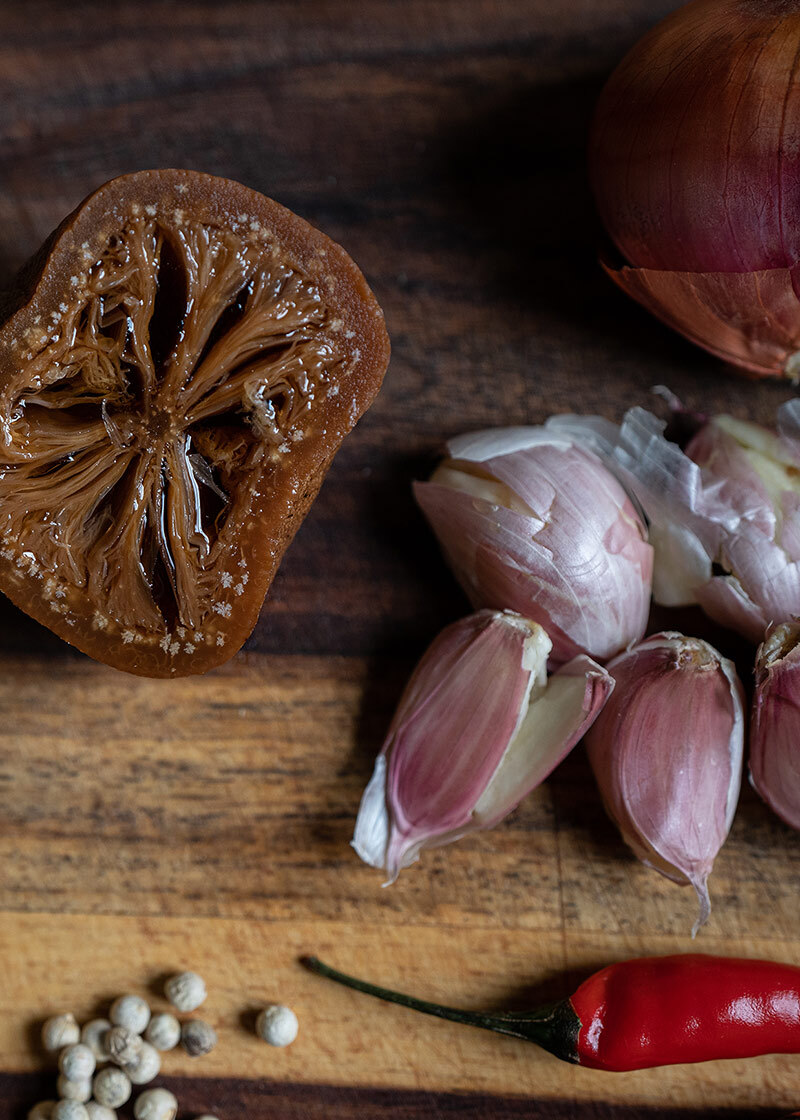
GROWING UP IN NEW YORK CITY, the fermented food I loved as a kid was pickles—fermented cucumbers—though I couldn’t have told you back then that they were fermented. My grandparents and great-grandparents came to New York from Belarus and Lithuania, and the pickles that my family ate (not homemade but bought from a delicatessen) were the Eastern European style: cucumbers fermented with garlic and dill. We knew these pickles as “sour” or “half-sour,” depending on the intensity of their acidity, which I later came to understand as an expression of time. The longer the cucumbers ferment, the more lactic acid is produced.
It turns out that cucumbers can be among the most challenging vegetables to ferment. Cucumbers and other watery hot-weather vegetables, such as summer squash, have high concentrations of enzymes that break down the pectin that makes vegetables crispy and crunchy. Many of the fermentation traditions used to preserve cucumbers come from places with relatively mild summers, like Belarus and Lithuania. In hot environments, it’s easy for fermented cucumbers to get soft and mushy; and nobody likes a mushy pickle! I’ve learned a number of techniques to help keep pickles crunchy, and I’m happy to report that despite the intensely hot summers where I live in Tennessee, I’ve learned to make consistently crunchy pickles.
SOUR PICKLES
Timeframe:
· About 2 weeks
Vessel:
· 1-liter jar (or for larger batches a larger jar, ceramic crock, or small wooden barrel)
Ingredients (for 1 liter):
· 500 grams small unwaxed pickling cucumbers, the fresher the better
· 25 grams sea salt, about 1½ tablespoons
· 1 or 2 heads fresh flowering dill, or 1–2 tablespoons dill seeds
· Prepare the cucumbers. Rinse the cucumbers, taking care to not bruise them and making sure their blossoms are removed. Scrape off any remains at the blossom end. If you’re using cucumbers that aren’t fresh off the vine that day, soak them for at least a half hour in ice water to freshen them.
· Mix the brine. Dissolve the sea salt in 500 milliliters of dechlorinated water to create a brine solution. Stir until the salt is thoroughly dissolved. Use sufficient salt, as the salt slows the enzymes that break down pectin.
· Fill the vessel. Clean the vessel, then at the bottom of it place dill, garlic, peppercorns, and fresh grape leaves (or other tannin-rich leaves; the tannins also slow down the enzymes). Pack whole cucumbers in the vessel, tightly to help them remain submerged under the brine.
· Add the brine. If the brine doesn’t cover the cucumbers, add more brine mixed at the same ratio. If the cucumbers are floating at the surface, an easy solution is to cut a chunk of a bigger cucumber to hold the others down, or cut the lid of a plastic food container so it’s just a little bigger than the mouth of the jar and squeeze it in, using it to hold the cucumbers submerged. If you’re using a crock, use a plate to weigh down the cucumbers and cover it with a cloth to keep out dust and flies. If using a jar, loosely seal the jar with its lid.
· Ferment. Leave the pickles to ferment until the color of the cucumbers changes from bright green to a duller olive green. Sourness will develop over time, how fast depending primarily upon temperature. These pickles are traditional mostly in places with cool summers, enabling long fermentation times and long-term preservation. The process can be adapted to warmer locales or shifting climate patterns with the help of refrigeration. If your kitchen is hot, transfer pickles to the refrigerator within a week and continue to ferment there for a couple more weeks. If any white surface scum appears, skim it from the surface. Taste pickles after a couple of weeks. If they are sour enough for you, eat and enjoy them; if not, continue to ferment and check them regularly.
Most other vegetables are easier to ferment than cucumbers, and pretty much all vegetable fermentation traditions are seasonal. My first fermentation experiences were driven by the realities of the garden. When I started gardening after I moved from New York City to rural Tennessee, I was such a naïve city kid that I hadn’t considered that in a garden, all the cabbages or all the radishes are ready at about the same time. Faced with a glorious abundance of cabbage the first year I was gardening, I turned to making sauerkraut, using fermentation as a strategy to preserve the harvest and extend the season.
While I continue to enjoy traditional cabbage kraut, I’ve come to make my biggest batches of kraut from daikon radishes, which a farmer friend grows as a soil-improving cover crop. Each autumn, in late October, I drive a pick-up truck to his farm and fill up the truck with hundreds of pounds of daikons, along with some cabbages. Friends help scrub, chop, and salt the veggies, and then pack them into a hundred-liter vessel. We enjoy radish kraut all autumn, winter, spring, and into the early summer.
As with other vegetables, there are actually many different ways you can ferment a daikon. You can do it Korean style, as kimchi. You can do it Japanese style, as takuan, nuka, or other types of tsukemono. You can do it Sichuan style, as pao-cai. Or you can do it Taiwanese style, as cai bo, aged for years or even decades. (I tried some that had been aged for more than forty years!) Or, you can use your imagination and create your own innovative style of pickling. My Tasmanian friend Adam James used an abundance of turmeric to create a turmeric-based paste which he uses as a perpetual pickling medium, and daikon pickled in that turn bright yellow (on the outside). All of which is to say, there is no limit to the possible approaches to fermenting! Do not be afraid to experiment.
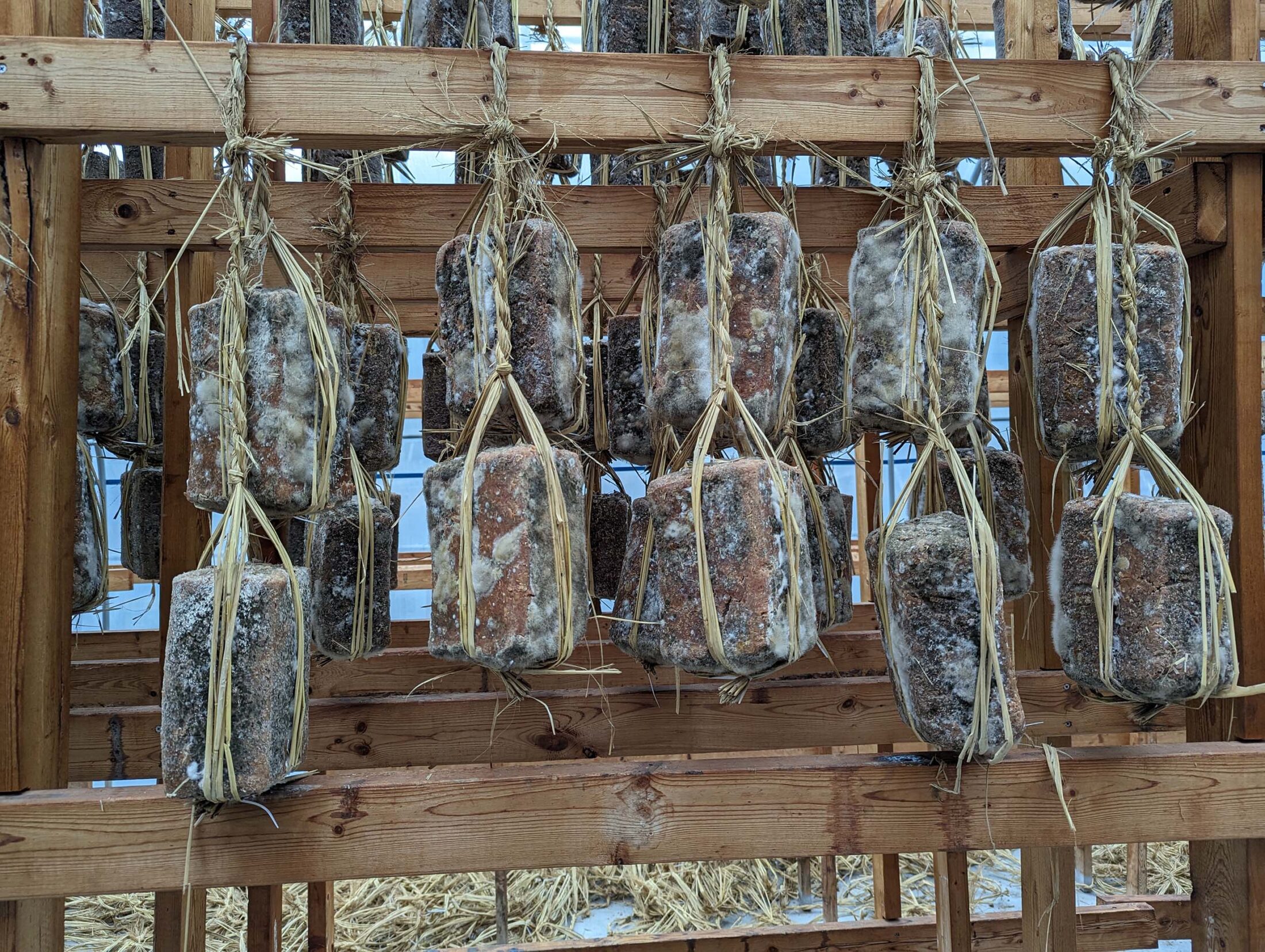
And it’s not only fruits and vegetables that give rise to seasonal fermentation traditions. Many of Korean cuisine’s most distinctive flavors come from jangs, seasonings fermented using meju, a starter which is itself fermented from a block of soybeans. The whole process begins with the soybean harvest, typically in October. The beans are cleaned, soaked, cooked until soft, and then mashed and pressed into brick-like blocks. The first few days of the fermentation, while the blocks are very moist, they are kept on a mat of rice straw in a heated space and turned periodically so that every side of each block comes into contact with the straw, an important source of bacteria and fungi, as well as with the air, so the blocks become dry enough to hang. During this initial stage, the fermentation is dominated by bacteria known as Bacillus.
After a few days in this warm environment, the exteriors of the blocks become dry enough that they can be handled. They are then tied and hung in an open-air environment where they continue to develop in fluctuating temperatures, protected from rain. The meju-maker I visited, Bong Rok Oh, hung his meju in an open-ended plastic-covered hoop house. Here, diverse molds flourish, typically dominated by the genus Aspergillus. According to Mr. Oh, the more diverse the fungi, the more complex the flavor profile of the meju. He hangs the blocks of meju in the hoop house for two to three months and begins to harvest them after the lunar New Year in February.
Photo by Sandor Katz
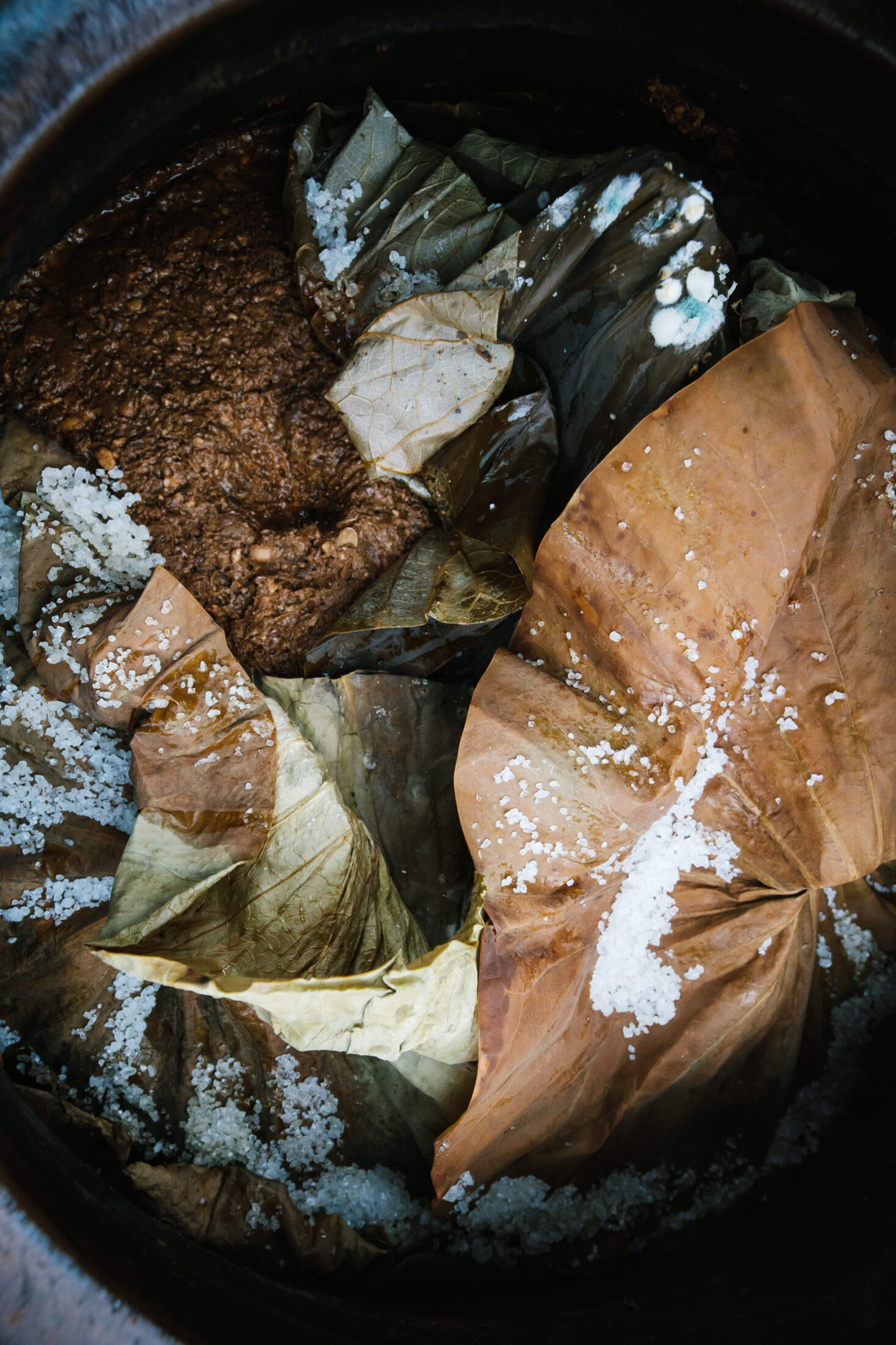
Meju is not eaten as a food; rather, it is the starting point for doenjang, ganjang, gochujang, and other jangs, which are used as building blocks of flavor in Korean cuisine. I’m making my first batches of doenjang (soy sauce) and ganjang (soy paste) from a block of meju that I was gifted by Mr. Oh. The two products are made in tandem, beginning with a single process: covering the meju with a salty brine. Mr. Oh was vague about his salt proportions, except to say that due to warmer temperatures, he had been forced to increase the salt in recent years, as salt inhibits putrefying bacteria and other undesirable organisms that are more prolific at warmer temperatures. Climate change impacts everything in fermentation, from what plants thrive where, to the dynamics of microbial growth and accordingly to details such as salt proportions and timing. I mixed my brine at 18 percent salt by weight (180 grams salt per liter of water)—extremely salty—knowing that the salt would be diluted by the mass of the meju. I used enough brine to allow the meju to float in it.
The meju absorbs brine, softens, and gradually breaks apart into the brine. Mr. Oh’s fermentation vessels were stored outdoors, with glass covers to allow for sun exposure while still protecting them from rain. I stored my crock in the house but brought it outside and opened it on sunny days to give it sun exposure, stirring it regularly. The meju is fermented in the brine for about three months, then the liquid is strained and pressed from the solids, and the two distinct products begin to diverge: The liquid is further fermented to become ganjang, and the solids are further fermented to become doenjang. These final fermentations take a minimum of one year, but ideally several. One fermentation master I met in Korea has a vessel full of 129-year-old soy sauce, and he adds a little of that to each of his contemporary batches.
An inheritance like this really highlights the generational continuity of seasonal food preservation traditions, which sadly few of us have carried on. Yet, if we are to be more connected to the lands where we live, and to the plants, animals, and ancestral processes that enable us to survive and thrive, we must find ways to reestablish these seasonal traditions. I call myself a fermentation revivalist, because my work aims to empower people to revive fermentation as a living tradition in our homes and communities.
All around the world, fermentation is an essential part of how people make effective use of food resources. It is both a strategy and a celebration, engaging us more intimately with plants, invisible forces such as bacteria, and other relationships that connect us, through the rich transformations of the seasons, to the Earth. Incorporating a simple fermentation practice into your kitchen routine will enable you to produce foods or drinks that you can enjoy and share with others, inviting them to join in these ancient processes, which are still as important and relevant as ever.
Reflecting a world where snow no longer arrives, annual migrations fall out of time, yet first blossoms still burst, Seasons, our sixth print edition, moves through three themes: requiem, invitation, and celebration—each a contemplation on the paradoxical ways the seasons now beckon us into intimate relationship.
Sign up to receive our biweekly newsletter, arriving every other Sunday morning. We are an ad and subscription-free magazine committed to sharing stories crafted with care. Join us as we explore the threads connecting ecology, culture, and spirituality.