Brian Isett is a Pittsburgh-based biologist and writer, whose work includes the poetry collection Grid Poems and his latest book, The Forgotten Teachers, created in collaboration with artist Claudia Biçen. His recognitions include National Science Foundation and National Research Service Award fellowships for his scientific work, and the Arthur Lynn Andrews Prize and George Harmon Coxe Award for his short fiction.
Pondering the age-old question his young daughter will inevitably ask—Where did the Moon come from?—biologist Brian Isett uncovers the story of how the Earth got Her seasonal song.
There was one star bigger than the rest in the night sky. Almost a moon. And one day it loosened from its fixture in that black expanse, overcome with an urge to wander. Over successive nights it grew larger and larger as it traveled close. It wobbled as it approached, appearing to stumble through unfamiliar constellations. On the final night, a glowing red planet filled the sky. A wall of molten rock lifted on the horizon, as the Earth itself reached out to embrace this traveler. The old Earth was splashing, lifting up, letting go, spinning and tilting.
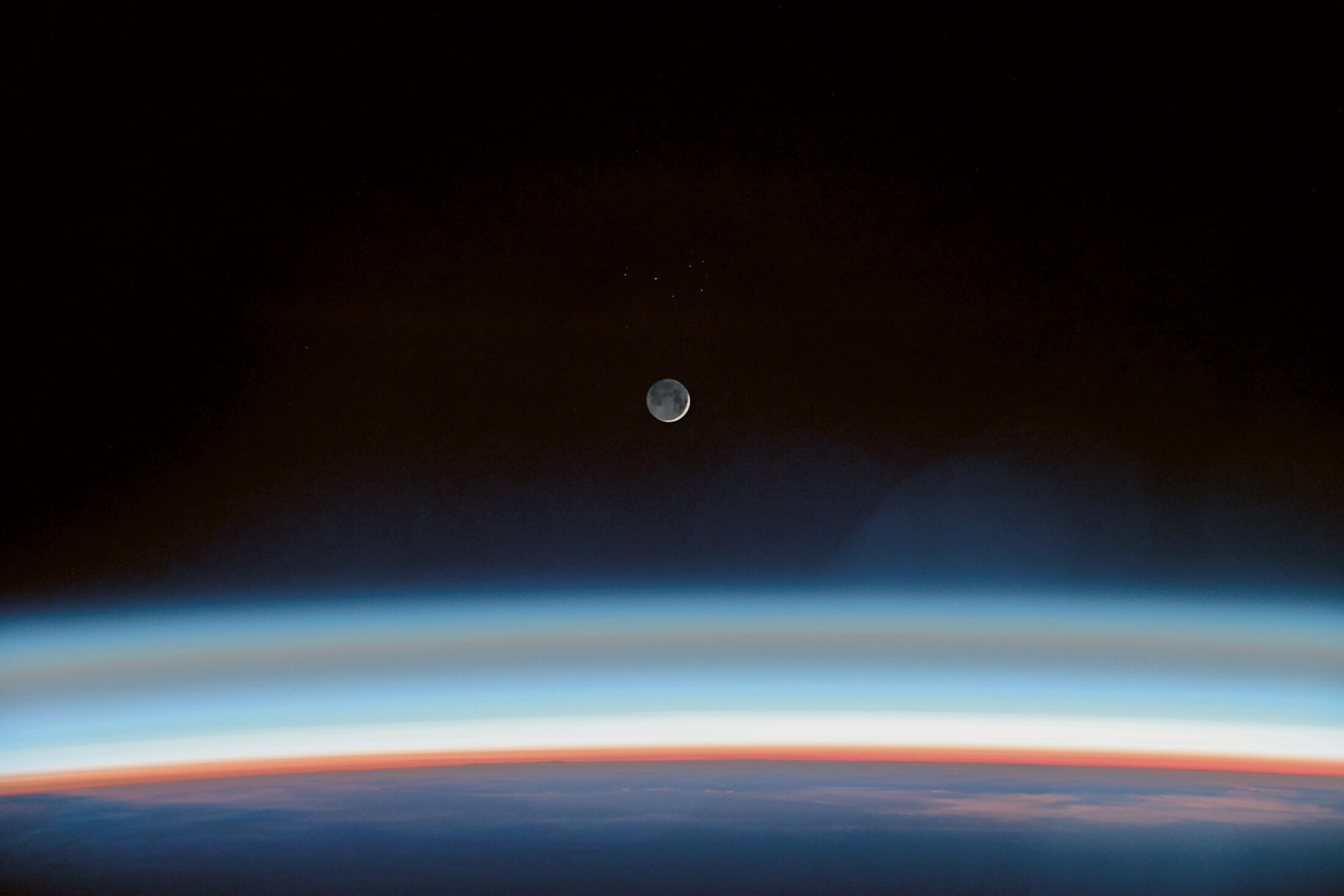
I TAKE A TURN through the low Appalachian ridges of central Pennsylvania and the Moon drifts back to the left side of the car. It is low on the southern horizon and exactly high enough for my three-year-old daughter to see from her rear-facing car seat. Most things are not. I wait with anticipation for it to enter her view, a possible highlight on a long monotonous drive. A few seconds later she shouts, “I can see the Moon!” It’s hard to miss, nearly full and with few clouds to hide it. It shines alone above black hills, the sole source of light in a stretch of highway distant from any city. And a little later, my daughter asks, more quietly, “Is the Moon following us to Pittsburgh?” And so it appears to be. The Moon as Earth’s acolyte, the Moon as timeless companion. “Yes, it is following us,” I say, knowing the feeling.
But as a scientist, my second thought is, well, no. That’s not how the Moon works—the distance to the Moon being so vast, and our six hours of traveling, though an eternity to a three-year-old, being in fact quite short—the Moon’s companionship along the dark highways is a simple trick of perspective. Among those tricks, the sense of following chiefly arises from the phenomenon of motion parallax, where objects closer to us appear to move faster than objects farther away. This gives the Moon an oddly serene sense of floating along. It appears effortless for the Moon to keep up with our travel. Yet despite this appearance, I think, the Moon doesn’t follow us any more than a distant mountain or tower.
The drive goes on and the Moon creeps back out from a ridge to stare at me head-on. In that moment I realize I am only partly right. The Earth is traveling through space at a blistering speed—without a deep gravitational embrace, wouldn’t we leave the Moon far behind? Aren’t these embraces a celestial manifestation of “following”? Back home, and with the girls in bed, I search online for the speeds and distances involved. Indeed, without the mutual pull of gravity, the Earth would have continued on at 65,000 miles per hour, doubling its distance from the Moon on our six-hour trip. The Moon would have barely made it to Pittsburgh.
Instead, the Moon followed us. And its steady presence on the horizon began to create a local rhythm: cycles of appearing and disappearing caused by our drive into valleys and around the edge of ridges. Because it was so close to the horizon, it rose and fell to the shape of the Appalachian Plateau. Over short stretches the Moon follows, but over longer periods it phases in and out of fullness, dividing our year into twelve lunar months.
The words “moon” and “month” are ancient, stretching back in similar form for thousands of years to the proto-Indo-European word “mḗh₁n̥s.” It is thought that mḗh₁n̥s would have meant both “moon” and “month,” suggesting that the Moon and the ways it measured time were tightly intertwined in human thought. And because the proto-Indo-European root “meh-” meant “to measure,” this might be interpreted as capturing both the Moon and what it does across a month: the Moon that measures time by filling and emptying, like a cup of flour. In Latin, the word for month was “mēnsis,” also descending from “mḗh₁n̥s” and leading to the modern word “menses.” Anything could measure time like the Moon or follow the Moon’s cycle, including people. This etymology of “moon” and “month” reveals a dual nature, both static and always changing. It feels difficult to fully appreciate a single word filled with so much meaning and action, but I am reminded of how modern physics describes light. Four thousand years ago, people already understood the Moon to be both a particle and a wave.
The rhythmic companionship of the Moon has given it profound cultural clout. In China, for example, the phases of the Moon have been used to describe a lunisolar calendar that dates back to at least the Shang dynasty three thousand years ago, when it was described on fragments of ox bone, called “oracle bones.” The Chinese Lunar New Year usually begins on the second new Moon after the winter solstice, marking a period of welcoming spring and preparing for a new beginning. On a dark night past the shortest days of the year, even the Moon starts over. But the Moon’s rhythms and companionship can sometimes become unsettling. Behind clouds, or outside our notice, the Moon’s phases can march on without us. Encountering an unexpected full Moon is exciting, jarring, and, in my case, expletive-inducing. People can see a face on its rocky surface, visiting and leaving: the “Man in the Moon.” When this companion again “follows” a traveler, but the weather is bad and thick clouds pull the Moon in and out of darkness, sometimes the companionship feels closer to stalking. These tendencies of the Moon to shift and change, to hide, stalk, and unexpectedly reappear, all contribute to our darker cultural associations with the Moon: the mental state of “lunacy,” the transformation of werewolves, the persistent fear of overflowing emergency rooms when the full Moon arrives. Even the phrase “the dark side of the Moon” captures more about our reservations than facts about the Moon itself: there is not a side of the Moon perpetually in darkness, there is only a side that we never see.
SOON AFTER our long drive, I find myself pulling a birding telescope out of the basement and onto a cushion in my daughter’s bedroom. I point it out her window above the streetlamp, and the Moon is almost blindingly bright. She jumps up and down with excitement, jostling the Moon out of frame and focus. With a closer look, a surprisingly rugged texture normally blurred away by the naked eye comes into view. Dark patches explode into craters and mesas. It is vast and multihued, cold and alluring. I have the same sensation even pointing a pair of binoculars at the Moon: it has so much more going on than I expect. When we are done, I ask my daughter what she liked best about seeing the Moon. “The rocks,” she says, by which I think she means “the craters.”
She does not ask that night, but inevitably she will ask—as so many of us do—“Where did the Moon come from?” And inside that question there are more. And despite all of the relevant science, we still end up with some version of, “Because it was so.” But short of that ultimate intractability, waiting for us at the dawn of time, what is the best story we can tell about the Moon today? And the answer surprises me. Because within that answer, there are more answers, explaining the origin of nearly every rhythm on modern Earth. The beginning is Theia.
THEIA IS A hypothesized planet, named after the ancient Greek Titan who birthed the Moon and the Dawn. When Theia arrived, Earth was still hot and new, circling the Sun with oceans of molten rock glowing under a cloudless sky. Days and nights might have flickered past in hours or churned slowly over months, yielding sunsets like a match going out or sunsets that blazed red and orange for a week. We don’t know. The sun might have set in the east and risen in the west. Days might have even been exactly like they are now, or there might have been almost no day at all, only a dark half of the Earth and a light half. After Theia’s destructive arrival it is difficult to know something so delicate as the timing and location of Earth’s original dawn.
What is more certain is that before Theia, there was no Moon. The early molten Earth would have experienced faint tides caused by the Sun alone, not dramatic high and low tides like our ocean experiences today. And on calm nights, a hot Earth rippled under a dark sky of unfamiliar constellations. Earth’s seasons would have been equally unrecognizable. Seasons emerge from a planet’s axis of rotation: if it is tilted towards or away from the Sun, there are seasons; if the axis is parallel or perpendicular to the Sun, there will be none. Like Earth’s spin, the precise tilt of the early Earth is difficult to know. By some estimates it could have been similar to how it is today. By others it could have been tilted ninety degrees, so far that the North or South Pole would be facing the Sun, meaning the year would pass without the arrival of spring, summer, fall, and winter. Without the familiar rhythms of months, tides, seasons, and days, Earth traveled with an unrecognizable relationship to time.
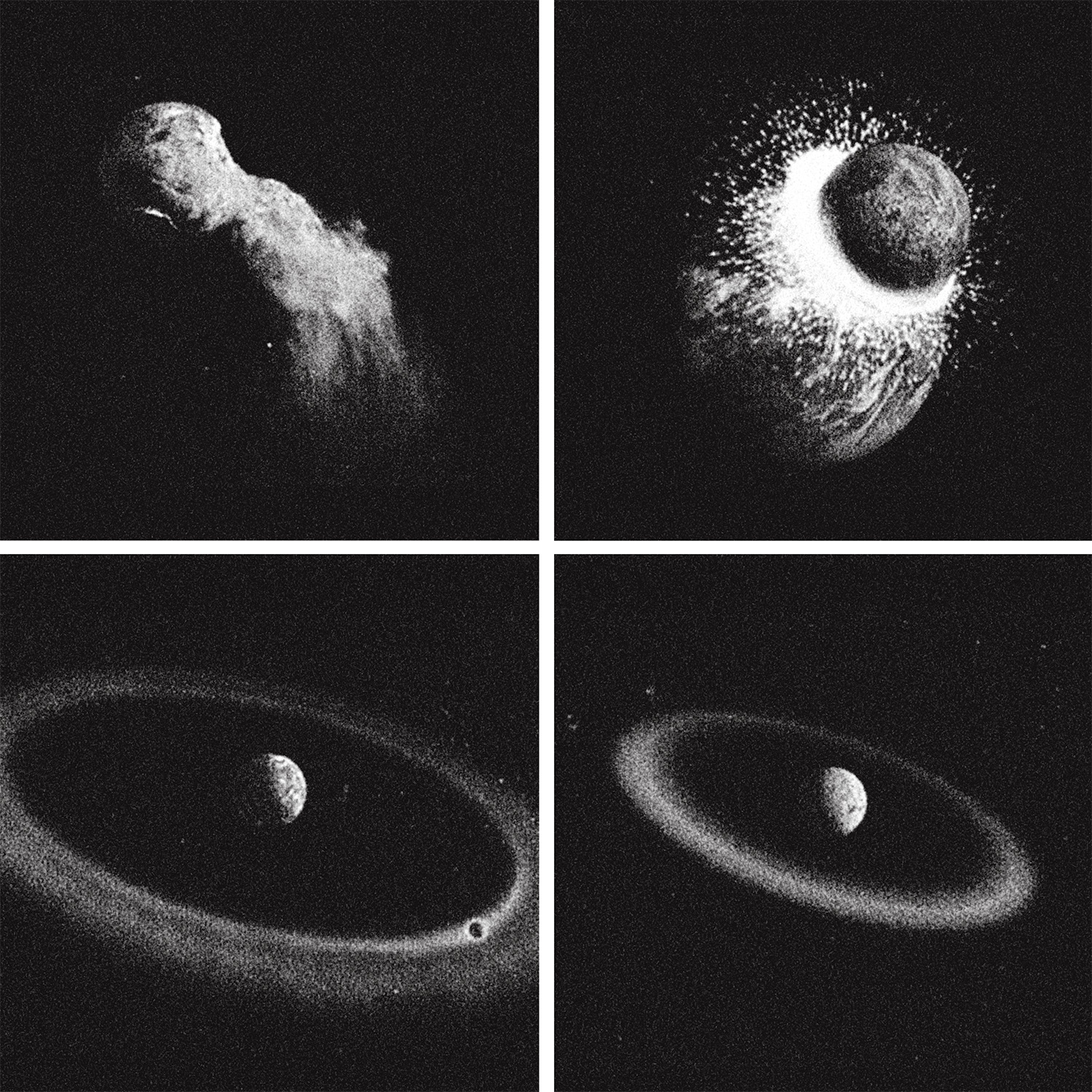
After millions of years orbiting in Earth’s gravitational wake, Theia was jostled by the gravitational pull of another planet, sending it on a collision course with Earth. Theia approached with a wobbling impact that spun Earth into an endless pirouette around the Sun, creating days with sunrise in the east and sunset in the west. The same collision knocked Earth onto a tilt of about 23 degrees. Rock ejected by the collision soon coalesced into the Moon, which pulled high and low tides on the molten surface of the new Earth, dazed and glowing. Earth spun with four-hour days while the first new Moon smoldered in the night sky. A taciturn planet had been given a song.
WHEN MY FIRST daughter was born, I remember a fall storm that passed by the hospital windows without us feeling its force. Somehow the glass was too thick, and the sounds we expected were all missing. Night and day were muted by overhead lights, and then almost entirely replaced with new rhythms of crying, diapering, feeding, holding. Our daughter was very healthy, but she required a lot of bouncing to feel calm. I started to wonder if we had given her some unrealistic expectations in utero about bouncing during our frequent hikes. Leaving the hospital, my wife held my daughter and I held a vase of flowers. When I looked down, I noticed I was bouncing the vase as vigorously as I had been bouncing my daughter the night before, the water now spilling out. Rocking and bouncing would be the first of many new synergies, tacit dialogs of movement, sadness, hunger, calm, and sleep as we passed through shifting cycles of need. Like reborn planets, infants cycle through shortened days, and we did our best to keep up.
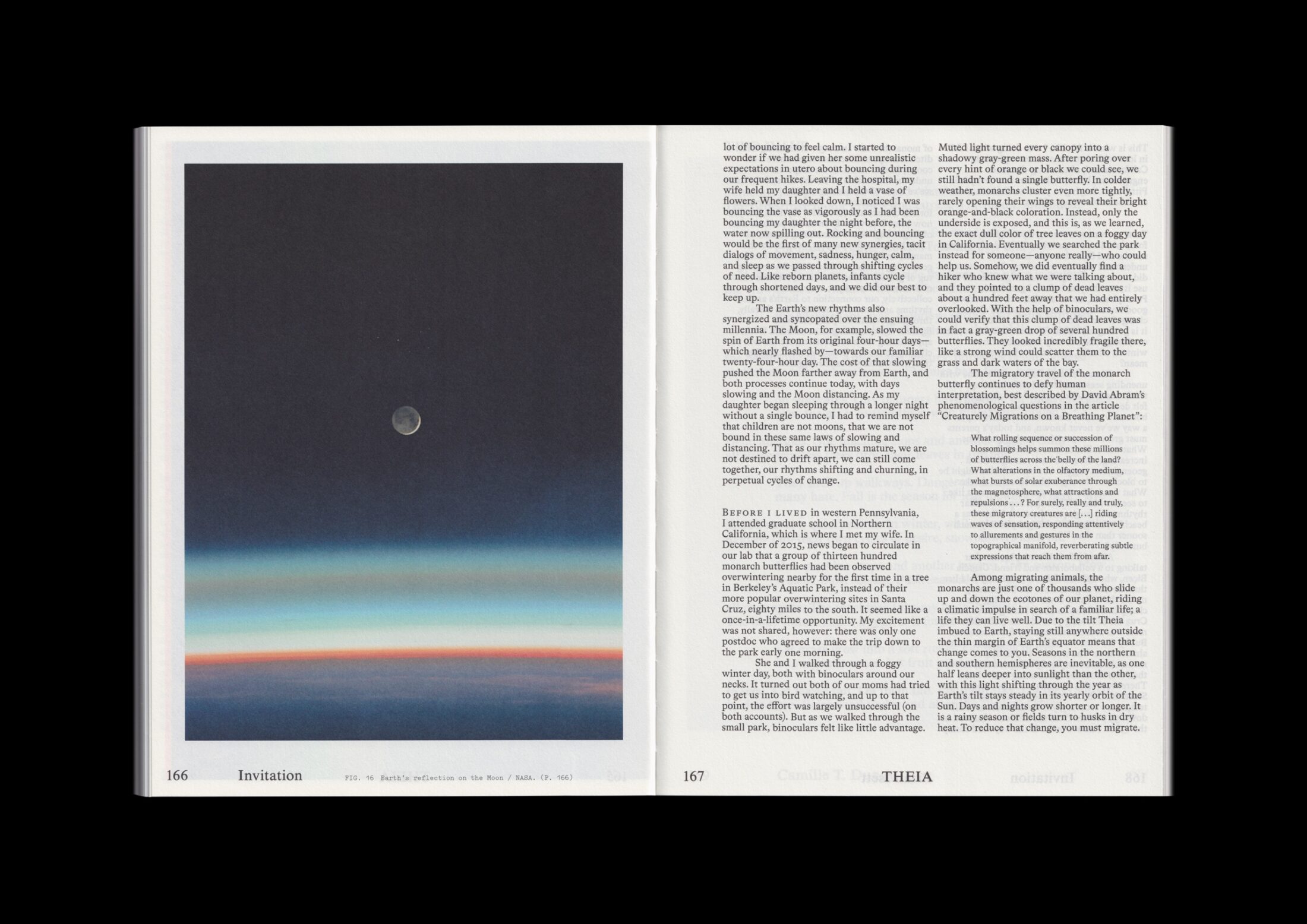
The Earth’s new rhythms also synergized and syncopated over the ensuing millennia. The Moon, for example, slowed the spin of Earth from its original four-hour days—which nearly flashed by—towards our familiar twenty-four-hour day. The cost of that slowing pushed the Moon farther away from Earth, and both processes continue today, with days slowing and the Moon distancing. As my daughter began sleeping through a longer night without a single bounce, I had to remind myself that children are not moons, that we are not bound in these same laws of slowing and distancing. That as our rhythms mature, we are not destined to drift apart, we can still come together, our rhythms shifting and churning, in perpetual cycles of change.
A taciturn planet had been given a song.
BEFORE I LIVED in western Pennsylvania, I attended graduate school in Northern California, which is where I met my wife. In December of 2015, news began to circulate in our lab that a group of thirteen hundred monarch butterflies had been observed overwintering nearby for the first time in a tree in Berkeley’s Aquatic Park, instead of their more popular overwintering sites in Santa Cruz, eighty miles to the south. It seemed like a once-in-a-lifetime opportunity. My excitement was not shared, however: there was only one postdoc who agreed to make the trip down to the park early one morning.
She and I walked through a foggy winter day, both with binoculars around our necks. It turned out both of our moms had tried to get us into bird-watching, and up to that point, the effort was largely unsuccessful (on both accounts). But as we walked through the small park, binoculars felt like little advantage. Muted light turned every canopy into a shadowy gray-green mass. After poring over every hint of orange or black we could see, we still hadn’t found a single butterfly. In colder weather, monarchs cluster even more tightly, rarely opening their wings to reveal their bright orange-and-black coloration. Instead, only the underside is exposed, and this is, as we learned, the exact dull color of tree leaves on a foggy day in California. Eventually we searched the park instead for someone—anyone really—who could help us. Somehow, we did eventually find a hiker who knew what we were talking about, and they pointed to a clump of dead leaves about a hundred feet away that we had entirely overlooked. With the help of binoculars, we could verify that this clump of dead leaves was in fact a gray-green drop of several hundred butterflies. They looked incredibly fragile there, like a strong wind could scatter them to the grass and dark waters of the bay.
The migratory travel of the monarch butterfly continues to defy human interpretation, best described by David Abram’s phenomenological questions in the article “Creaturely Migrations on a Breathing Planet”:
What rolling sequence or succession of blossomings helps summon these millions of butterflies across the belly of the land? What alterations in the olfactory medium, what bursts of solar exuberance through the magnetosphere, what attractions and repulsions…? For surely, really and truly, these migratory creatures are […] riding waves of sensation, responding attentively to allurements and gestures in the topographical manifold, reverberating subtle expressions that reach them from afar.
Among migrating animals, the monarchs are just one of thousands who slide up and down the ecotones of our planet, riding a climatic impulse in search of a familiar life; a life they can live well. Due to the tilt Theia imbued to Earth, staying still anywhere outside the thin margin of Earth’s equator means that change comes to you. Seasons in the northern and southern hemispheres are inevitable, as one half leans deeper into sunlight than the other, with this light shifting through the year as Earth’s tilt stays steady in its yearly orbit of the Sun. Days and nights grow shorter or longer. It is a rainy season or fields turn to husks in dry heat. To reduce that change, you must migrate. This is what it felt like I was doing when I fell in love with that monarch co-explorer in California and, after a long-distance engagement, left to follow her to a new job in Pittsburgh. Staying in place would have meant an unbearable season of loss.
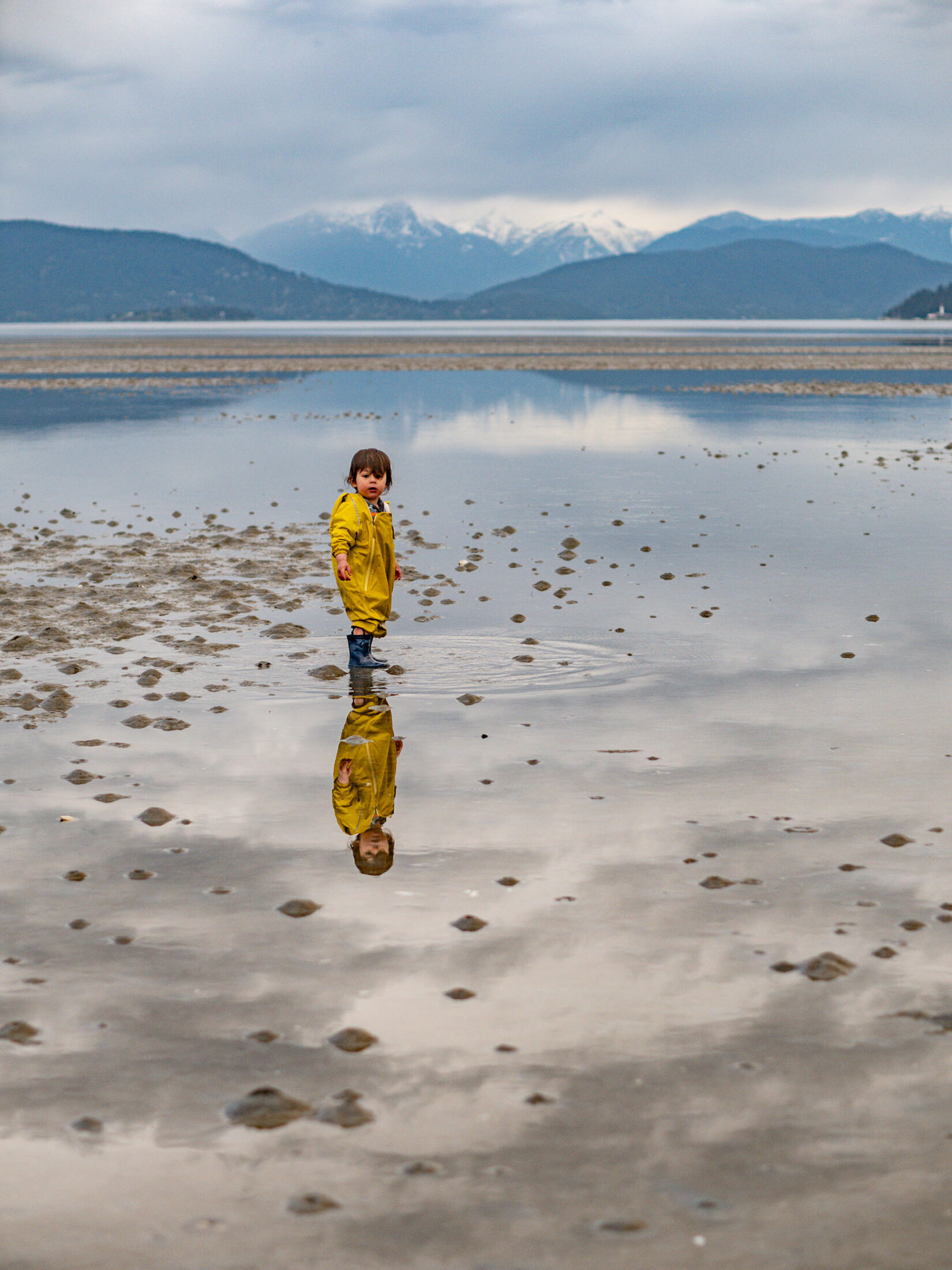
THE WINTER OF 2023 my daughter, now four, asked a new question. “Why don’t we ever use the sled Santa brought last year?” I understood why she was asking. That year it did not snow enough in our neighborhood to use it; nor the year before. I grew up in Pennsylvania, and as a child, a sled was always a good investment. Somehow that has already changed. I tried to explain to my daughter that it is getting too warm for snow, but this seemed confusing. She can only remember three winters, all mild, so what is winter supposed to mean?
Climate change threatens everyone with unending seasons of loss. Inside buildings with thick windows, the storm of that change has felt deceptively quiet to far too many. Children born now will be insulated from Earth’s past in a way we’ve never known, and today’s parents must grow to expect devastating questions. What was it like to have winter? On an increasingly frequent basis, straight-faced geoengineers suggest our best solution might be to block out the sky with a chemical smoke. What was it like to see stars? What was it like to see the Moon? Tides that kept a familiar rhythm will surge past the sand. What was a beach? What is a month? And possibly much sooner than that: What was a monarch butterfly?
After I left California, I remember talking to a collaborator and friend, Claudia Biçen, who still lived there. I excitedly told her that she had to go and see the hibernating monarchs in Santa Cruz—after seeing that clump in Berkeley in 2015, I had gone to Santa Cruz the following year and the lazily fluttering mass was as memorable as my first encounter. But by the time we talked in 2020, there were almost none. The western population of monarchs had completely collapsed into fewer than two thousand hibernating individuals. There were talks of extirpation, pesticides, loss. Since then, the western population has made a temporary recovery, yet the numbers are still down 95 percent from the millions observed in the 1980s. I now wonder if the wayward clump of monarchs I saw in 2015 were making a last-ditch attempt to hibernate somewhere a bit cooler, farther north. Some desperate effort to undo the interaction of Earth’s tilt and the mess we’ve made of the heating world.
The existence of Theia, the old reason for our climate and its careful rhythms, has just now come into view. Even in this perilous time of forgetting, we are discovering chunks of Theia buried under our feet, deep in Earth’s mantle, under Africa and parts of the Pacific, generating a large portion of Earth’s ongoing tug of gravity. These discoveries feel like our own last-ditch attempt to remember, collectively, our connection to Earth’s ancient rhythms and how they hold us, both literally, through gravitational pull, and more figuratively, by holding us to account. Without appreciating these connections, we too will be clinging to the low branch of an unfamiliar tree, in a winter we can’t recognize.
Reflecting a world where snow no longer arrives, annual migrations fall out of time, yet first blossoms still burst, Seasons, our sixth print edition, moves through three themes: requiem, invitation, and celebration—each a contemplation on the paradoxical ways the seasons now beckon us into intimate relationship.
Sign up to receive our newsletter each Sunday morning! We are an ad and subscription-free magazine committed to sharing stories crafted with care. Join us as we explore the threads connecting ecology, culture, and spirituality.