Jake Skeets is the author of two books of poetry: Eyes Bottle Dark with a Mouthful of Flowers, winner of the National Poetry Series, American Book Award, Kate Tufts Discovery Award, and the Whiting Award; and his new collection, Horses. His work has appeared in journals and magazines such as Poetry, The New York Times Magazine, and The Paris Review. He has been awarded an NEA Grant for Arts Projects, a Mellon Projecting All Voices Fellowship, and the 2023-2024 Grisham Writer in Residence at the University of Mississippi. He is the third Navajo Nation Poet Laureate and teaches at the University of Oklahoma.
As wildfire haze and sandstorms intensify on the Navajo Nation, poet Jake Skeets considers how these extremes will alter how we remember the seasons.
I. I’m writing this essay during an excessive heat warning
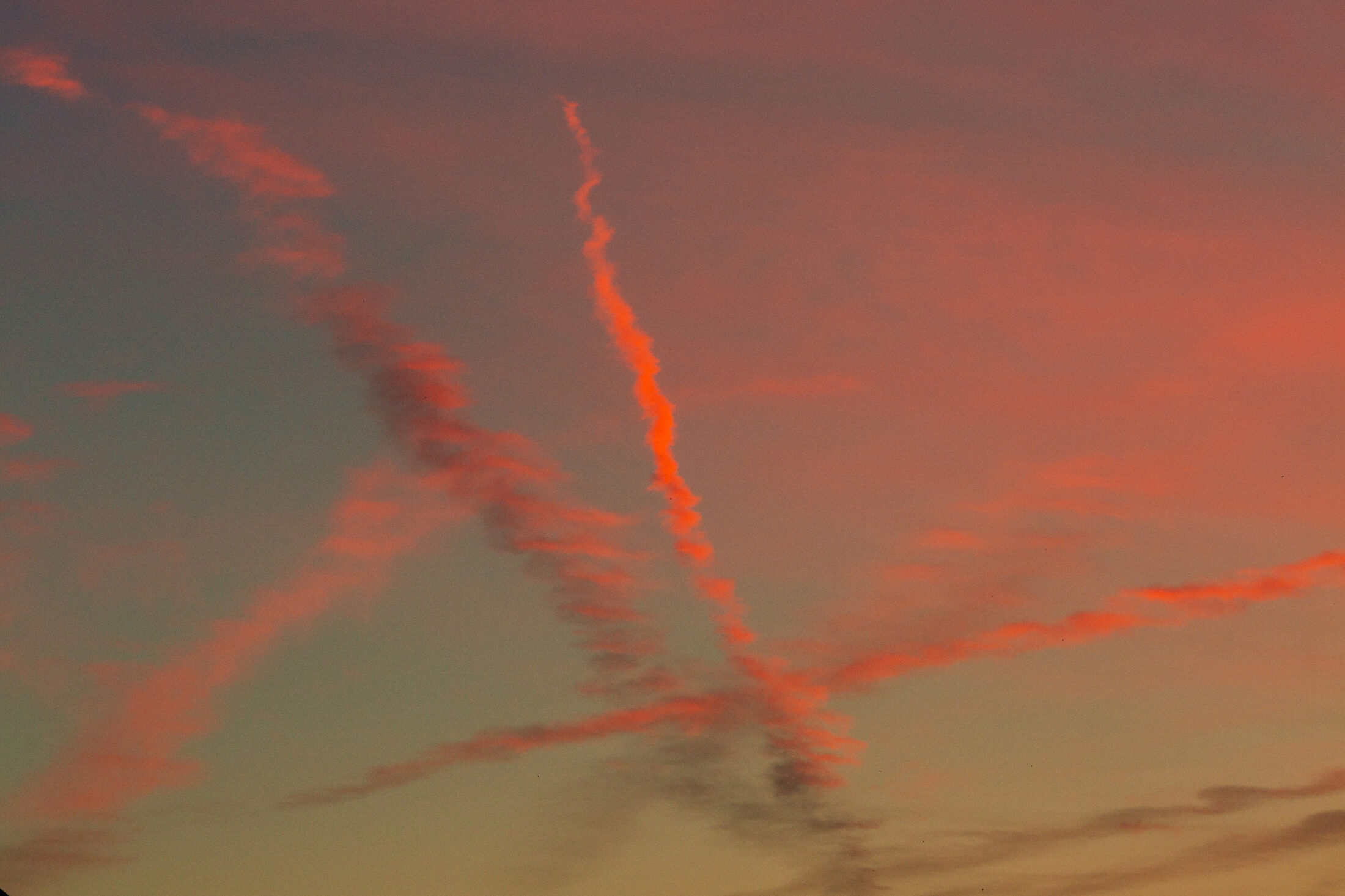
I’m writing this essay during an excessive heat warning. For days, the skies have been singed a hazy pale blue. Just the other day I went for a walk in the evening and the sunlight was pink as if a wildfire was burning nearby. We can recognize a wildfire by the way it slants the light. I held my palm in the air and watched the light fall onto my skin in shades of rage and discontent. I’m writing this essay during an excessive heat warning, and I have never been shy to heat. I’m a boy born of desert. I’m a boy born of summer. I am also a boy born of drought.
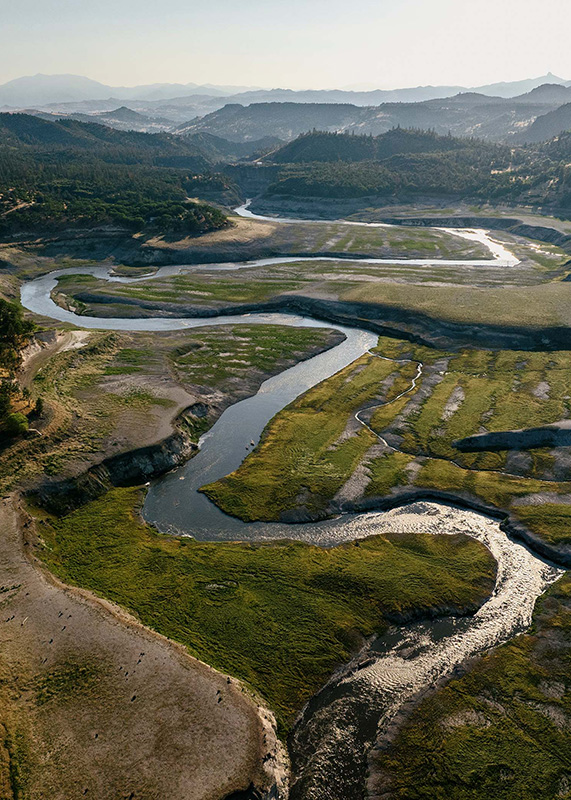
Drought conditions created by a warming planet and years of resource extraction that stole water from Navajo communities to build cities like Las Vegas and Phoenix have been an ongoing issue across the Navajo Nation. Conditions tightened in the 1990s, and as a boy growing up at that time, I remember people gossiping, often, that we could run out of water. Fortunately, Navajo communities still have access to running water on the reservation—though strained access at best, which became illuminated during the initial peak of the pandemic. I wrote about apocalypse then, and in the years since, my meditation on the end of the world has shifted but the materiality of it has only heightened as we see more and more signs of climate catastrophe.
I’m writing this essay during an excessive heat warning, and I learned of apocalypse as a boy. I remember witnessing the way the land shifted around me as time moved on, how my brothers and sisters often talked about the end of the world, and how grief falls into a room like sunlight.
The earliest memory I have of wildfire involves the first season of American Idol. As Kelly Clarkson was singing on the television, I stood outside and watched the sun set in a stunning red and neon orange glow, different from other sunsets. The air smelled of smoke. I’m pretty sure the fire was the Rodeo-Chediski Fire that burned nearly a half million acres in 2002, though I can’t be sure exactly which fire that year was big enough that I could see its smoke on the reservation. Later that year—as Laura Paskus wrote in a feature for a High Country News issue aptly titled “The Great Western Apocalypse”—Navajo Nation president Kelsey Begaye declared a drought emergency across the reservation and ranch owners were urged to cull their cattle: an action that has been deeply scarring for most Navajo people, who have had to battle livestock reduction for decades since the government’s initial mandatory reduction program in the 1930s. It feels like every one of my summers on the reservation since 2002 has had elements of wildfire. Each memory holds the stench of smoke and singed sunset light. I’m writing this essay during an excessive heat warning.
When I was a boy, the heat was not an aggressive factor in how much time we spent outdoors. Even on the hottest days, we raced cloud shadows on the dirt road in front of my house as dry winds carried small clouds across the sky. To keep cool, we dug into the dark soil under tall trees. We drank water from the hose spigot and swam in the small stock ponds that were carrying on through the heat that even then felt excessive. When we were lucky, one of our aunts or uncles drove us into Gallup, New Mexico, so we could swim at the community pool. We always spent a week with our late aunt in Albuquerque because her apartment complex had a swimming pool. Each morning, we ran to the pool and only came back for lunch and after the pool was closed. Our skin darkened from the sun, and each August when we returned to school, we held our arms against each other to see how brown we had become over the wild days of summer.
And as I’m writing this essay during an excessive heat warning, I’m thinking about those summer days on the reservation and the way heat became a contour of my life. I always said summer was my favorite season. My best memories involve the evening time in July, sitting on the porch eating watermelon with my brothers and sisters. The past two years, however, have tested my appreciation for summer, as excessive heat warnings have begun plaguing most of the summer months. When we were boys, we looked to the west and the southwest during hot days to see whether dark clouds were growing. If we saw the clouds, it meant the monsoon storms were coming and the heat was about to break. It always began with the wind, sometimes gritty with sand. As the monsoons neared, sand twisters became more frequent. We were always told to keep a distance. We were given many reasons why we had to stay away from them: they were spirits, they make you confused, they take something from you if you’re caught in one, they are a sign of bad things to come. As rez kids, though, we never really listened. The sand twisters were markers of the coming storms, so we welcomed them as they grew, sometimes several feet into the air. We often ran straight into them, feeling the sand scatter across our bodies. What I did not know then was that the sand these twisters and the winds carried was a sign of climate change.
As boys, we would walk barefoot over the sand dunes that grew in the deeper parts of old, abandoned cornfields. Today, when I return home, I see sand dunes taking up even more space. Sand dune migration across the Navajo Nation is eating entire roads and homes as drought conditions worsen. So those reasons to stay away from sand twisters might have some weight, because they did start to take things from us in the end. I mean, I am writing this essay during an excessive heat warning after all.
“Triple-digit heat index” was not a phrase I thought I would ever use, despite writing this essay during an excessive heat warning. I’ve always had an affinity for the weather. The 1996 film Twister, with Bill Paxton and Helen Hunt, was a staple of my boyhood. Back then, we only ever owned a few VHS tapes and Twister was one of them. I pretended my laundry basket was a tornado as I chased my toy trucks across my house and in the dirt outside. I often recreated the first tornado scene in the movie, when Bill (Bill Paxton) and Jo (Helen Hunt) have a close call with a tornado as they are driving in a ditch. I remember picking up any VHS tape from Blockbuster that dealt with tornadoes, often watching documentaries about the weather. I remember I wanted to be a fireman because “fire twisters” were something I could potentially see in person. Then, I wanted to be a weatherman after hearing about meteorology and the study of weather. I somehow shifted and became a poet instead, but my career as a writer brought me to the University of Oklahoma, where I teach now. I can safely say that close calls with tornadoes are as scary as I thought they would be and just as exhilarating. During severe weather days, I often monitor all the weather channels in Oklahoma just to listen to the language they employ to talk about the weather: mesocyclone, dry line, wind shear. I now realize that tornadoes in Oklahoma mark the season the way weather marked the season back home on the reservation.
Seasons, then, are deeply interior. They rest in an instinct that is both deeply human and deeply temporal. They represent a relationship humans have had with deep time for generations. And as I’m writing this essay during an excessive heat warning, I’m wondering how the climate crisis will impact our relationship with the weather and the way we have mapped seasons for ourselves. I’m writing this essay during an excessive heat warning, and this might be a new kind of calendar for me; a new way to mark the summer. The way sunsets fall into my palm in a singed light, the color of rage.
I’m writing this essay during an excessive heat warning, and it has made all the difference. Go outside and see if you can smell smoke. I know I can.
II. Seasons are to the body
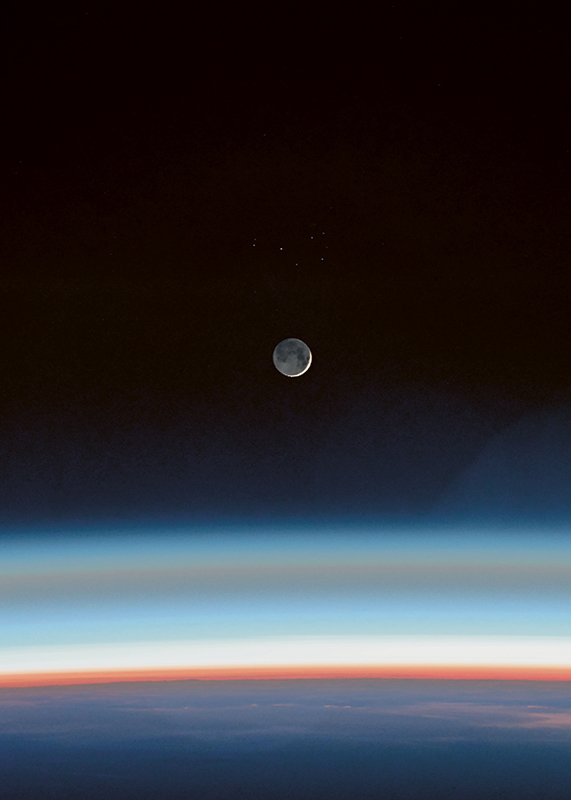
Seasons are to the body what memory is to time. Back home, we have unique ways of measuring time. As kids we are taught how to tell what season it is not by using a calendar but by looking to the weather. It all begins in October. “Ghą́ą́jí’” is the Diné word for October, and it can mean “half” or a kind of summit but can also mean “the separation of the seasons.” It also marks the Navajo New Year. The moon is important here too. “Cold air is coming,” my partner says whenever the moon looks like a bowl turned over. Cold air is spilling from the moon.
The Navajo dictionary I often use to help me with translation and working with Diné language lists “Ghą́ą́jí’” as “October,” but it also gives “back-to-back” as a literal translation—as in, “summer and winter are back-to-back.” The word “Ghą́ą́jí’” then is a sibling to the words for the various parts of the upper back, including “‘íígháán” (backbone), “‘agąąstiin” (shoulder blade), and “‘agąągah” (area of the shoulder blades). If we layer this new orientation to seasons and the body with the word “k’os,” a word that means both “cloud” and “the neck,” we come to understand the way the body is uniquely tethered to the land and its weather. We see parts of our body as parts of the world around us: our necks are the clouds, our shoulders then become the mountaintops that touch the clouds. Our upper bodies are tied to processes of transition: breathing, pumping blood in and out, swallowing food, and talking. They are systems tied to each other.
Seasons are to the body what clouds are to the mountains. We honor this relationship by leaping into time as an actual practice. The annual snow bath is the way we mark the start of the winter. When the first snows come, we are told to jump into the snow to let it cleanse our bodies. It’s a kind of renewal. In the summer, we use the weather again to mark the seasons shifting.
We call it the First Thunder when the spring storms come. As kids, we were often home alone during the early storms of the year because our parents worked all the time. As I grew older and took on the role of babysitter for my younger siblings, my brothers and I grew quite familiar with thunderstorms in the spring. They felt different from monsoon storms, which are often dense and windy. Spring storms looked taller. I could often see through the curtains of rain to the other side of them, whereas monsoon storms were thick, choked by rain and rising dust. Whenever we heard the First Thunder, we were always told to stretch to shake winter off our bodies. Just like First Snows, First Thunder was an insistence of the body. The first thunderstorms were always the loudest.
Once, my brother busted his head open when a storm started outside and he rushed to open the door. The wind was so strong, the door swung open and pushed his body into a dining room chair. Another time, a storm caught us as we got off the bus after school. We only lived a few yards from the main highway where the bus drop was, but it meant having to run in the mud as the rain came down in harsh and sudden ribbons. The lightning was fast, and the thunder was loud. We ran toward home to find we had left our keys behind. We were stranded. So, we broke into my uncle’s truck through his back window and rode out the storm inside his truck—the thunderstorm outside reminding us of its strength. I remember the act of looking: witnessing its immensity. It felt like I was watching the body of eternity walk through the trees. A wide swath of pressure and moisture. A body of physics ancient to the earth beneath us.
These early storms marked the spark of summer and mirrored the monsoon storms that would mark its waning. Interestingly enough, the Diné word for summer is “Shį́,” which bears a striking resemblance to “shí,” or “me.” The meaning is changed depending on the sound we employ. If we add an additional “i” to the word, it then becomes new words that are conditional upon time. For example, the word “shíi’” means “mine” but a “mine” conditional with time, as “became mine [over a period of time].” The word is only possible with temporality. The word “shį́į́” is another word evocative of time, which can mean “maybe” or “perhaps.” Of course, I can’t make a connection between “Shį́” and “shí” as I did between “Ghą́ą́jí’” and other related words, but I like to theorize that the “sh” consonant sound here is referring to the sun or a kind of interior energy that brings life and energy. The word for sun—when not referring to the holy deity but a general reference, as in “sunlight”—can be “shá,” as in “shá bitł’óól” or “sunbeam.” (When translated literally, “shá bitł’óól” means “the sun’s string.”) For me, the linkages between “Shį́” and “shí” are too prominent to ignore, especially when thinking through the meaning of “shá.” But though we don’t fully understand, we can still react to the texture of these linkages—what becomes an instinctive sinew between seasons and the body. I don’t know why I need to stretch at First Thunder or bathe in the First Snows, but I can engage with their premise and gestures. The thrums of my ancestry sing when I practice these kinds of ritual because of the way it “feels.” It’s a kind of poetry that probably bridged my interest in the weather and my career as a writer. Weather after all is a kind of poetry. But if I’d been a weatherman, I might have only learned to make meaning of the weather. Whereas poetry taught me the way to take things we cannot understand as a kind of meaning-making. Seasons are to the body what First Thunder is to me.
As I write the phrase “seasons are to the body,” I’m thinking through the somatic nature of our daily experiences. We experience the world through our bodies. We measure pressures and physics using the processes of our various organs and nerve endings. It’s almost as if our body is acting like a spider web. The other day in my family group chat, my brother sent a picture of an Orb-weaver Spider that made a home near some oil canisters in my parents’ back porch. He told my sister to touch the spider’s web, because if she did, she would learn how to weave. The gesture of simply touching a spider’s web as an act of faith, to me, is like jumping into First Snows and stretching at First Thunder. It’s a way to honor the life we have in relation to the life around us.
I think of the late Native philosopher Viola Cordova’s theories of the air around us as a kind of yolk and that we should consider our lives as not existing in open air but in a closed, contained system. Air is a pressure, after all. It’s composed of elements. It’s a life force with an “invisible architecture,” to borrow a term from the poet Barbara Guest. I also think of the late Carol Edelman Warrior’s essay “Indigenous Collectives: A Meditation on Fixity and Flexibility.” She meditates on the non-structures of slime molds as a kind of metaphor for organizing societies around collectivity and flexibility and posits that Indigenous people had often followed these ideas before contact. In the essay, she wrote, “Controlled by humans, the slime mold’s purpose shifts and becomes foreign and antagonistic to the slime mold’s natural relationships, environment, and self-determination. It seems to me that this definitional process is both analogous to the work of a gaffer on a blob of glass and the effect of external definitions of identity and boundaries in treaty language. Transformational capabilities are slowed, relationships between people and peoples are constrained by formal (codified) language, and relationships in places suffer under the pressure to commodify and control.” She continued, “I am excited by any life or existence that defies the rationalist bent to impose a language of authoritative definitions onto life forms: the unilinear, cartographical, bordered, and hierarchical structures that constrain the meaning of identities, self-determination, places, and the exercise of sovereignty.”
If seasons are to the body, then calendars are to seasons what walls are to people. We use language to restrict the very movement of our bodies and energies across time and space. We contain the intricate, innate, and instinctive nature of our relationality with the world around us. We employ punitive systems that oppose corporeality, emotion, and flux social orientations. The very nature of our language becomes a cage. And we look to what poet Joyelle McSweeney calls “the necropastoral,” as in slime molds, to see the ways in which life continues to subvert, resist, and reclaim a kind of sovereignty on and below the ground beneath us. If seasons are to the body, then seasons are to the body.
The evening time becomes a kind of love story, the sun reminding us that all things are temporary, and I have to write about this because I’ve become a writer of memory.
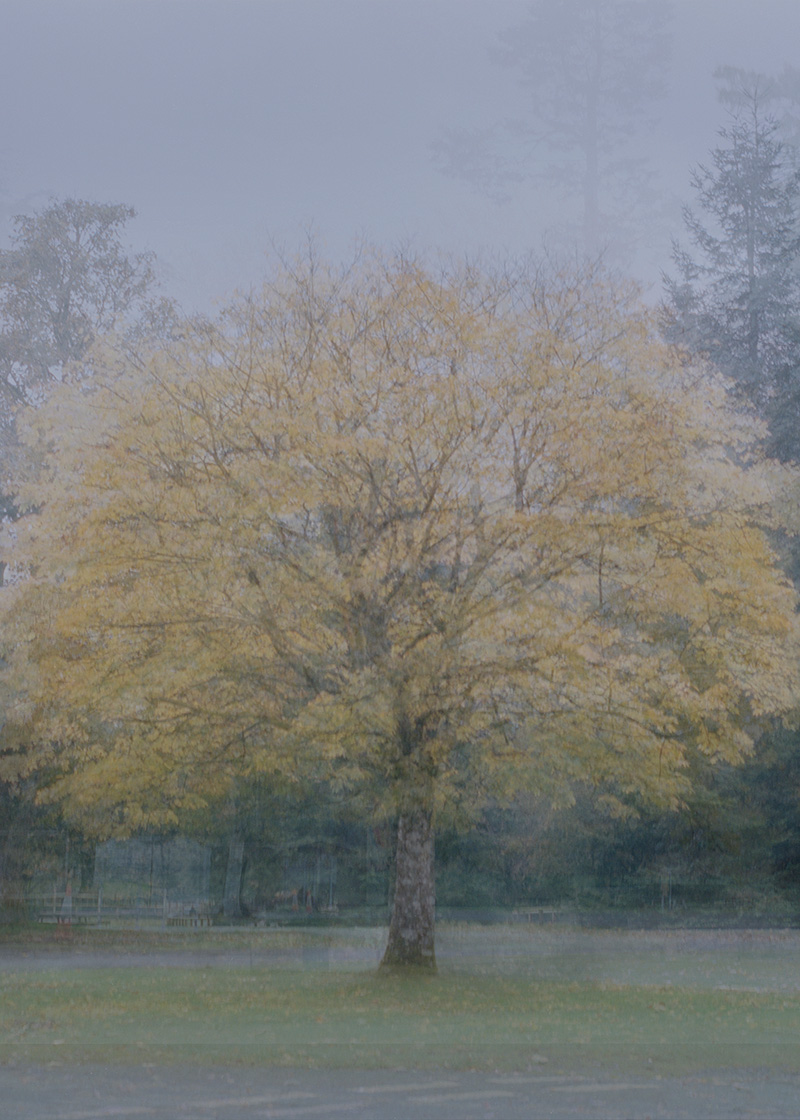
Evelyn Dragan / Connected Archives
III. In the evening’s last lick of summer light
In the evening’s last lick of summer light, I catch a glimpse of dragonflies stuck to the gesture of two spans of time connected by the sun’s ribbon. On the road along the long evening, I stand in the current of another memory. I’m in deep; the scope of singed light carrying with it an elegy to January cold. Calling me into the deepest part of the ditch where my brothers broke their bones more times than I can count, boys of late night holding cheap cigarettes between their teeth, a long night of drinking tucked somewhere behind their ear. They taught me how to glide my hands through my hair so I could be like the men in the movies, to woo some poor girl into loving another broken Navajo man with a crooked smile. I look through the constellation of our howls in the summer’s hottest day to find each one of them shivering in January, waiting for the bus to take us to a school built on the broken bones of our uncles, who still sweat into the brim of their trucker hats and cowboy hats. I’m sorry to say I lost some of them and others don’t look the same.
We’re older now, our bones solid in the grooves of where they were once broken. I mend the broken seam of the memory with a long gaze upon this never-ending evening, lasting another eleven hours it seems. Summer has always been my favorite season and somewhere in the distance I am still making snow cones with my brothers along the 602, and we are bright with anticipation and potential and intellect, not yet stolen from us. My arms are still making imaginary waves outside the passenger window. From this, I look with regret at finding myself here all over again, the pond water at my feet, a low bird lurking just above the still water, and suddenly, a rock slides across the pink horizon. There is tremendous time in the evening. I savor every moment during the summer, when the evenings last a lifetime and I’m holding onto the night’s breath with just the promise of another morning. In the evening’s last lick of light, I’m thinking of summer as an orientation to the world.
Summers back home are a window. With all the trucks and trailers driving along the dirt road by my house, the dust would float above the ground like fog does in Mississippi. Sometimes, all the Navajo cowboys and cowgirls with their cowboy hats and boots would drink and drive, throwing their beer cans and bottles all along the road. Sometimes, all the Navajo cowboys and cowgirls would drink way too much. And sometimes, they would roll their trucks clean off the road.
IV. I’ve become a writer of memory
I’ve become a writer of memory and it’s terrifying, because memory is the one thing I’m afraid to write. The first physical manifestation of memory is scarring. During the summer, my body would become a museum of scars. How else are we to be one with the land if we are not subject to its violences? As kids, we made dirt ramps along the road and jumped our bikes into the sage brush. We would sit on our porch in the evening, sweating in the heat, but fully alive. There is tremendous time in the evening. I often return to the sunset: the colors dancing from behind the clouds. Lightning blooming in the south inside a pink-gray storm cloud. The wind speaking in small sentences as I sit in the sky’s time. It’s gold, then pink, then deep aqua: the kind of blue that only exists in the evening. This blue, unlike any other, halos around the brain.
I heard that the stripe design in a Diné Chief Blanket could represent many things, but the one I carry with me is the stripe that represents an embrace of the sky and horizon. I look to the west in summer’s late evening when the sun has set and there is an aura of calm as the night sinks in. Sky and horizon. The two dance and river for miles across the reservation, caught in cosmic touch and only for a moment. Imagine being so inspired by that sight, that dance, that you push to mirror it. We tend to seek out the things that compel us, hurt us, move us, love us. The evening time becomes a kind of love story, the sun reminding us that all things are temporary, and I have to write about this because I’ve become a writer of memory.
I would live my life only through the summer evening if I could, because I’ve become a writer of memory. A sudden burst of everything, all at once, and it moves on, away from me, and I must learn to be on my own again. The winter’s evening comes too soon sometimes. I’m never ready for it. I close the curtains as if to forget about it all. Sometimes, I don’t want to be reminded of things the evening has to tell me. Sometimes, it’s okay to turn away from things we love if we need to relearn how to love ourselves. Sometimes, the evening is too much all at once and lasts forever.
It’s an orientation to the world that I don’t mind much. From a Diné worldview, summertime represents farming. It’s the season of movement and big sky. We witness the weather act like a mirror during the summer, because it’s moving, too. What is our weather telling us now? Excessive heat warnings. Floods intensifying in areas flattened by wildfires. Extraordinary hurricanes. The end of the world is the bent light we get as the sun sets through the haze of a wildfire or city smog, but even something ending can be a gesture toward something else. Shį́į́. Only time will tell.
For now, I invite you to sit with me during the long and wide evenings during the summer in open light. Hear the bugs sing in the bushes. See the cars on the highways move like geese walking along a pond’s edge. Maybe a neighbor waves or a deer catches your scent and gallops off into the tree line. Or maybe you’re sitting on your apartment balcony and the evening is being reflected by a thousand windows and the lights from the city beneath you are the bugs that are singing in the bushes. Because I’ve become a writer of memory, I must wonder what stories they are telling. We often look to writers to tell us the future. To tell us why we’re hurting or help us contain our joy. But what writers won’t tell you is, we are human, too. We experience the same evenings. We feel the heat of summer and we fail to write about it. I consider this essay a failure in four parts, but only because it happens to be about time. Any essay about time is meant to fail. My body is the essay about time. It’s the essay about summer. I hope we can read it at some point in the future. Maybe at the evening’s last lick of summer light.
Reflecting a world where snow no longer arrives, annual migrations fall out of time, yet first blossoms still burst, Seasons, our sixth print edition, moves through three themes: requiem, invitation, and celebration—each a contemplation on the paradoxical ways the seasons now beckon us into intimate relationship.
Sign up to receive our newsletter each Sunday morning! We are an ad and subscription-free magazine committed to sharing stories crafted with care. Join us as we explore the threads connecting ecology, culture, and spirituality.