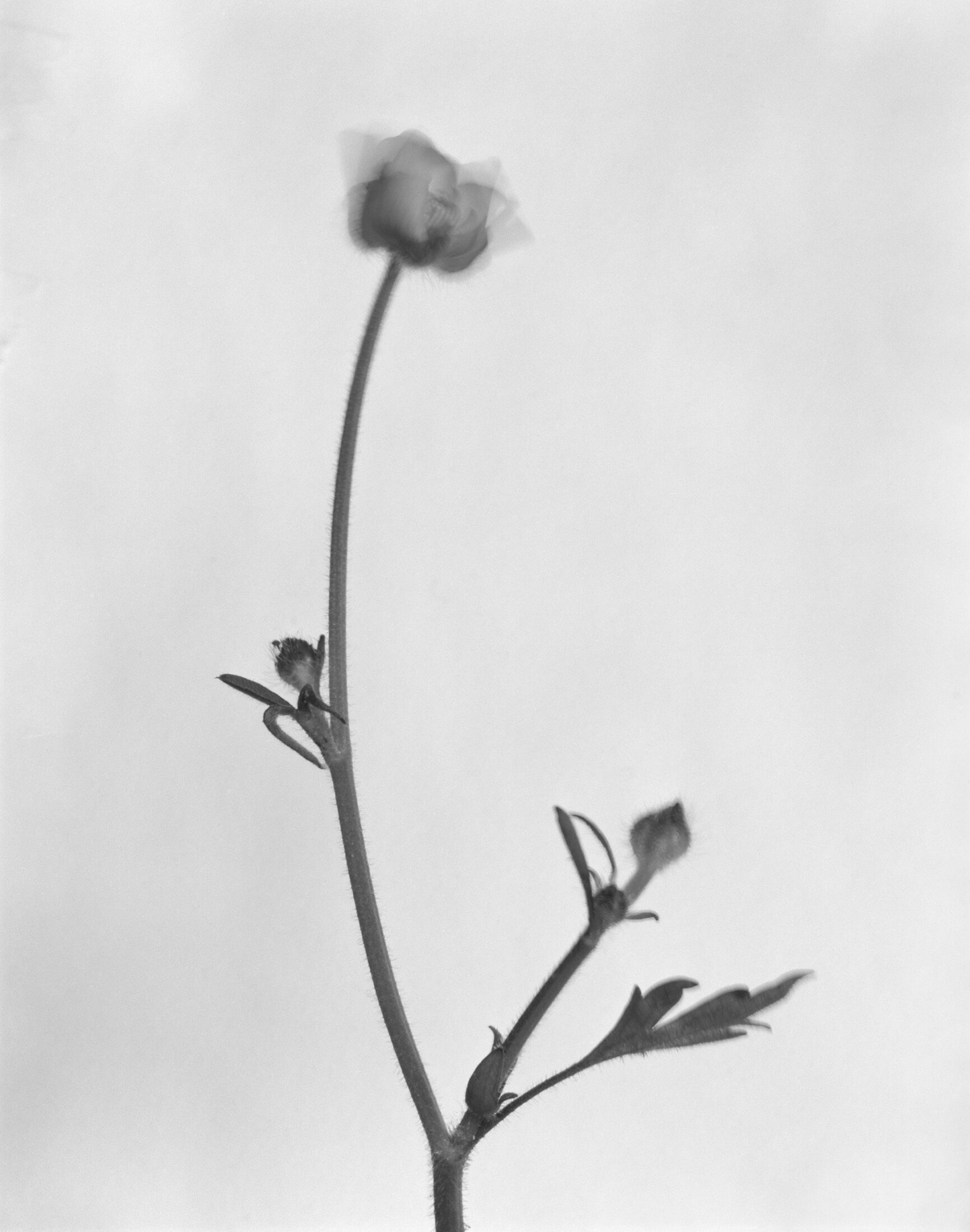
Buttercup (Ranunculus acris) closing for the night.
Photo by Sam Laughlin
Writer
Zoë Schlanger is a freelance writer covering biology, botany, climate, and the environment, and the author of The Light Eaters: How the Unseen World of Plant Intelligence Offers a New Understanding of Life on Earth. She previously covered climate change at The Atlantic, and the environment at Quartz and Newsweek. Zoë’s work has appeared in The New York Times, Time, NPR, and elsewhere. She has received a National Association of Science Writers reporting award, honorable mention from the Society of Environmental Journalists awards, and was a finalist for the Livingston Award, the Morley Safer Award for Outstanding Reporting, and the National Academies of Sciences Award. She lives in Brooklyn, New York.
Photographer
Sam Laughlin is a Bristol-based visual artist, mainly utilizing large format black-and-white photography, who draws inspiration from the patterns and cycles of nature. His work has been exhibited in several galleries across England and Ireland, and he is the recipient of the Hariban Juror’s Choice Award. His first book, Gathering Light, was made during six weeks spent living off-grid in the uplands of Southern Scotland.
When is the right time to bring new life into the world? Journalist Zoë Schlanger explores how the moment of spring emergence is increasingly the biggest gamble of a plant’s life amid unpredictable freezes and erratic warm spells.
My fiancée and I decided to try to have children. We are in our middle thirties, so this has now become a question of timing: How fast are we willing to do it? In a relationship of two wombs the biological clock is felt doubly. And both of us being people who write about the environment, the existential dread is doubled too. What world would we be bringing children into? But that conversation had turned a corner years ago; we had no right to foreclose hope in the future so totally. And foregoing children for climate reasons would be giving in to the corrosive myth that humanity is an ecological disease to be shed, rather than a steward in need of reminding of its role. There will be a future, and we could try, as a family, to be meaningful parts of it. So instead of the dread, we started to talk about how remarkable it would be to watch another human grow, to watch a life come into itself. To impart whatever we’d managed to learn so far, yes—but also to be a safe homeplace for another person to unfurl. By the time we reached it, the decision to have children was a joyful one: We took a hike, climbed a hill, looked at one another and decided yes, this is what we want. But that a conception does not make.
After the romance of our hilltop moment came the sort of research one might expect from a pair of reporters: the fertility forums, the journal studies, casting about for tidbits of advice from fellow queers who’d trod the road before us. Immediately I came upon shocking statistics. I’d had a hazy idea that waiting until forty might be a gamble, fertility-wise, but I’d naively thought that was a vague and malleable deadline. More like a suggestion. Soon I was looking at charts of precipitous fertility decline beginning around thirty-six, a line leading a body down the stairs, to the lower floors, away from the fecund penthouse of one’s twenties. Forty was practically a subterranean dungeon. But! I protested. Everyone is different! I know a woman who had an easy and uncomplicated route to pregnancy at forty-six! And yet I also know about the false prophet of anomalies. Someone, I thought, should really have told me about this sooner.
That I now hold two senses of time in my body will be familiar, I expect, to anyone who has been at this crossroads before. There is now biological time and cultural time and they do not agree. Our bodies have not caught up with the demands of cultural time and are now out of sync. One’s late thirties and early forties are a moment of personal and professional flourishing—the career that is finally taking off, the romantic relationships that are solidifying, the friendships that are growing more profound. By now I’ve dabbled in enough versions of myself to be clearer than ever about what worldly pursuits interest me—and I possess, at last, the clarity and authority to ardently pursue them. And yet, all the while, my reproductive system is running a different game. Whatever intellectual and social momentum I have must be set aside to have babies, or risk forever missing the opportunity. Parenthood is a walk through a one-way door; there is no going back. A chilling thought, to so permanently exit the excellent anteroom I’m in now. It really is great in here, have you seen it? But not stepping through the door at all is a forfeiture more dire, now that I’ve allowed myself to desire becoming a parent. And of course having children is its own wanted outcome. I feel the tug of them at the fringes of my vision now. I walk by the children’s museum on my way to read in the park (a strongly anteroom activity) and think, I’d like to be the parent with the three-year-old stuffed in a snowsuit waddling toward the entrance. I do a spit take at myself. Where did that thought come from? Some deeply human place, probably, the mammalian voice in us all. But that children must come now still feels incongruous. At this point, the timeline of cultural adulthood and the timeline of human biology feel preposterously, maddeningly out of whack. The seasons simply do not align.
Spring is a time of furious becoming. The plants know what reproductive timing they should be on. The early signs are not subtle like the gentle sunset into fall but are rather declarative, ostentatious, befitting the furious life-making going on. Royal purple beaks of snow crocus puncture the frozen black earth. The gush of sap rises in the sugar maples. Forsythia spits splats of yellow onto brown sticks. The chartreuse of young leaves is garish with exuberance. What an absolute spectacle. Each haughty shoot and whorl of calyx pierces the veil; the long hard winter is ending. We’ve all made it to the other side. What comes next is nothing like what came before and that’s pure relief.
The demonstrative nature of spring fluorescence matches its underlying biological truth: once a plant breaks out of dormancy, there is no going back. A molecular switch, or more accurately several, have been turned on and these cannot be turned the other way until next year. For all plants, this is the gamble of their lives, and timing is everything: Any error could prove fatal. Emerging during a warm spell in January is a disaster. And so they try their best to avoid this. Various proteins in a plant speak to each other, monitoring the fluctuations of temperatures between day and night, absorbing untold bits of data about the conditions of its world, and tallying the time. This is how plants spend the winter: waiting, sensing, counting.
I am not a winter creature. Despite all indications that I should be: I was born in Connecticut and have lived my whole life on the East Coast, the land of much of American winter mythos-making. But the four or five months of cold take their toll on my psyche as I hunch my shoulders to my ears on a walk in the wind. I want to attribute this lack of winter hardiness to Puerto Rican ancestors, but the reality is that they are out-batted three to one by the Eastern Europeans in my lineage, presumably winter-hardened, cellar-digging, root-vegetable-eating people. Either way there is nothing scientific about this analysis. Don’t listen to me. I’m just looking for an excuse while my fellow New Englanders crave snow.
One year, I spent some months living on a farm in Connecticut. It was deep pandemic and I was writing a book about plant behavior, and it had all begun to feel like too much of an abstraction from the confines of my Brooklyn apartment, numerous houseplants notwithstanding (they are mostly tropical varieties, not winter creatures either). So my partner and I packed the houseplants into the car and drove some ninety miles north to the farm of close friends, one town over from where I grew up. We arrived for the winter months: November through January. I watched downy woodpeckers perforate the shaggy sugar maples and deer scavenge in the browning fields. I saw the kitchen garden behind the great farmhouse shut down: We walked out into the cold dark of evening to pull leek after leek for fritters and soups, we ate every last eggplant before the first frost. In the first week of December we planted the hardneck garlic in two neat rows, and woke the next morning to fresh snow blanketing everything; we’d done it just in time. I thought about the decline of snow in the Northeast in recent decades, and how, at a certain point, snowpack has a nonlinear relationship to temperature, which means as the world warms New England may be destined to fall off a snow-loss cliff. I regarded the snow with nodding respect, as one might an elder statesman who has served his country well and might not be here next year.
For weeks after, as I waited through the cold, my thoughts drifted back to the garlic, each single clove silent in the ground, and each cell within them counting winter’s passage. In June, spindly green scapes would emerge, and whole bulbs would develop where each clove was planted. But none of this would happen without a good long deep freeze. Indeed, what the garlic would need to send up its contribution to spring flamboyance in a few months’ time is precisely this long period of cold. This requirement is called the “memory of winter,” or, more scientifically, “vernalization.” Apples and almonds and peach trees won’t flower without the memory of winter either. The snow crocuses I waited for as a child in spring, and daffodils, hyacinth, tulips—these all need the memory of winter to bloom too.
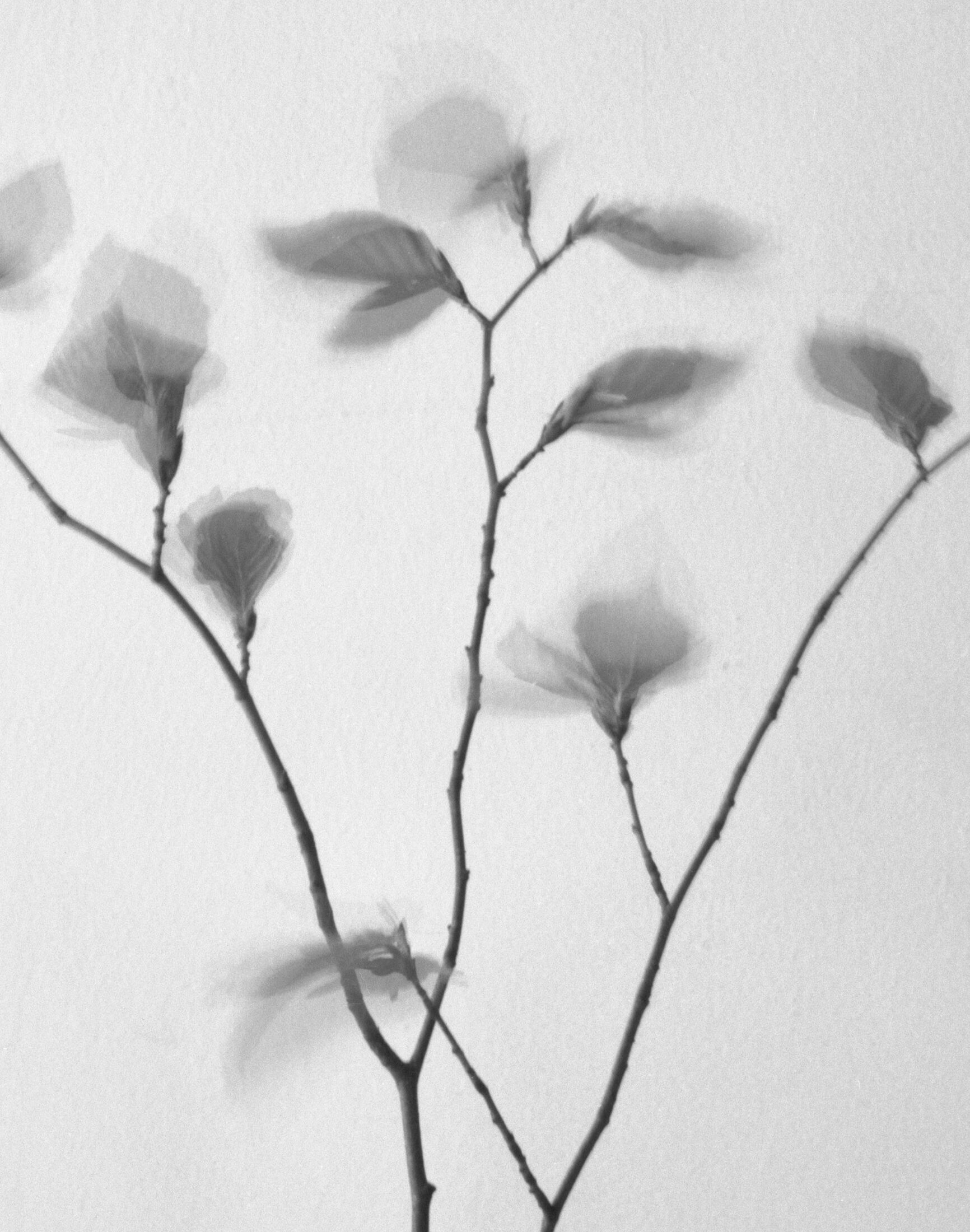
Beech (Fagus sylvatica) long exposure over two days.
Photo by Sam Laughlin
Apples and almonds and peach trees won’t flower without the memory of winter.
While scientists are in the midst of discovering many forms of memory in plants, this sort of molecular memory—an elaborate and yet elegant calculation being made, continuously, inside each cell of the plant—has been known by farmers for centuries. Plants are time beings as much as we are. And time, as it relates to the natural world, is best thought of as passing in two ways: There is individual time, and then there is evolutionary time. Individual time is the turning of one’s own circadian clock, the cycle of day and night, the experience of the seasons, the movement from youth to old age, even the passage of time between generations. It contains your memories, your mother’s, your grandmother’s. It reshuffles as necessary, adjusting for modern changes as best it can, even those not seen by your ancestors. Evolutionary time is much grander: The sweep of epochs. The rise and fall of species. The flow of the ancient into the now, by way of physiologies.
All of science, for the most part, concerns itself with one or another of these time-tracks. One field is concerned with plant evolution, for example, or one is concerned with novel processes happening in the shoots or roots or whole neighborhoods of plants today. But scientists know there are threads connecting the two timelines, because really, there is only one track. There are not two tracks running in separate rooms, but just one room, one track, stretching into infinity. This is the Earth, after all, and we are all contained on it, for all time. The threads connecting these two times, then, are the environment, the substrate of each life. We are, each of us, plant and person, porous to it. Our bodies are suffused by and mingled with the stuff of our environment. For plants, the weather, the wetness, the quality of sun, the soil its roots must probe, and whatever other biotic life is in the area—all of these together literally shape what the plant will become. The size and shape of each leaf is both the dictum of a plant’s evolutionary lineage and the product of the environment that the plant had to encounter. All things in the environment are in constant flux, and a plant body’s response to those changes quite literally shapes the direction of that body into the future. Every being is the product of biological time and the context of its moment.
Plants use both time-tracks to calibrate themselves to the seasons. Plants that require the memory of winter to bloom in the spring straddle both tracks at all times: Flowering in these plants is governed, we now know, by two sets of genetic switches. One is the vernalization switch, which is counting out a certain amount of elapsed cold, the length of which seems to depend on where the plant has evolved. When Dame Caroline Dean, a plant geneticist and world-renowned expert in vernalization, went to Sweden to investigate the vernalization of various varieties of thale cress—a weedy plant in the same family as cabbage—she found that the varieties native to the north of Sweden required twelve weeks of winter to fully vernalize, while those in middle Europe required only four. This makes evolutionary sense: Winter is longer up north; spring will arrive later too. A plant from farther north must have a sense for longer winters than its southern relations. Memories are meant to help a body make good choices in the future, after all.
Then, Dean tells me, when vernalization is satisfied, another set of switches takes over. These are monitoring every little variation in temperature and sunlight through the entire winter, even when the plant is in dormancy. They are attuned to the other time-track: the tumult of the immediate environment, how frigid nights give way to relatively warmer mornings, the changing length of a day. Yet all this data means nothing until the first switch—the one tied to evolutionary time, the deep conception of how long a winter should last—is turned off, having gotten its needed fill of cold. The first switch is like a gatekeeper, then, holding back the floodgates of information that the second switch is parsing. But now, winter requirements satisfied, the second switch is free to unleash a series of developmental changes according to how spring progresses. Now, a burst of warmth can change everything. Frondescence begins. A streak of warm days sends the crocuses bursting forth.
And yet this sublime marriage of the two ecological time-tracks is being destabilized by climate change. It is no longer enough to have an evolutionary memory of how long winter is meant to last, nor is it reliable to trust the fluctuating spring temperatures to make a solid choice to bloom. Deep biological clocks are no longer in sync with modern realities.
In my work as a climate reporter, I’ve written about how warming is producing more chaotic springs, leading, among many other outcomes, to fruit-related cataclysm. Spring, already the season of glorious chaos, of thunderstorms and wild temperature swings, is morphing into a caricature of itself. Freak spring cold streaks are obliterating fruit crops across the Northeast: In 2023, apple trees in New Hampshire that were fully vernalized—their memories of winter sated—burst into pink blooms only to have them browned and shriveled on the branch within a day thanks to a late-season frost. New York’s Hudson Valley had a nearly peachless summer for the same reason. Connecticut lost between a half and three-quarters of its stone fruit that year, and another freeze in late May came for the strawberries and blueberries. In Georgia the year before, an unusually warm winter deprived the state’s iconic peach trees of the period of cold they needed to bloom, and a cold snap in early spring finished off the ones that did manage to flower. Georgia lost some 90 percent of its peach crop that year.
Erratic springs are bringing other challenges too: stressed trees, strained by conditions they did not evolve to withstand, are more susceptible to pest infestations, which themselves are more frequent in a world with warmer winters. Stress accumulates over a tree’s lifetime, weakening its constitution and changing its fruit. Record-warm winters can accelerate the life cycle of a fruiting plant, and unseasonable warmth early in the year can send fruit development progressing at warp speed, giving a peach or a plum less time to accumulate sugars. The very flavor of fruit could change as a result; a brutalized spring could mean a less-sweet summer. The tweak in timing distorts everything that comes after. The flourishing has gone subtly, horribly wrong.
When I asked Caroline Dean about this, it was the first of November. She was in the UK, and she said she’d just driven past a field of oilseed rape in full bloom, a whole field of blazing yellow flowers. That’s not right at all, she said. “I don’t quite know what’s going on with that. We are seeing very erratic flowering behavior of our crops and our wild species now.” Plants keep time in their bodies but it’s not the same as what this new, warped version of spring allows them to keep. Things are changing too fast for plants’ evolutionary time-memories to keep up.
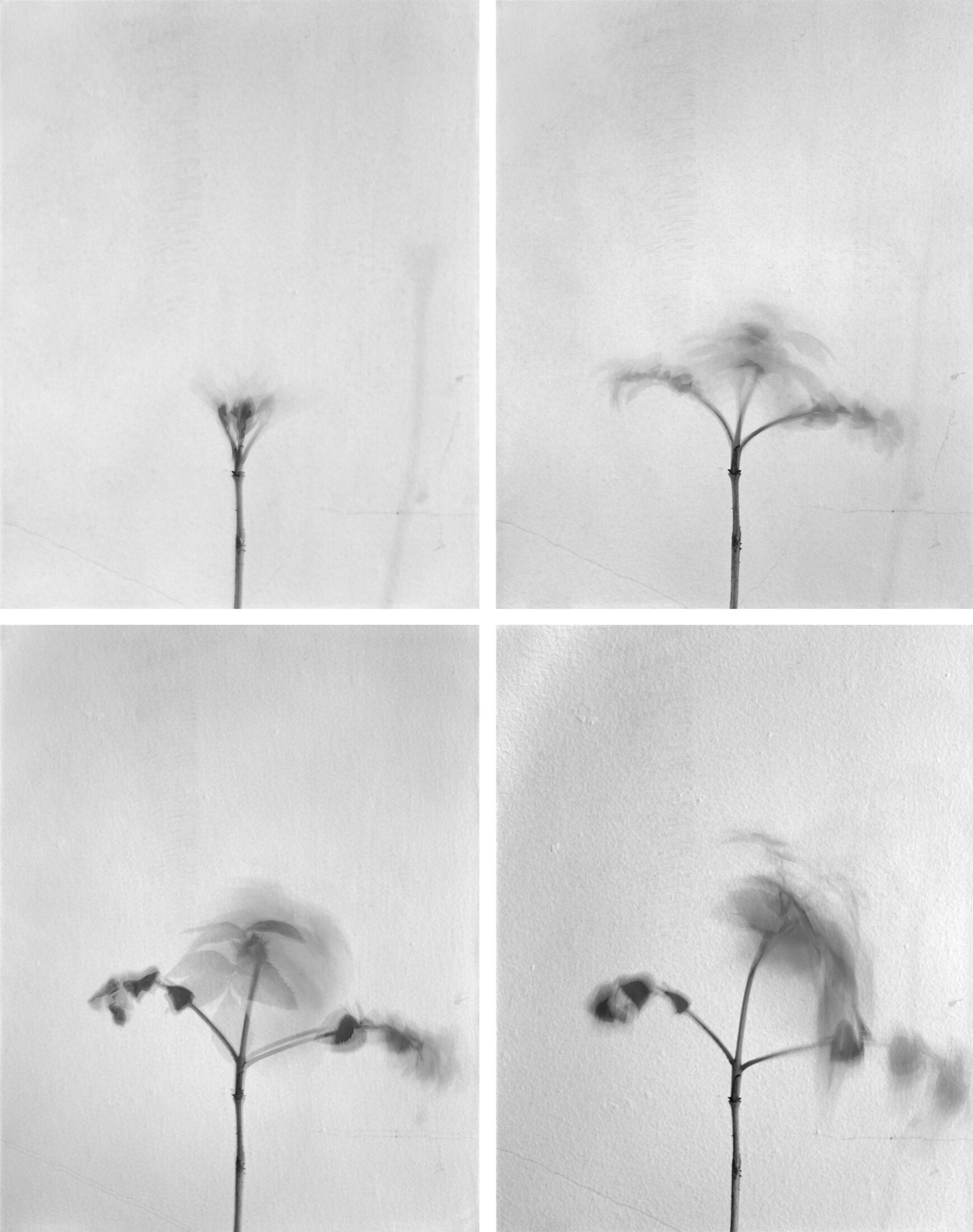
Ash (Fraxinus excelsior) over ten days.
Photos by Sam Laughlin
Eventually the changes of the present will make their way into evolutionary time, because these pulsing changes to a seasonal cycle must, eventually, influence the future trajectory of a species. Those that withstand it will be the future of their species. Nothing is static, even if it may be cyclical—yearly, decadal, and centennial cycles alter in small and big ways, and so they push into the future at a new wobble. The great changes we are experiencing now—climate changes—will send some creatures’ trajectories wobbling into new evolutionary directions, and for others the change will prove too great for that and it will extinguish them. Their absence from the tangled web—from the universal body of environment—will also alter the trajectory of everyone else. Nothing in a system happens without reverberation.
Climate change will shape our societies too in both dramatic and subtle ways we can’t imagine now. I thought of the sugar maples at the farm, hundreds of them standing like yetis in the snow. In February, my friend, the farm owner, will tap them for their sap. I’ve eaten the maple syrup from this farm—from these same trees—over pancakes since I was a child. The changes they’re experiencing now are unlike any they’ve seen before. Arnold Arboretum scientist Jake Grossman once put it like this:
Maples have been evolving independently as a genus for about two million generations. This means that if you traced back any given maple tree two million generations, you would hit the grandmother of all maples. During that time, the climate changed a lot, going from periods in which there was no ice anywhere on earth through several ice ages, and maples evolved along with it. By 2200, in about seven maple generations, the climate could change so much that it resembles a past extremely hot climate that the world hasn’t seen for roughly 1.5 million maple generations, or 50 million years. Maples will probably be able to survive somewhere on Earth in this new, hot climate, but they absolutely will not be able to evolve to be adapted to it in seven generations. For reference, our hominid ancestors began using tools only 1.8 million years—or 60,000 maple generations ago, so this future climate scenario will also be totally unlike anything we have ever seen.
Plants are much older, evolutionarily, than us. It is useful to remember that plants have been through a lot, long before us, and that we have been with them only through a fraction of their permutations. As a group they’ve been through ice ages and extinction events—but their lives and forms and distributions looked radically different then. In our short window of life alongside plants, we’ve grown fond of certain varieties, and of having those varieties where we have known them to be. We have cultural affinities—and they have lifestyles—that are in many cases unfit for the world we’re handing them. That’s not to say they’re not doing their best. Plants are remarkably plastic; spring has always been chaotic, and for the most part they’re able to withstand the extremes already usual in a growing season. But there’s a limit to that plasticity. Our job now is to steward them into an uncertain future, one changing faster than their capacity to change with it, and in which we have been the primary force driving that profound and inhospitable change. This makes it all the more urgent for botanists to learn the ways plants respond to these time-changes, like which individuals or lineages manage the changes most deftly and should be grown in place of their less-well-adapted cousins, or which varieties from farther south should be transferred north to buy a species more time. Without that investment, the gulf between the timelines will grow wider, the threads more tenuous, subject to snapping entirely. With it, a road ahead might open, a future no longer foreclosed upon. Assisted reproduction, so to speak.
The next step, for my partner and I, will be to make our biological clocks fit the world we live in, to do our best to make them suit our modern timeline. We will use reproductive technologies my great-grandparents could not have dreamed of. Sperm cryogenics, then IUI, perhaps IVF, embryo freezing. I’m grateful for these innovations and what they mean for queer families—particularly those made in the context of a culture where doing this earlier than we are seems the only thing more impossible than doing it now. I carry the signature of my biological time in my body, but I’ll adapt it to the present, pushing the plasticity of my reproductive system as far as it will go. The flourishing will happen, if we’re lucky, at a very different time and in a very different way than how my ancestors did it.
But those future lives, and my own parenthood, will unfurl into a world that’s very different too. Its seasons will have shifted far from those of a few generations ago, a ways even, perhaps, from the seasons of my own childhood. Ecological dangers may loom more frequently over what was once a region of temperate calm. The generational memories will no longer serve as guideposts for the future. Adapting to it will take reinvention, new ideas, a loosened grip on how things should be and an embrace of what they’re becoming.
The garlic in the field sprouted beautifully in the spring, I am told. The peaches the following year were a different story; the chaos of a late-spring frost nipped much of the region’s stone fruit in the bud. A changed spring will change plants, and so will change us. The changes will accrete. The reverberations will ebb and flow, stronger some years than others. But the result will be a new world. We don’t know exactly what is next, but something will be. It will test the limits of our bodies to change, as it will theirs. The world, after all, has always been new.
Reflecting a world where snow no longer arrives, annual migrations fall out of time, yet first blossoms still burst, Seasons, our sixth print edition, moves through three themes: requiem, invitation, and celebration—each a contemplation on the paradoxical ways the seasons now beckon us into intimate relationship.
with Melanie Challenger, Sam Lee, Dara McAnulty, Kerri ní Dochartaigh, and Emmanuel Vaughan-Lee
74 min
Emergence Magazine’s Newsletter
Thanks for signing up for our newsletter (:
Sign up to receive our newsletter each Sunday morning! We are an ad and subscription-free magazine committed to sharing stories crafted with care. Join us as we explore the threads connecting ecology, culture, and spirituality.