CMarie Fuhrman is an author and poet, whose work is rooted in the landscape of the West. She is the author of the essay collection Salmon Weather: Writing from the Land of No Return and Camped Beneath the Dam: Poems; and the co-editor of Cascadia Field Guide: Art, Ecology, and Poetry and Native Voices: Indigenous Poetry, Conversation, and Craft. She has published poetry and nonfiction in several journals, including Terrain.org, Alta Magazine, Big Sky Journal, and Poetry Northwest; and is the host of Colorado Public Radio’s Terra Firma, and an award-winning columnist for the Inlander. At Western Colorado University, CMarie serves as Associate Director for the graduate program in creative writing. She resides in the Salmon River Mountains of Idaho.
In Idaho’s remote wilderness, CMarie Fuhrman listens to the roll of thunder, the river emptied of salmon, and the howl of wolves to remember the stories of those who once lived close to this land.
IT WAS A RAINY NIGHT, but not where we lay. We were curled on the ground in the Frank Church Wilderness. Our tent flaps were open because the rain was on the ridgelines south of us, but those ridgelines filled the frame of the open doors of our tent and so we lay in the dark, wide-eyed and more alive than we would normally be at night, or at all. Our old dog Cisco was between us, my partner and me. Our older dog, Carhartt, was fresh in her grave and I still held dents in my flesh from where I lay on the earth, two nights in a row, my ear to the ground, listening for a heartbeat or her breathing, not because I thought she was living, only because I wanted to know she was of the ground.
I am a person of ground. This is not to say grounded, but of earth, attached to the earth. I cannot even jump far from it. It is as if an invisible tether holds me close, closer to the earth. I am unwinged. I do not fly. I root. So it was, rooted on the ground, the ground of Tukudeka, of Sheepeater, of Nimiipuu and Shoshone-Bannock, of people who, too, knew ground, but also sky, that I stared at the place where ground met sky, the ridgeline, where lightning tapped and rain fell. The thunder was distant. Like a memory, or like the past calling. And the toes of the lightning reminded me of dancing. Of toes touching earth to the drum beat. And though my father’s grandfather was born of thousands of years of this continent, so far as anyone knows, of people who knew a desert earth, it was land that connected us, this land, this island floating on a floating island in a sky that is a river that held the bodies of the dancers whose legs of lightning tapped the earth.
This is to say it was not a clear night and it was not the stars we sought. It was not even what could be seen that brought us here and my eyes blinked toward that horizon, grasping as they could toward the beauty of darkness inflected with shafts of dance, the same electricity we hold in our hearts, the light held behind my eyes, which finally closed, and where I fell was not so much into sleep as into a deeper understanding, as if my body grew roots, found mycelium and its memory, and other memories, which is where I believe memory goes, that opposite place from wishes and hopes and prayers. And perhaps that is why the latter is less reliable, because we can never lay our head on the wings of such unseeable things.
We had come to this high mountain meadow, this liminal place between alpine and not, to listen. To re-member. We are not content with borrowed starlight. We seek the illumination of our own experiences, the radiance of the first stories.
There, I recall another night, much like this one, and we were on the edge of Twin Lakes. We called the hike to get there walking the High Lonely, for there was only a ghost forest of Whitebark Pine. We walked a ridge that looked down into alpine lakes. There was silence until we reached the place where the trail dipped back into the forest. Caleb, my partner, stopped, unshouldered his pack and cupped his hands around his mouth. He was facing the trees, not a simple copse of them, but acres. And not simply a few, but thousands. Trees as far as we could see and behind us still the skeletons of trees. The white bark of the trees that fed Grizzly and ispu’kux, the name before the name Clark’s Nutcracker, attributed to a feckless explorer whose name is everywhere, and about whom I care to know less and less, as if forgetting that abruptive history could make the one my partner was calling forth more present, as if time were layers we could unearth and in doing so return to. His cupped hands around his mouth, he drew a deep breath in and howled. We stood silent and listened, waiting, it seemed for the trees to do something. To look our way perhaps or maybe to grant us entry into a world that they protected beneath their understory. Perhaps, it was all understory. And we waited.
He howled again. It was midday so perhaps that explains the silence. Then again, perhaps it was because the past was not so easily uncovered and the present put a bounty on those that would howl back. I asked to try and Caleb nodded knowing that my attempts in the past had always sounded more like coyote or dog or someone who wanted to summon coyote or dog or summon coyote within them. There is a sound only we can make. Mine does not mimic well the Wolf. But I tried. I cupped my mouth, I drew the O, and what followed was more plea than howl. The trees, again, did nothing. But we waited, just in case pollen might rise. In case something like song would arise. Just in case we stirred memory.
We made our camp that night beside Twin Lakes.
We slept with our heads on the ground. I listened. It was quiet that night but weeks later I heard the words to the story of the land where we had lain. The silence of that trail was a century old. Nearly to the date of our visit the last of the Tukudeka were captured, though the history writers used the word “surrender” to tell the end of a month’s long plight of a handful of people who survived in the High Lonely, in the places where only Bighorn and seraphim succeeded. In the land of Whitebark, now gone ghost, too, the Tukudeka had, along or near the same trail we walked and gallantly howled from, slit the throats of their beloved dogs to silence them so the soldiers might not find them. They hung them along the trail, letting their pursuers know how far they would go to remain free, to be left unseen, but no matter. They were captured and chained together in heavy irons. Perhaps they were silent, as fate sometimes dictates in its arrival. Perhaps they whispered their histories into the earth. Words for earth and sky and enemy and end. Words for Wolf. Perhaps rather than lifting their eyes to a sky they only knew by sight they turned instead to an earth they knew by touch and emptied themselves of prayer. I might have heard this that night, had I known what to listen for, but the power of colonization lies in its insistence on recording story in a language only it can understand. What voice was left to howl the story of the Tukudeka did not and does not belong to colonizers.
The next morning when we woke, we walked around the shoreline and found bullet casings and bits of tack and one steel cigarette holder. As clouds sometimes cover the sky, history sometimes covers itself. I wondered what I might find if I scraped the earth until it bled. But this earth should not be disturbed. My elders have said that languages of the First People are sleeping. As we walked away, we walked into the pawprints of Wolves. Our dogs sniffed deep at their leavings and piss. What memory lit up the night of their minds’ sky? We were careful as we placed our feet, walking to the side so as not to disturb what belonged. Leaving the trail to the silent Wolves. If they thought us pursuant, who might they kill for silence? Who might they sacrifice to show their determination to be free? To simply be?
And what about the Salmon? A single spawned-out carcass lay on the streambank alongside the trail we walked before coming to the meadow where we lay now with tent flaps open. A single spawned-out carcass. Single carcass. The run, I am told, was once so many as to keep those streamside awake at night. Imagine! Waking in the dark to the sound of Salmon. Just to peer into the water of late summer evening and see those flashes of silver, unbelievably large bodies who gave their lives to return home. I have often slept by streams and rivers and wondered what passed in the night when the earth turned her back on the sun. What had I missed that moved so close, what lives bisected my dreams, and what else had my feeble ears failed to translate? A single Salmon makes no sound. No, Salmon are even quieter.
We are not content with borrowed starlight. We seek the illumination of our own experiences, the radiance of the first stories.
I am a person of the earth, I carry it beneath my fingernails like ten black and waning moons. I have left my closest companions under a blanket of soil and I have buried dreams in cryptobiotic crust. My name, the one my parents gave me, means Bringer of Light. Means Star of the Sea. It carries connotations of celestial beauty and illumination. It says nothing of these roots I have formed, of my downward gaze. Of when I was a young girl and my father lay beside me on the grass of my childhood home and pointed to the stars. “That one,” he said, pointing north, for it was summer, “is the North Star. Do you see how bright it is?” Stars all looked like stars to me, but I was a daughter seeking to please so I squinted hard in search for it and said, “Yes, I see,” though honestly, I am not sure that I did. But he traced a trail with his finger which led to the Big Dipper and as he connected the dots, I did see it. He said, “The Little Dipper is pouring into the Big Dipper.” I asked what it was pouring and he said that it was only a metaphor, nothing was being poured. I must have shrugged or seemed to lose interest. These were the days when the Milky Way was as obvious as the moon, and yet, it was not obvious to me that my father was not only connecting the dots to form a shape in the sky, he was re-shaping the sky to re-member it. My father, too, carried soil beneath his fingernails. “Sometimes, Bug,” he said, placing his pointing hand on my knee, “it helps to stare at the place between the stars. Staring at the darkness makes the stars more visible.” This, which I made metaphor, I carried, like the dirt, always with me.
When it is dark, you can hear your own beating heart. When it’s this dark, you can hear the heartbeat of those beside you.
It was a rainy night, but not where we lay. We lay on the ground in the Frank Church Wilderness. Our tent flaps were open because the rain was on the ridgelines south of us, but those ridgelines filled the frame of the open doors of our tent and so we lay in the dark, wide-eyed and more alive than we would normally be at night, or at all. This is to say it was not a clear night and it was not the stars we sought. It was not even what could be seen that brought us here and my eyes blinked toward that horizon, grasping as they could toward the beauty of darkness inflected with shafts of dance, the same electricity we hold in our hearts, the light held behind my eyes, which finally closed, and where I fell was not so much into sleep as into a deeper understanding, as if my body grew roots, found mycelium and its memory, and other memories, which is where I believe memory goes, that opposite place from wishes and hopes and prayers. And perhaps that is why the latter is less reliable, because we can never lay our head on the wings of such things.
We had come to this high mountain meadow, this liminal place between alpine and not, to listen. To re-member.
It was in that place, that river of silence that flowed after the thunder, that was carried by the blanket of earth, that lives quietly, like Salmon, like the place between the stars, that I had fallen finally into when the howling began. In the dark you can sometimes feel the joy that fills another. Caleb whispered, Wolves, as if he could not help it. As if saying the word made them so. They started in the north, below a star I had no name for. Then, from the south spawning. Finally to the east and the cries could have been Wolf or Dog or human seeking to raise something from its rest, but we did not move. We lay there one hand seeking another. Letting the sound rain onto us.
I am a person of ground. This is not to say grounded, but of earth, attached to the earth. I cannot even jump far from it, it is as if an invisible tether holds me close, closer to the earth. I am unwinged, I do not fly, I root. So it was, rooted on the ground, the ground of Tukudeka, of Sheepeater, of Nimiipuu and Shoshone-Bannock, of people who, too, knew ground, but also sky, that I stared at the place where pawprints were left in the soft earth around our tent. I looked deeper, wanting to scuff the earth with my foot and seek out other tracks, visitors quiet as ghosts, but knew that my passing had done enough damage.
A day will come when I stare into darkness and cannot see the stars, real or imagined. A day will come when we have flooded the earth with too much light of our making and we will only be able to see the stars we make. A day will come when darkness doesn’t fall, doesn’t sing with the howls or the lightning, bright as they both may be. It will all be new stories poured from one cup to another.
My name means Bringer of Light, means Star of the Sea. It does not mean eraser of dark. It does not mean that stars aren’t shining even as we cannot see them. I am a person of the earth, rooted in the stories of my ancestors, and illuminated by the light of my own experiences. As I walk this path, I vow to honor the memories of those who came before me, to listen to the whispers of the wind and the earth, and to share my own light with the world, refusing to let the darkness erase what makes us unique, what makes us human.
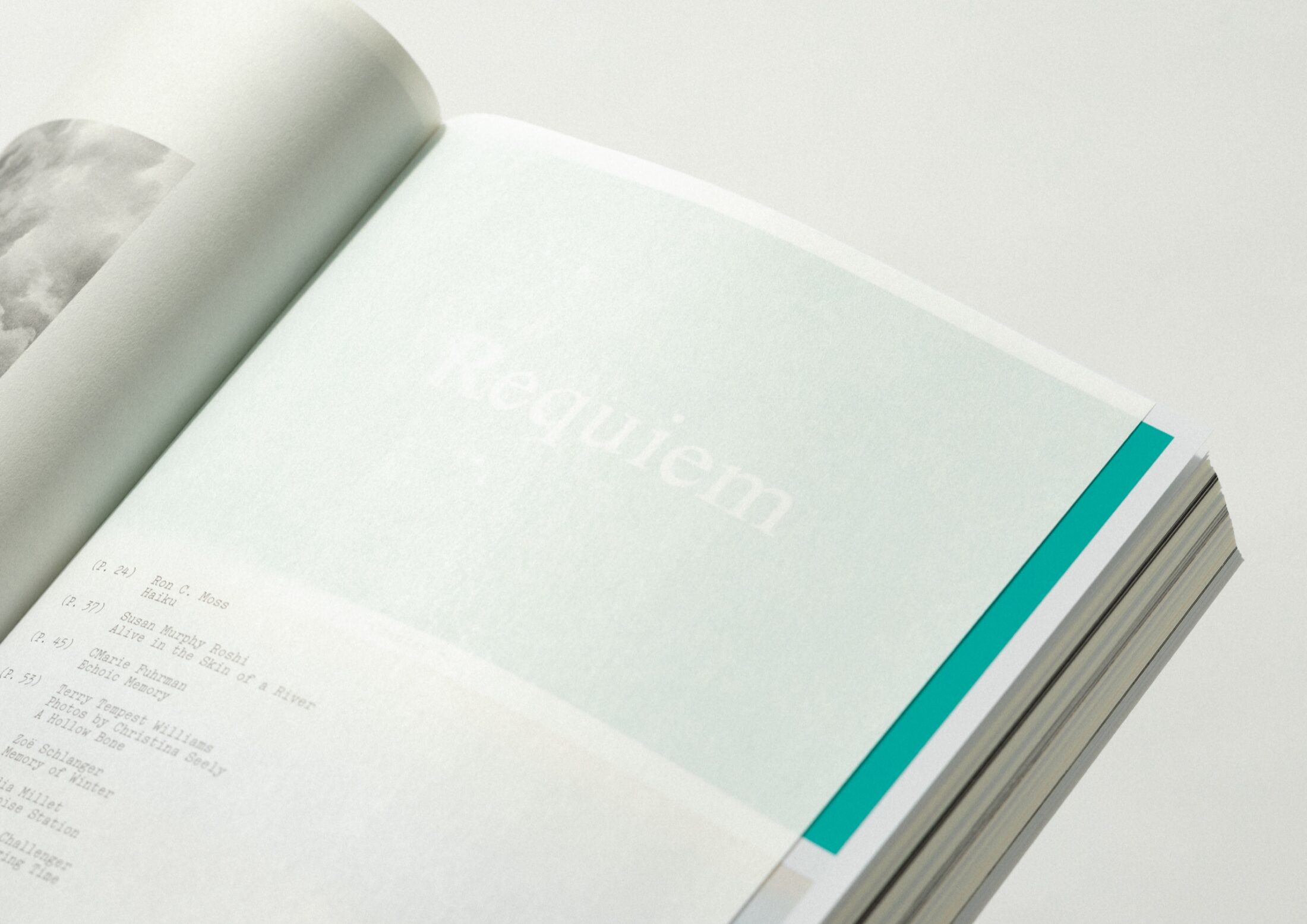
Reflecting a world where snow no longer arrives, annual migrations fall out of time, yet first blossoms still burst, Seasons, our sixth print edition, moves through three themes: requiem, invitation, and celebration—each a contemplation on the paradoxical ways the seasons now beckon us into intimate relationship.
Sign up to receive our newsletter each Sunday morning! We are an ad and subscription-free magazine committed to sharing stories crafted with care. Join us as we explore the threads connecting ecology, culture, and spirituality.