Ben Goldfarb is an environmental journalist and author of Crossings: How Road Ecology Is Shaping the Future of Our Planet, a New York Times Best Book of the Year; and Eager: The Surprising, Secret Life of Beavers and Why They Matter, winner of the PEN/E.O. Wilson Literary Science Writing Award. His writing has appeared in The Atlantic, The New Yorker, Smithsonian Magazine, Science, The New York Times, National Geographic, Orion, and many other publications; and has been anthologized in The Best American Science & Nature Writing and Cosmic Outlaws: Coming of Age at the End of Nature.
Photographer
Kiliii Yüyan is a photographer and storyteller who has spent years immersed in the polar regions, documenting Indigenous lifeways, marine ecosystems, and remote landscapes. Of Chinese and Nanai/Hèzhé (East Asian Indigenous) descent, he works through a cross-cultural lens, exploring how humanity—inseparable from nature—lives in relationship with land and sea. Kiliii is an award-winning contributor to National Geographic and other major publications, including TIME, Vogue, and Wired. His work has been recognized by Pictures of the Year, Leica Oscar-Barnack, PDN, and ASMP, and is held in museum collections across the US. In 2023, Kiliii received the National Geographic Eliza Scidmore Award for Outstanding Storytelling. He also builds traditional kayaks, maintaining a living link to his northern Indigenous heritage.
Journalist Ben Goldfarb and photographer Kiliii Yüyan trace the monumental effort to restitch relationships between land, salmon, and humans on the Klamath River, after four of its most obstructive dams are dismantled.
EVERY SPRING, up a vast circulatory system of rivers in the northern hemisphere—in Alaska and Norway, Maine and Oregon, Labrador and Japan—salmon begin to run. When they enter fresh water, they are creatures of the sea, chrome-plated and plump; by the time they reach their spawning grounds, they are ragged and dying, having exhausted their life force in the course of their arduous journeys and in the production of eggs and milt. Their nutrient-dense bodies, upon being scattered by bears and eagles, nourish riparian forests as thoroughly as sacks of fertilizer; their gravel nests recontour the streams in which they spawn. Their arrival occasions human celebration, too, in places as far-flung as Kamchatka, Iceland, and Seattle. Salmon season is one of ecological nourishment and cultural jubilation, wrought by a fish that renews the world.
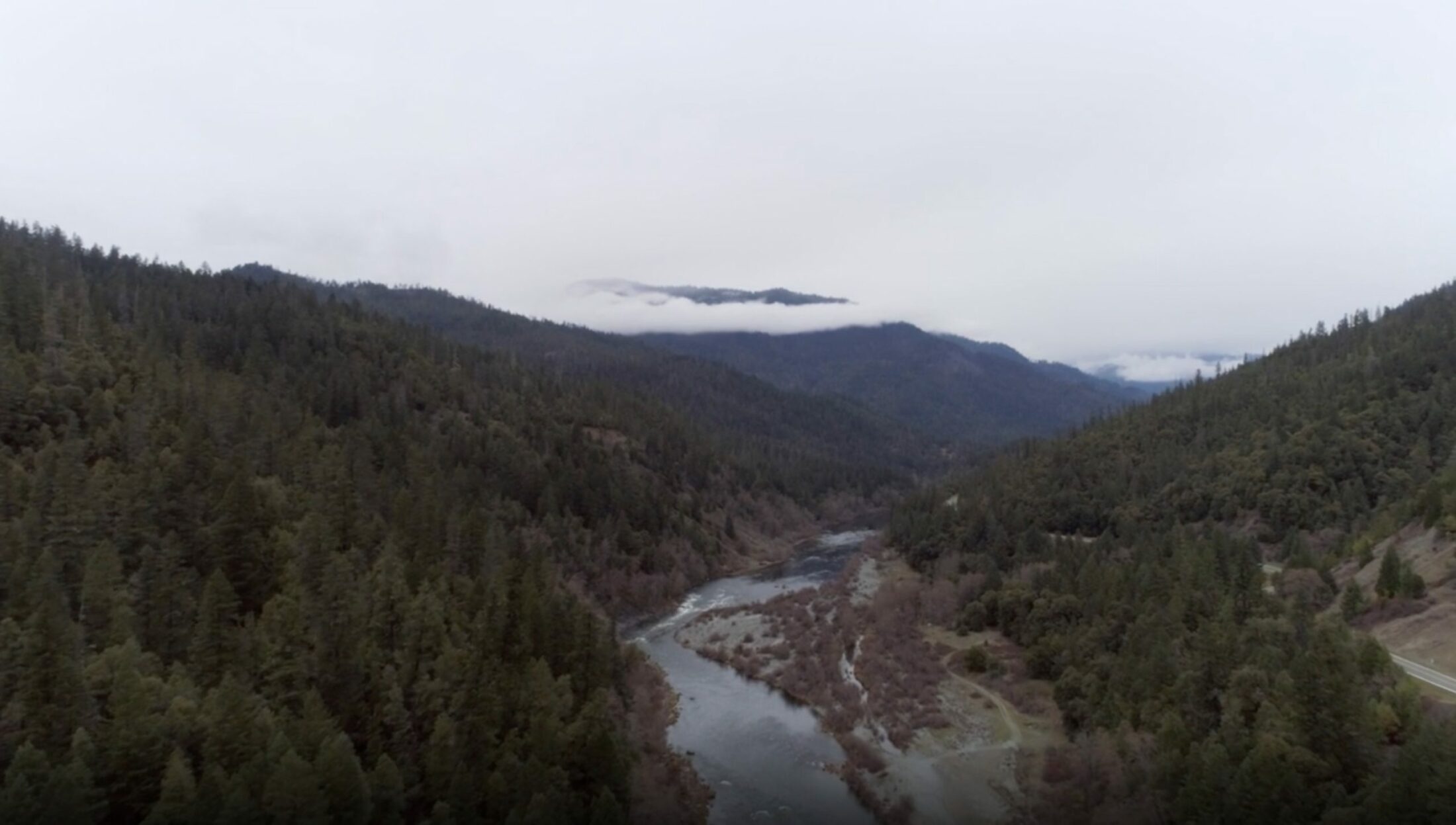
Salmon season was once especially profuse on the Klamath River, which winds more than 250 miles from Oregon’s mountains to the California coast, splashing through high desert, chiseled canyons, and foggy redwood forest. The Klamath hosts two annual runs of Chinook salmon—one that arrives in late spring, one in early fall—as well as coho salmon, steelhead, and other aquatic bounty. As many as a million salmon once coursed up the Klamath annually, a surge of sustenance that fed Native peoples including the Yurok, Hoopa, Karuk, and Shasta. Thanks largely to salmon, one researcher wrote, the Klamath’s Indigenous residents were “the wealthiest people in what is now known as California.” To the Tribes, though, salmon were more than material riches: They were spiritual guides and sacred kin, the revered subjects of First Fish ceremonies that commenced each spring and ensured the fish would endure through the generations. Salmon, the Yurok and Karuk scholar and artist Brook Thompson once wrote, “are a direct tie to my ancestors—the physical representation of their love for me.”
White settlement, alas, impoverished the Klamath and the Native peoples who relied upon it. Beginning in the nineteenth century, logging and mining battered the watershed’s forests, and irrigation diversions sapped its flows. Most injurious, from a salmon’s perspective, were the dams that impeded upriver migrations and sickened the river with toxic algae. Spring-run Chinook, the river’s most toothsome and prolific fish, crashed to less than two percent of historic levels, to the profound detriment of Tribes who, as Yurok chairman Joe James once put it, consider the Klamath the “lifeline of our people.” The destruction of Klamath salmon, some observers have claimed, is “the most significant human rights violation resulting from any dam construction in the United States.”
The Klamath’s collapse is archetypal: Per one 2020 report, many of the Northwest’s salmon runs are today “on the brink of extinction.” Salmon in numerous Pacific rivers—the Sacramento, the Snake, the Yukon—have suffered cataclysmic declines, and many Atlantic rivers have lost their runs altogether. Like most streams, the current of salmon populations tends to flow in only one direction. “The cry of ‘Salmon in Danger!’ is now resounding throughout the length and breadth of the land,” Charles Dickens declared in 1861. “A few years … and the salmon will be gone—he will become extinct.”
On the Klamath, however, salmon are now running in an unfamiliar direction—toward recuperation. In 2022, the federal government authorized a half-billion-dollar plan to obliterate the river’s four most egregious dams and reopen more than four hundred miles of spawning habitat: the largest fish restoration effort, and among the most significant rectifications of environmental injustice, in American history. Eager to see this reborn river, I traveled much of the Klamath Basin in the summer of 2024, just before the last of the dams came down. I wanted to know how the long suspension of salmon season had changed the Klamath and its people—and what it meant that the fish would soon come home.
The Dams
In 1910, a twenty-three-year-old engineer named John C. Boyle arrived on the Klamath River and almost immediately set about transforming it. The river’s tight canyons, Boyle realized, lent themselves to hydroelectric dams, which would impound the Klamath and funnel it through power-generating turbines. Over the decades that followed, Boyle and his ilk built six dams, including four on the lower river that came to power a relatively modest seventy thousand homes. “If properly conserved and utilized, there was enough water to supply every need which might locate in the Klamath Basin,” Boyle later claimed cheerily—though he said little about fish.
Other observers were less sanguine. “It is feared that unless a fish ladder is provided, there will be a notable falling off in the number of fish,” one newspaper reporter cautioned in 1913, with the completion of Boyle’s first dam in sight—a warning that went unheeded. And the dams didn’t merely block salmon from their spawning grounds, they fatally disrupted the river’s natural hydrology. The Klamath, whose swift, chilly flows once swept juvenile salmon to the Pacific, transformed into a concatenation of sluggish reservoirs baked by the California sun. These slack and tepid lakes became cauldrons for toxic algae blooms that often dyed the river a nauseous green. Irrigation withdrawals for upstream farms and ranches further diminished the river. In 2002, an outbreak of gill rot fomented by low, warm flows killed more than thirty thousand salmon. “Our worst nightmare has come true,” then-Yurok chairwoman Susan Masten lamented.
As salmon suffered, the dams twisted in the wind. Ownership of PacifiCorp, the power company responsible for the structures, bounced first to ScottishPower and then to Berkshire Hathaway, Warren Buffett’s voracious conglomerate. The lower Klamath’s four dams were hardly mouthwatering assets: They stored no irrigation water, produced less than two percent of PacifiCorp’s power, and were reviled by protestors. PacifiCorp calculated that retrofitting the dams with fish ladders, as modern legal standards required, would cost more than decommissioning them. Finally, after years of negotiation between regulators, company officials, and Tribes, the government made its announcement. The dams would come down.
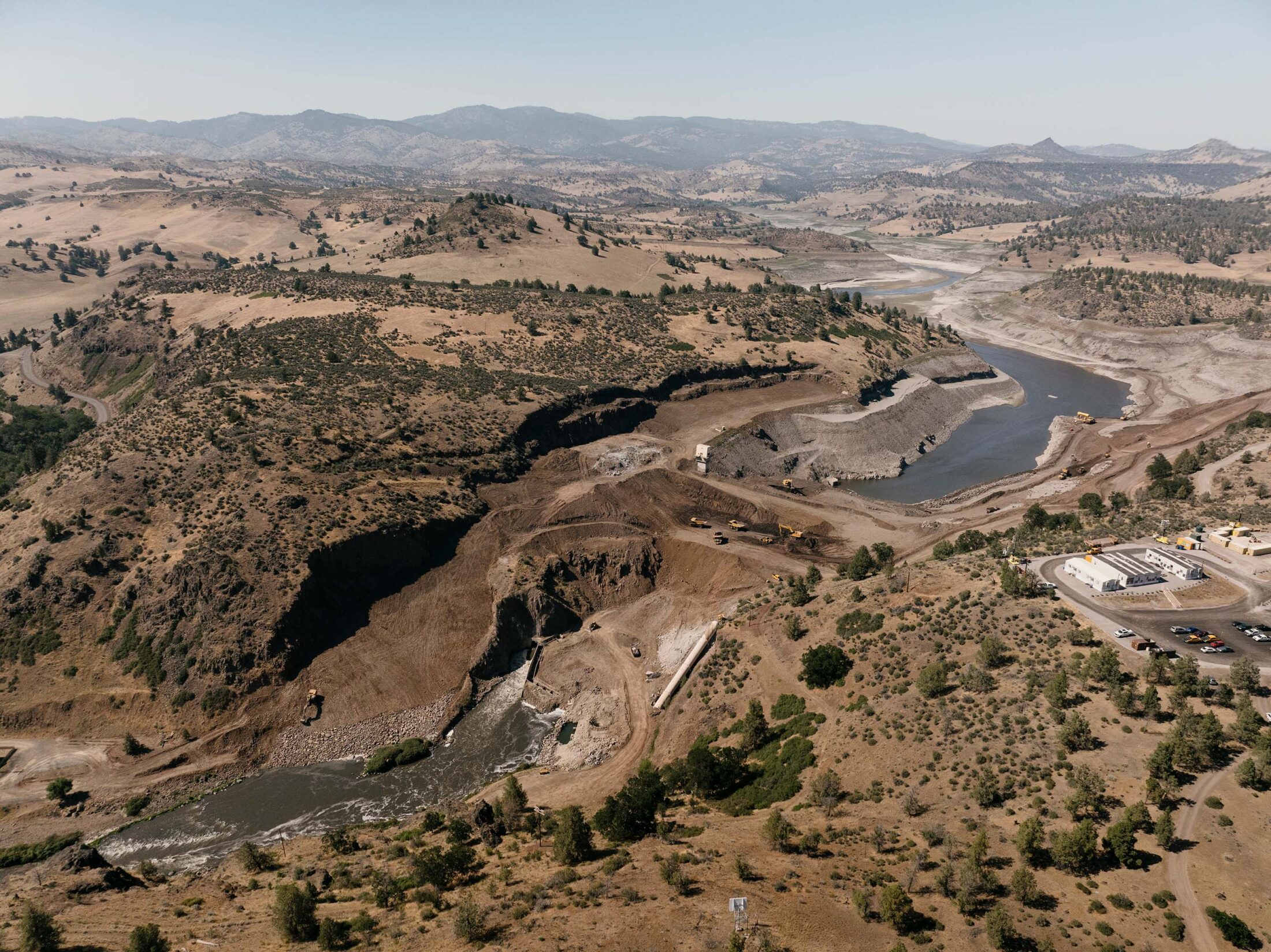
The removal of the Iron Gate Dam, the largest and furthest downriver, involves clearing a million cubic yards of earth.
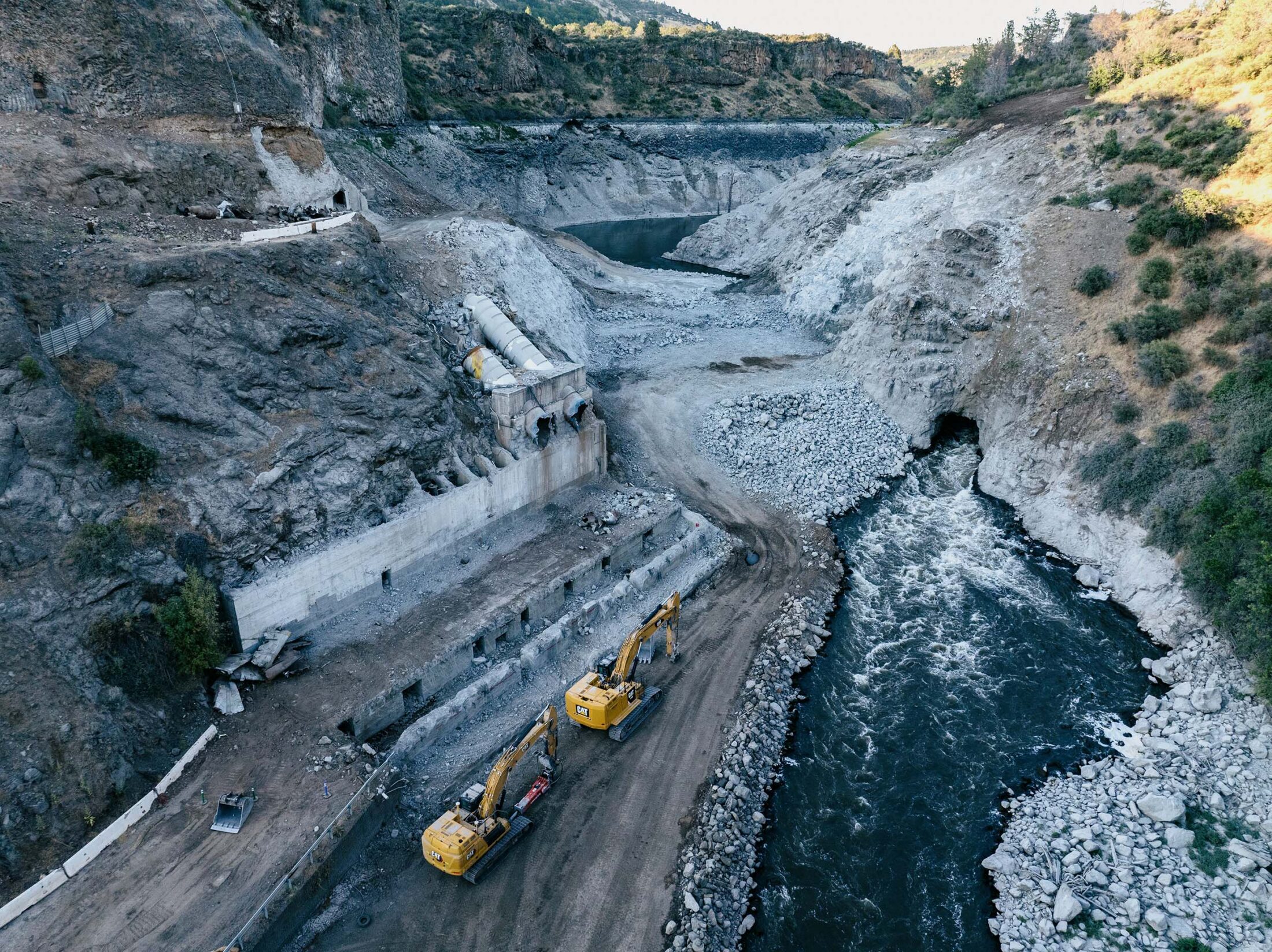
The waters of the Klamath upstream of the Copco 1 Dam flow freely once more.
One morning, I went to observe the destruction with Ren Brownell, public information officer with the Klamath River Renewal Corporation, the nonprofit tasked with removing the dams. We climbed to a bluff overlooking Iron Gate Dam, the structure furthest downriver, end of the line for salmon since 1962. The scale of the operation below us confounded my mind. A colossal crater, wide as two city blocks, yawned where the pyramidal dam once stood. Construction equipment, yellow and tiny as rubber ducks, scraped at the dam’s foundation. Because Iron Gate had been a simple earthen dam, Brownell explained, the process of dismantling it was straightforward: the Renewal Corporation was returning the dirt, a million cubic yards of it, from whence it came. We watched bulldozers shove the earth into piles, which were scooped up by excavators and deposited into dump trucks, which rolled in caravans to the quarry where it had been extracted in the first place. It reminded me of watching a film played in reverse.
Behind what remained of the dam, the river nibbled impatiently at the built-up mud before flowing through a diversion tunnel and downhill, biding its time until freedom. Releasing the Klamath was a delicate operation, Brownell explained: If the Renewal Corporation had instantaneously blown up Iron Gate, the flood, however cathartic, would have endangered downstream communities. Instead, the group had gradually drained the reservoir via the tunnel in January, when adult salmon were at sea. Some five million cubic yards of liberated sediment had briefly turned the Klamath into a chocolate shake, but the river had since thinned to the color of milky tea—hardly the Caribbean, but plenty clear enough for salmon. “The more sediment we can move now, the better it will be for fish coming up this fall,” Brownell said.
From Iron Gate, we visited two other former dams, called Copco 1 and Copco 2. (The fourth demolished dam, dubbed J.C. Boyle in honor of the river’s hubristic tamer, lay miles upriver, across the Oregon border.) Most poignant of the pair was Copco 2, the first to come out, which had routed the Klamath through gargantuan steel pipes to a hydroelectric turbine. For decades the dam had completely dried up the river canyon below, nearly two miles of majestic basalt columns and boulders sacred to the Shasta people. Now the Klamath raced again through the gorge, roiling down its timeless course. I imagined the now-silent pipes rumbling and rattling with the river’s trapped ferocity, and felt a vertiginous awe—both at the technological savvy that enabled humankind to bottle a river, and the shortsighted bravado that compelled us to try.
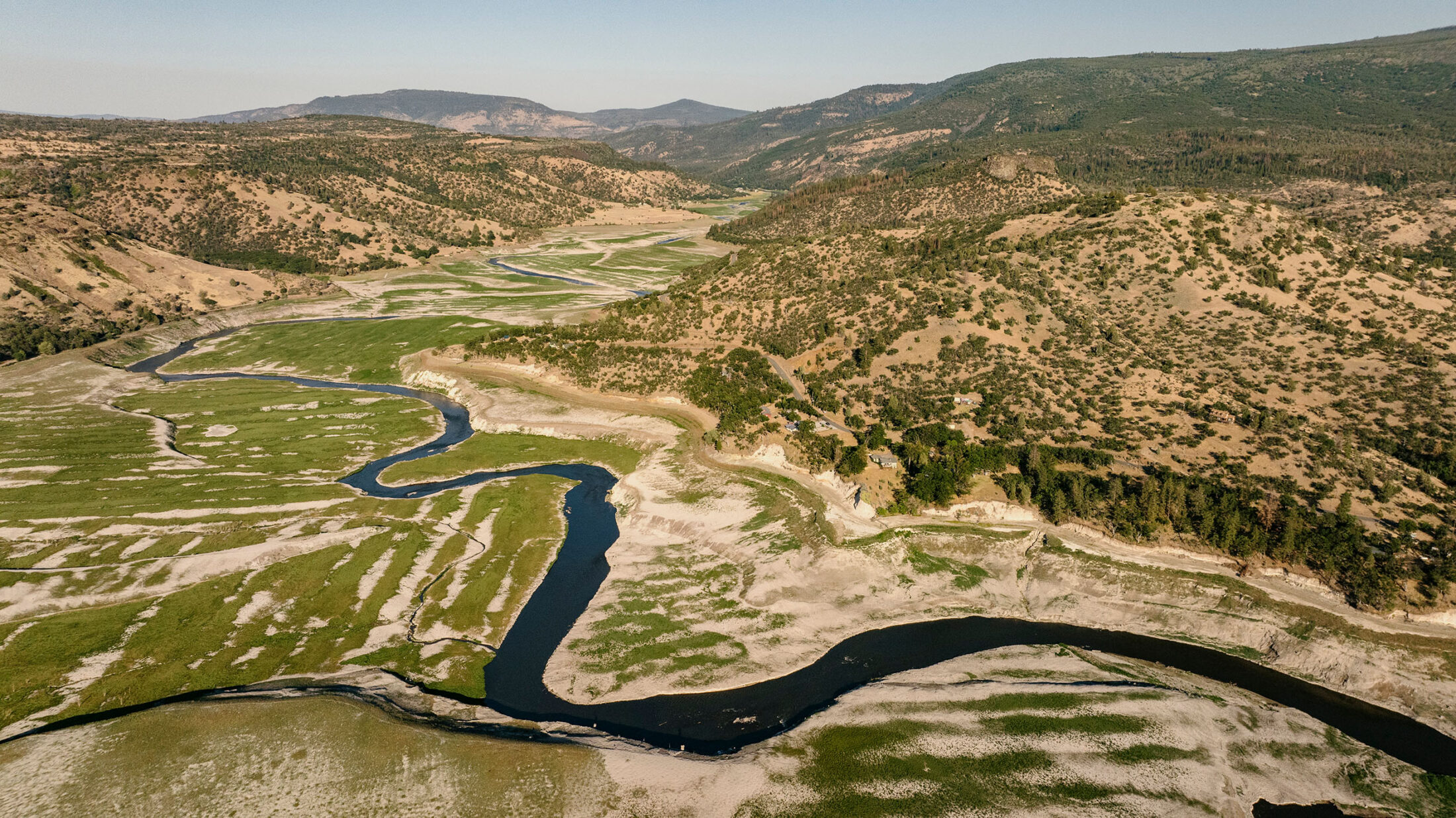
By late August 2024, a month after my visit, the dams were rubble, and the Klamath now flows free once more. Yet some of the project’s greatest challenges still lie ahead. As the reservoirs receded, they exposed thousands of destitute, algae-clotted acres that, absent intervention, would become overrun by invasive vegetation. The task of rehabilitating these barren lake bottoms had fallen to a company called Resource Environmental Solutions, which, starting in 2019, had partnered with the Yurok Tribe to collect billions of seeds from nearly one hundred species of native plants. The firm and the Tribe began to sow their harvest as soon as the reservoirs drained, and also intend to plant a quarter million trees and shrubs. During my time on the river, the newly exposed flats behind Iron Gate were already carpeted with a vibrant sweep of emerald: an ecosystem both ancient and new, awaiting the salmon that would nourish it afresh.
The Tribes had good reason to believe that the fish would respond in droves. On Washington’s Elwha River, where two dams were demolished between 2011 and 2014, coho salmon have sufficiently bounced back to permit the Lower Elwha Klallam Tribe to resume ceremonial subsistence harvests—and to restitch the river’s tattered ecosystem. Vanessa Castle, formerly a natural resource technician with the Lower Elwha Klallam, has documented bears, cougars, and bobcats feasting on salmon and dragging their carcasses into the forest, where they donate nitrogen and phosphorus to maples and cedars. “These large predators have access to salmon where they haven’t for over a hundred years,” Castle told me. “That’s connecting the aquatic world with the terrestrial world.”
The Klamath, too, would surely experience rejuvenation. My tour with Brownell took us to Jenny Creek, one of the first tributaries that returning salmon would encounter, which now carved through the exposed floor of the Iron Gate reservoir. At first glance, the scene was desolate: our feet sank into black mats of dead algae, a fetid goo that reeked of tidal wrack. Yet the stream gurgled merrily along, as content in its rediscovered channel as a gloved hand. A few spindly willows had naturally taken root on the banks, and dragonflies zipped past our ears. “I will bet you money there will be fish spawning in Jenny Creek this fall,” Brownell said. Nearby lay a jumble of logs that crews would soon install in the stream, forming pools and runs in which salmon would eventually shelter and spawn—an infusion of red blood cells, circulating afresh in the body of the Earth.
The newly exposed lakebed of the Copco Reservoir quickly becomes green thanks to native planting efforts.
The Falls
The Klamath, like virtually every North American watercourse, flows through land long occupied and sculpted by humans. Near its mouth live the Yurok and Hoopa; closer to the headwaters dwell the Shasta, the Modoc, the Klamath, and the Yahooskin-Paiute. Between them lie canyonlands so rough-hewn and densely timbered that their inhabitants, the Karuk, were among the last Indigenous groups to be contacted by white people. The Karuk hunt deer, elk, and squirrel, and gather acorns, mushrooms, and manzanita berries; but salmon has traditionally sustained them. The typical Karuk person once filled his belly with 450 pounds of salmon per year—more than a pound each day. These days, the salmon that the average Karuk eats in a year could fit in a handbag.
Around a hundred Karuk villages once lined the river, known as Ishkêesh, the largest at a rapid called Ishi Pishi Falls, where Tribal members fish for much-diminished salmon today. “This is the center of the world,” Ron Reed, a Karuk fisherman and ceremonial leader, told me at Ishi Pishi one hot morning. Just downriver, out of sight beyond a bend, the Masúhsav—the Salmon River—crashed into the Ishkêesh in a whirl of foam. Reed, who wore a braid down his back and a thin mustache, led me through dense brush to the river, blackberry vines plucking at his board shorts. Bear scat and otter spraints littered the gravel; overhead, a bald eagle tangled with a pair of ospreys. “That means salmon are in there,” Reed called over the roar of water.
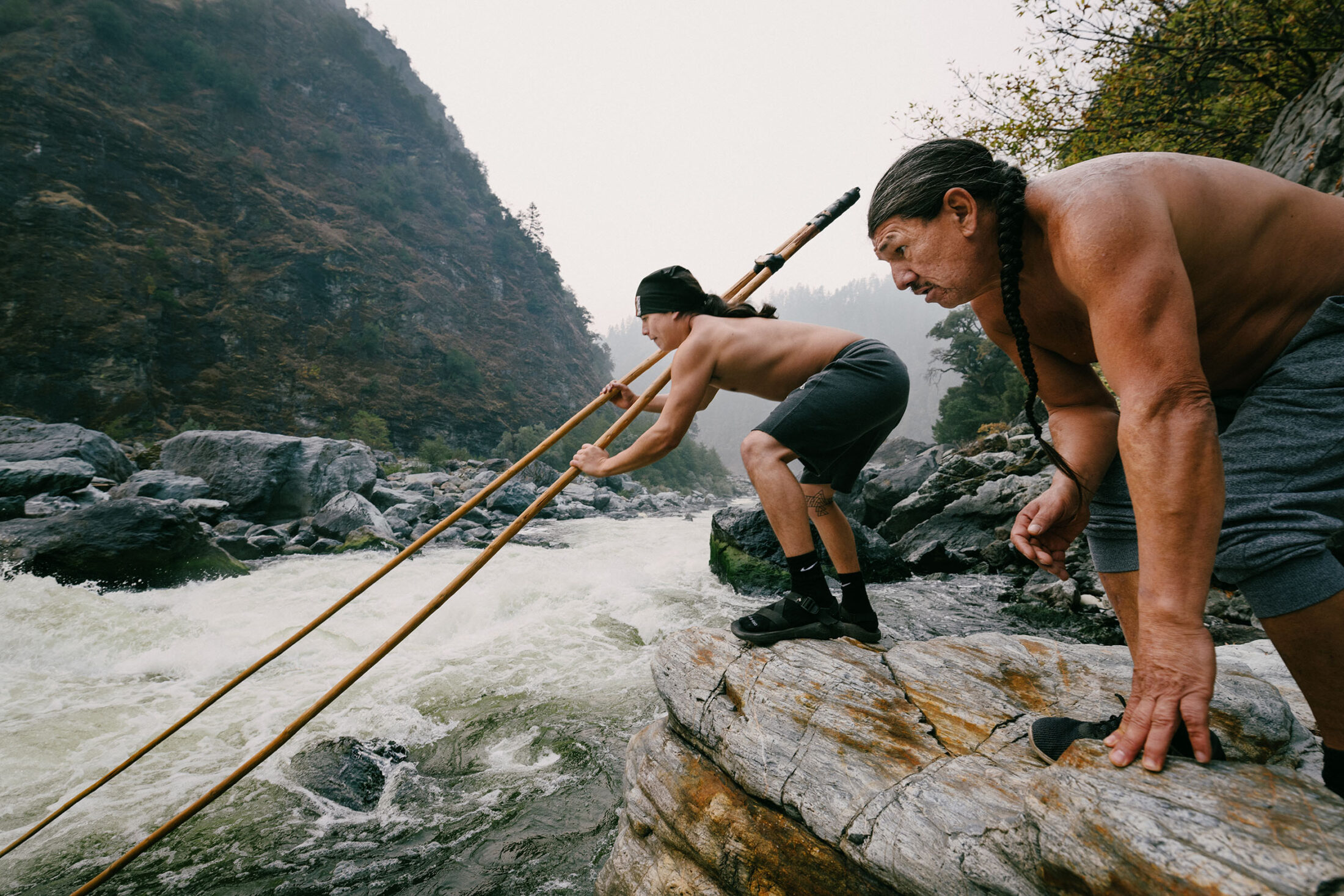
We entered the stretch of river that Reed called the “fishery,” a jumble of truck-sized boulders, etched by water, that loomed precariously over tumultuous whitecaps. “This is my world. This is my sanctuary,” said Reed, tranquil amidst hydrologic chaos. Between immense rocks, the river gentled into pools, eddies, and side channels where migrating salmon pause to marshal their strength. Reed and other Tribal fishermen ply these pockets with dip nets traditionally made of fir poles and iris fibers, swinging the nets through slow water to corral lingering Chinook. Reed kills his fish with a club and smokes them, barbecues them, or pierces the steaks with redwood sticks and roasts them over open flame. “I’ll be catching the first fish here, and probably the last fish,” Reed said.
We proceeded upriver, tracing a route that Karuk fishermen have followed for hundreds of years. The Klamath, normally azure in summer, was cloudy with dam sediment, but Reed was unbothered; if anything, he said, the opacity would afford shade for cold-loving fish. Reed pointed out his favorite pockets: “There’s our first hole. The second hole. The meat hole.” Though he was sixty-two years old, he bounded between boulders with casual grace, his Adidas sneakers fitting snugly into notches that his own feet had worn smooth. “When I can’t make this jump anymore, I’m an elder,” he said with a grin—then vaulted across a chasm, the Klamath raging beneath him.
Karuk fisherman Ron Reed fishes for Chinook salmon with his son, Ryan, at the sacred Ishi Pishi Falls.
Reed may not call himself an elder, but few Karuk hold deeper knowledge. He’d grown up in Happy Camp, a nearby mining and logging village, where white kids persecuted him for being Native. He sought refuge in basketball and the river, fishing with his mother and uncles at a time when Karuk fishermen would catch hundreds of salmon before noon. After high school he moved away—“I wanted to get the fuck off this river, because I associated being Karuk with poverty and hate,” he said—and wandered for years in the spiritual wilderness before moving home to survey salmon for the Tribe and the federal government. During his first season, he was irked to see non-tribal biologists cavalierly punching temperature probes into the fishes’ nests. “When there’s fish spawning, you’re supposed to totally respect that,” he said. He complained to his supervisors, and Tribal officials eventually elevated him to a position as a cultural biologist. “They looked at me and said, well, we need this guy, because he questions everything,” Reed said.
Reed also began to question his own youthful antipathy toward his upbringing. As he dug into the Karuk’s history, he learned about how his people had been pressed into boarding schools and robbed of the ability to practice traditional ceremonies. “I grew up in that shit: intergenerational trauma, historical trauma, oppression,” he said. The Karuk, once some of North America’s richest people, had become some of its poorest and least healthy, as modern processed fare replaced salmon and other traditional foods, exacerbating maladies such as diabetes and hypertension. At the heart of it all were the dams, imperial monuments that had deprived the Karuk of salmon and transformed the river that was their cultural heart.
Would fish that famously home to their birth streams swiftly find a stretch of river that had been foreclosed for more than a century?
Reed threw himself into battling the dams. He flew twice to Scotland with a Tribal delegation to protest ScottishPower, to Nebraska to register his displeasure with Warren Buffett. He wrote articles, gave presentations, granted interviews to countless reporters. No single person was responsible for dam removal—the campaign had been diffuse and multipronged, incorporating a panoply of Indigenous leaders, environmental activists, and white commercial fishermen. Yet Reed had undeniably been a key player, the movement’s moral and insistently vocal conscience. “The fish don’t have a voice—that’s my job as a medicine man,” he told me.
Though Reed had never been more optimistic about the future of his river, the fight seemed to have cost him much. He struck me as a man pressed by the weight of history; a few times during our conversation his eyes turned liquid with tears. Though he no longer worked full-time for the Tribe, he’d spent years in its employ, trying to preserve and revive relationships between people and land. The Atlas-like task he’d assigned himself was nothing less than lifting the crushing legacy of colonialism—for his six children, eleven grandchildren, and the Karuk people. “I’ve got a pretty full schedule in terms of trying to fix the world,” Reed said.
The Tributaries
After meeting Reed, I needed to see some sacred salmon for myself. Although sediment had rendered the mainstem Klamath too murky for fish viewing, its tributaries were clear—particularly the aptly named Salmon River, which plunges through precipitous gorges to meet the Klamath below Ishi Pishi Falls. The Salmon still hosts a viable spring Chinook run, and, in theory, the mighty fish would be in the river.
The next morning I followed a tortuous road up the Salmon River, inching along cliff faces and nearly trading paint with oncoming cars, to Forks of Salmon, the minuscule town where the river’s threads twine. I’d come to participate in the thirtieth annual spring Chinook dive, a salmon census, conducted by snorkel, put on by the Salmon River Restoration Council. Years of surveys had revealed a troubling trend: As recently as 2012, more than a thousand spring Chinook had returned, but by 2021, the run numbered fewer than ninety. Climate change had contributed, by depleting the snowpack whose frigid melt fed the Salmon and warming the watershed’s flows; but the dams had undoubtedly hurt, too, by degrading the mainstem river that Chinook rode to the Pacific. A revitalized Klamath would thus help resuscitate the Salmon River, some of whose fish would, in turn, stray upstream to spawn above the former dams. The watershed was as entangled as mycelium, the health of its hyphae inextricable.
“Having better conditions on their way up through the system will help our fish quite a bit,” Andy Ayers, the survey’s coordinator, told me. “We might look back at this one day as a turning point.”
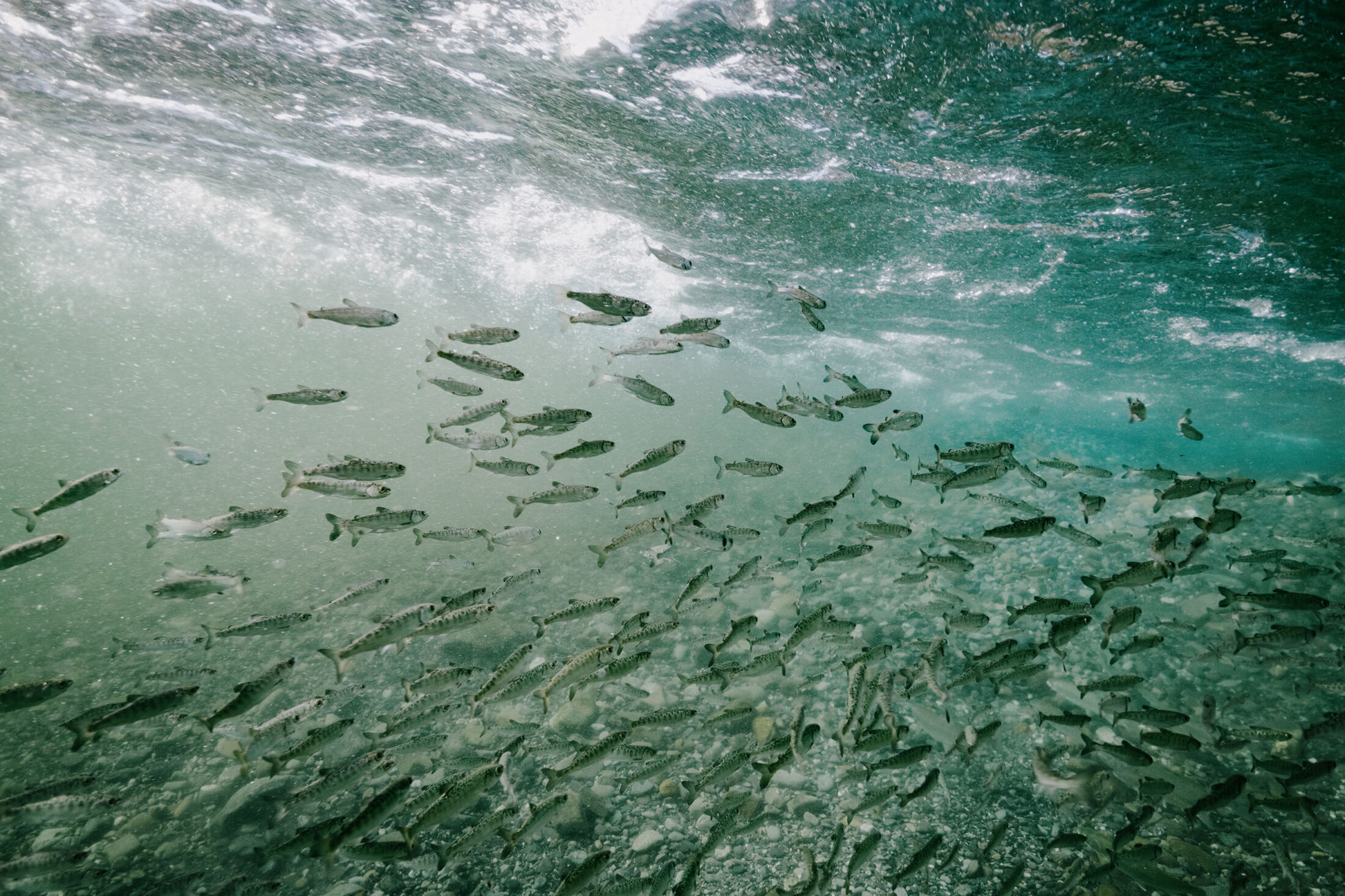
Salmon smolts headed for the ocean will return to spawn along previously unreachable areas of the river, completing an ancient cycle.
I was assigned to a squad of four volunteers tasked with scoping an icy headwater known, in typically perplexing riverine nomenclature, as the East Fork of the South Fork of the Salmon River. We parked beside a bridge and donned wetsuits and snorkels. Below us, the East Fork was so narrow that a fly rod laid on one bank would nearly have touched the other. Perhaps Chinook had spawned here once, skinning up rapids and leaping waterfalls to reach this stronghold; but now, with so few salmon in the Salmon, it seemed unlikely they’d bother coming this high. Still, the stream was crystalline and lush, shaded by maple and fringed by umbrella plants with hubcap-sized leaves. If nothing else, it would be a lovely spot for a swim.
And swim we did—sort of. Much of the East Fork was too shallow to permit floating, so we stumbled along on foot. When we reached deeper pools, we lowered ourselves to our bellies, thrust our faces into the stream, and drifted, scanning for salmon. Fruitless hours passed. The stone cases of caddisfly larvae carbuncled the rocks, abrading my legs like the pores of a cheese grater. The sun was hot, the water cold. On a previous census, I’d heard, a volunteer had gotten hypothermia. Another, surveying the same river, had suffered heatstroke.
Snorkeling with massive Chinook, I’d been told, was a near-spiritual experience. “You and the fish surprise each other a little bit,” Ayers had said—two megafaunal species, separated by several hundred million years of evolution, reconverging in water clear as gin. I wouldn’t know: we didn’t see a single adult salmon in the East Fork of the South Fork of the Salmon River. Nor were we the only ones to get skunked. Later, I’d learn that the other crews had seen, in total, 106 springers—among the worst years on record. Dam removal couldn’t come soon enough.
Still, the river held life. Rainbow trout, Chinook’s diminutive cousins, swirled in every hole, pink flanks blushing. Their fry flitted like motes of sunlight, snapping at caddisflies. Darting among them, I also saw the occasional baby Chinook, identifiable by the oval parr marks that striped their flanks—or at least I thought I saw them; hope may be the thing with feathers, but it also possesses fins. The quicksilver salmon, descendants of last year’s spawners, seemed almost playful. They approached my fingers to peer at the strange protuberances, then danced away into the rocks. Most, I knew, were short for this world, future prey to kingfishers and herons. But a few would survive, trade their dappled stripes for silver scales, and wash down to the Klamath and thence the Pacific—the first generation in decades to ride the cold current of a free river.
The Mouth
The removal of the Klamath’s dams may be the most consequential development in the checkered history of salmon recovery, but it’s far from the only restoration project within the watershed. Up and down the Klamath, I learned, Tribes and agencies and nonprofits were busily reversing more than a century of degradation. Near the river’s headwaters, Trout Unlimited and other groups were busy constructing artificial beaver dams to furnish habitat for fish that would soon flood back into the upper basin; further downriver, the Mid Klamath Watershed Council was excavating off-channel ponds to shelter baby coho. The river called to mind a relay, each partner passing the baton of restoration to the next.
If the Klamath is a relay, the anchor leg is run by the Yurok Tribe, whose reservation encompasses forty-four miles of river near the ocean. During my time on the Klamath, the Yurok’s holdings were on the cusp of substantially growing. In 2008, Green Diamond, a timber company, had begun the process of returning nearly fifty thousand acres to the Tribe—among the largest land-back projects in American history. Around two-thirds of those lands, which should officially transfer back to the Yurok in 2025, will become a community forest, where sustainable logging will generate Tribal jobs, income, and timber. The rest will be a sanctuary surrounding Blue Creek, a cold-water refuge for the Klamath’s salmon. “In a particularly hot, nasty year, this might be the most important tributary on the Klamath for fall Chinook,” Mik McKee, stewardship director at the Western Rivers Conservancy, the group that brokered and raised funds for the complex transfer, told me.
McKee showed me the soon-to-be transferred land one morning. We drove up near-vertical logging roads, through redwood, Douglas fir, alder, and oak; below us, a white mattress of fog shrouded the Pacific. Although McKee, a forester by training, noticed that the trees were too homogenous in age, a hallmark of industrial logging, we were struck by the land’s apparent good health and wildness. Trail cameras had picked up rare martens cavorting in these woods, and McKee often felt the eyes of mountain lions boring into his neck.
“It has so much potential,” he said admiringly. “It’s like a blank canvas with tons of opportunity.”
Although the Tribe didn’t yet hold title during my visit, it had already begun the process of healing the land. McKee took me to a ridgeline atop which Yurok crewmen in excavators and bulldozers were ripping out scraggly, overgrown trees. The Tribe was in the midst of restoring this seventy-acre site to prairie, which the Yurok had historically kept open as a travel corridor, firebreak, and game meadow. “The elk and the deer are gonna come thrive in here,” Roger Boulby, a heavy equipment operator for the Yurok’s construction company, told me after he’d hopped down from his massive Caterpillar. “It’s going to be an oasis of food.” The ungulates would, in turn, lure predators such as mountain lions, whose kills would feed condors, which the Yurok, who know the great vultures as prey-go-neesh, had recently reintroduced to the area. Many of the saplings and root wads that Boulby’s crew extracted, he added, would go to the Tribe’s fisheries department, which would install them in streams to enhance salmon habitat. “Saving fish is my jam,” Boulby said with a grin.
The reclamation of their historic lands wasn’t merely an opportunity for the Yurok, though; it was also a challenge. Although the forest was in decent health, it was veined by derelict logging roads, which bled silt into creeks with every storm and threatened to smother fish eggs. The Tribe, with the support of the Conservancy and other partners, had upgraded many roads, but dozens of miles more remained dilapidated. During our tour, McKee and I ran into Richard Nelson, director of the Yurok’s watershed program, sweat-drenched and attempting to fix a dump truck’s flat tire. “We got a lifetime’s worth of work to do out here—my children’s lifetime,” Nelson said, lifting his baseball cap to wipe his brow. I was reminded of Ron Reed’s vow to fix the broken world he’d inherited, and how heavily that responsibility sat on his shoulders.
As part of its recovery, the Klamath releases sediment caught behind the dams for decades.
McKee and I went down to Blue Creek, whose waters sparkled in the afternoon. In Yurok cosmology, this was a sacred place of healing sometimes described as a “golden stairway” into the restorative high country. It was also a haven for Chinook, who detoured into Blue Creek to seek thermal refuge when the Klamath got dangerously warm; McKee showed me one limpid, turquoise pool where he’d once snorkeled with hundreds of resting fish, stacked like cordwood. We trudged along gravel banks and bushwhacked through willows to the stream’s confluence with the mainstem Klamath. The convergence stopped my breath: Blue Creek, clear and musical as a wind instrument, pushed into the muddy muscle of the Klamath, still turbid with the liquefied matter of the demolished dams. McKee and I stood on a bar in silence, watching the two rivers swirl like watercolors, abask in the power of a place sacred to humans and salmon alike.
Speaking of convergence: The previous evening, I’d visited the Klamath’s mouth proper, where fog-veiled redwood forest abruptly turns to beach and the river punches through a sand spit to greet the crashing Pacific. I arrived at sunset to find the estuary teeming: seals bobbed in the waves, pelicans hurled themselves into the surf, and a pair of gray whales, astonishingly close to shore, exhaled mist into the orange evening.
A pair of Yurok fishermen plied the mouth with a gill net, holding fast to one end and permitting the Klamath’s flow to carry the net into the ocean and pull it taut. Seals monitored their work in hopes of extracting an easy meal. “You gotta watch out, those seals are greedy,” said one of the fishermen, who introduced himself as Sly. They hauled the net in, hand over hand, to reveal a waterlogged slab of driftwood. “Caught a log,” Sly sighed. “Big-ass log,” his friend muttered.
Still, the day had been productive. With their bare hands, they’d captured a lamprey, an ancient, eel-like migratory fish that once crept up the Klamath in near-uncountable legions, and which, like salmon, should be revitalized by dam removal. And though it was early for salmon, they’d caught a pair that morning. “They weren’t that big, probably twenty pounds, twenty-five pounds,” he said, holding his arms apart. “Still a nice size.”
The Gift
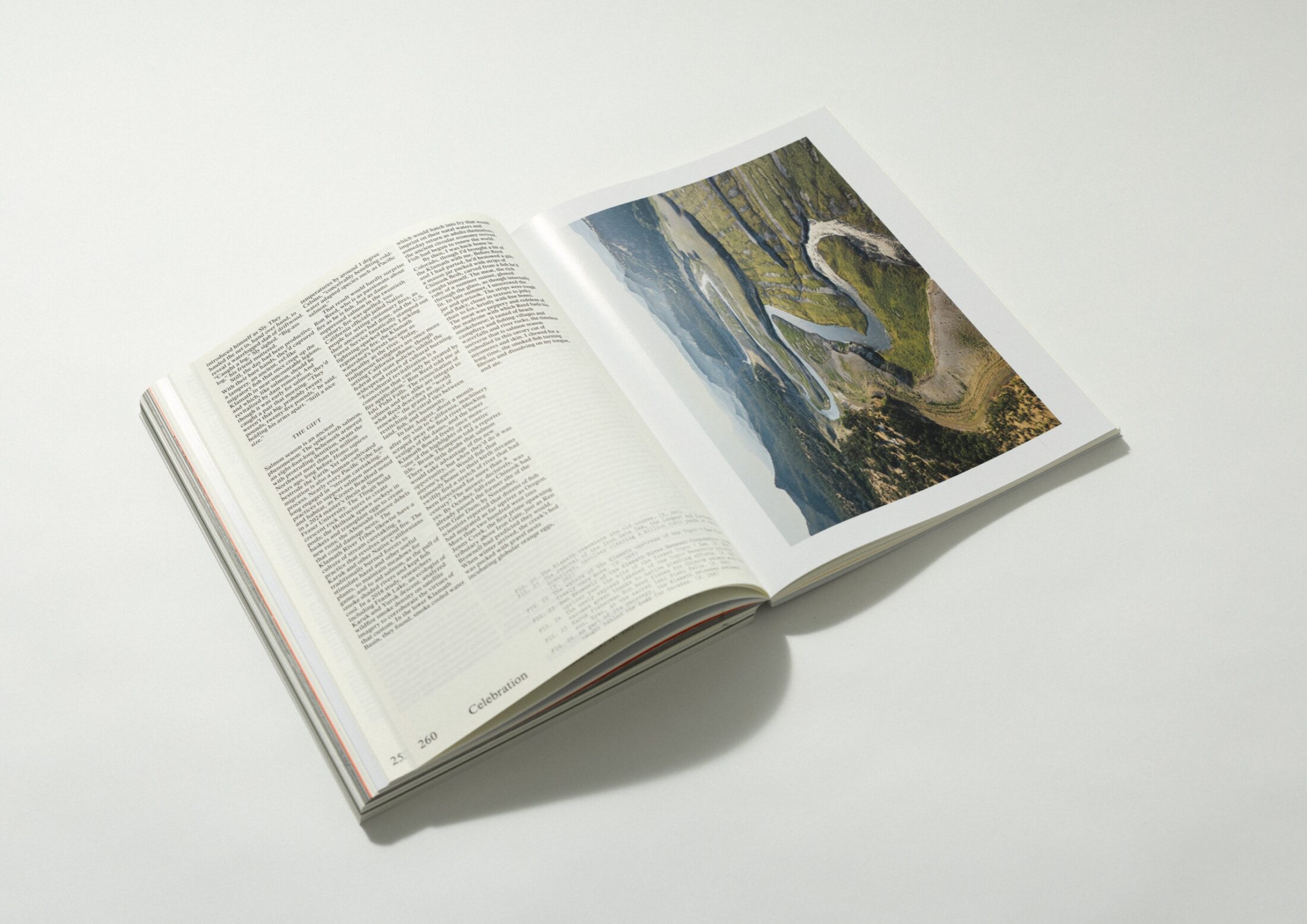
Salmon season is an ancient phenomenon: The spike-tooth salmon, an eight-foot-long behemoth armored with protruding dentition, swam the Northwest more than five million years ago, long before Homo sapiens bestrode the Earth. Yet salmon migration is also a human-cultivated process. Nearly every Pacific Tribe has long engaged in “stream caretaking,” practices to support salmon movement and habitat, as Kirsten Bradford noted in a 2024 master’s thesis at Simon Fraser University. The Tlingit build crescent rock structures to create pools; the Heiltsuk spawn sockeye in baskets and transplant eggs to create new runs; the Ahousaht remove debris that could damage nests. The Klamath River Tribes likewise have a culture of stream caretaking, a practice that revolves around fire. The Karuk and other Native Californians traditionally burned forests to stimulate hazel and other useful plants, to maintain meadows for game, and to aid salmon, as the pall of smoke shaded rivers and kept fish cool. In a 2018 study, researchers including Frank Lake, an ecologist of Karuk and Yurok descent, analyzed wildfire smoke density on satellite imagery to corroborate the virtues of that custom. In the lower Klamath Basin, they found, smoke cooled water temperatures by around 1 degree Celsius, “conceivably benefiting cold-water adapted species such as Pacific salmon.”
That result would hardly surprise Ron Reed, who is as passionate about fire as he is fish. Just as dams suppressed salmon in the twentieth century, fire was quelled, too: California officials jailed Native people for setting customary fires, as their ancestors had done, and the U.S. Forest Service fanatically stamped out lightning-sparked blazes. Lacking regenerative fire, the Klamath watershed’s forests became as unhealthy as the river. Today, Indigenous firelighters are once more setting California aflame, though federal and state policies inhibit the widespread return of cultural burning. “Ecocultural revitalization is a connection that can only be created by fire application,” Ron Reed told me at Ishi Pishi Falls. The resuscitation of salmon and fire alike are integral to what Reed describes as “world renewal,” the grand project of restitching ancestral ties between land, fish, and humanity.
Fish had begun to renew the world.
In late August, about a month after my visit to California, machinery scraped away the final river-blocking vestiges of the dams, and the lower Klamath flowed freely once more—“one of the highlights of my entire life,” Brook Thompson told a reporter. There was little doubt that salmon would take advantage of the new opportunity, but when they’d do it was anyone’s guess: Would fish that famously home to their birth streams swiftly find a stretch of river that had been foreclosed for more than a century? The answer, decisively, was yes. By October, fall-run Chinook had already passed the former site of the Iron Gate Dam; by November, scientists reported that dozens of fish had migrated as far upriver as Oregon. More than two hundred went into Jenny Creek, the first prime spawning tributary above Iron Gate, just as Ren Brownell had predicted they would. When winter arrived, the creek’s bed was pocked with gravel nests incubating globular orange eggs, which would hatch into fry that would imprint on their natal waters and someday return as adults themselves, the ancient circular economy revived. Fish had begun to renew the world.
By then, I was back home in Colorado, though I’d brought a bit of the Klamath with me. Before Reed and I had parted, he’d bestowed a gift: a mason jar packed with strips of Chinook flesh, carved from a fish he’d caught himself. The meat, the rich ruby of a summer sunset, glowed through the glass, as though internally lit. In late summer, I unscrewed the jar and partook. The strips were tough and flaky, closer in texture to jerky than to lox, bristly with fine bones. The meat was peppery and redolent of the madrone with which Reed fuels his smokehouse; it tasted of beach campfires and fishing villages and waterfalls and river rocks, the timeless universe that is salmon season embodied in this savory cut of myomeres and skin. I chewed for a long time, the smoked fish turning fibrous and dissolving on my tongue, and ate.
Postscript
In the fall of 2025, the first full year after the obliteration of the lower Klamath’s four dams, fish came back—and kept coming, thousands upon thousands, a tsunami of salmon, a run that staggered the mind and gladdened the heart. They’d returned the previous year, too, hundreds of fall-run Chinook passing the rubble of Iron Gate Dam to spawn in the newly opened river, yet this year was different: Chinook swam further upstream and in greater numbers than anyone had thought possible so soon. They crossed the border between California and Oregon and hit Upper Klamath Lake, the giant murky body at the river’s head, whose poor water quality many biologists had assumed would stop them from advancing. They traversed the lake unfazed, exiting the Klamath River proper and pushing onward into the upper watershed’s arterial maze of tributaries. They spawned in the Williamson River, and the Sprague, and the Wood. They spawned in spring-fed creeks and alongside boat ramps and atop rocky embayments. They ventured into irrigation ditches. It was as though the dams were corks pulled from a bottle, the fish an effusion of champagne bubbling forth.
The newly exposed floodplain was cracked and parched, the slate river chugging along in its rediscovered course. I’d hoped to see a fish or two; instead, the river practically vibrated with them. Salmon skittered from pool to pool, shark-like dorsal fins waving above the surface, dozens of Chinook chasing and nipping and circling each other in ancient dance. One of the Trout Unlimited staffers sent a drone aloft, and we watched the birds-eye view flicker on his phone. From above, we could see ovals of pale, clean gravel, swept free of sediment by powerful tail-thrusts—the redds, or nests, into which females squeezed their globular pink eggs. Nests pocked the riverbed in such density that in some spots they fused into swaths as large as baseball diamonds.
“It’s just one giant redd,” someone gasped …
The improbable fact of so many salmon, so far from the coast, had given rise to a misapprehension, espoused by a few fish-gawkers we encountered along Spencer Creek’s banks, that the Chinook had actually been trapped at the Klamath’s mouth and delivered here by truck.
No trucks, we told a white-bearded gent in a U.S. Navy hat.
Reflecting a world where snow no longer arrives, annual migrations fall out of time, yet first blossoms still burst, Seasons, our sixth print edition, moves through three themes: requiem, invitation, and celebration—each a contemplation on the paradoxical ways the seasons now beckon us into intimate relationship.
Sign up to receive our newsletter each Sunday morning! We are an ad and subscription-free magazine committed to sharing stories crafted with care. Join us as we explore the threads connecting ecology, culture, and spirituality.